
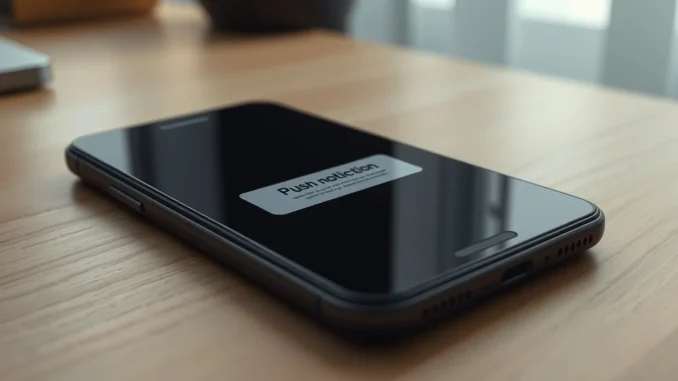
Messaging app push notifications represent a serious and persistent privacy vulnerability, according to Telegram founder Pavel Durov. His warning, issued in late 2025 and resonating into 2026, follows documented cases where law enforcement accessed deleted messages through notification logs. This exposes a fundamental weakness in digital privacy, even for apps boasting strong encryption.
How Push Notifications Became a Privacy Attack Surface
Pavel Durov’s concern centers on metadata. While apps like Signal use end-to-end encryption to protect message content, the notifications that alert users to new messages generate separate data trails. This data is often stored in device logs managed by Apple’s iOS or Google’s Android operating systems. According to a report from 404 Media in late 2025, the U.S. Federal Bureau of Investigation retrieved deleted Signal messages from an Apple iPhone by subpoenaing these notification logs from Apple. Durov highlighted this case, stating the vulnerability remains even if users disable previews. “Turning off notification previews won’t make you safe if you use those applications, because you never know whether the people you message have done the same,” Durov said.
Also read: CLARITY Act Faces Urgent Deadline: Lummis Warns of Final Chance Before 2030
This method bypasses the encryption protecting the message itself. Investigators gain access to metadata showing who was contacted and when. In some instances, notification content might also be captured. Data from Apple’s transparency reports shows that requests for such data have increased. The implication is clear: a system designed for convenience creates a permanent record.
The Technical and Legal Framework of Data Access
The process relies on the architecture of modern smartphones. Push notifications typically travel from the sender, through the app provider’s server, to a central push notification service operated by Apple (APNs) or Google (FCM). These services then deliver the alert to the device. This pathway creates multiple points where data can be logged. Law enforcement agencies can legally request this data from the tech companies with appropriate warrants or court orders.
Also read: Polymarket's Google News Appearance Sparks Debate Over Prediction Market Legitimacy
Signal, known for its privacy focus, confirmed the 404 Media report’s accuracy. In a blog post, Signal president Meredith Whittaker explained that while they minimize stored data, they are compelled to comply with valid legal requests for information they do possess. This includes the phone numbers and dates of account creation. The notification data, however, resides with the platform operators. Industry watchers note that this creates a jurisdictional challenge. A U.S. warrant can compel Apple or Google to hand over data for any user, regardless of location.
A Shift in Surveillance Tactics
This represents a tactical shift. For years, the public debate focused on breaking encryption. The push notification method shows a pivot to harvesting the abundant metadata surrounding communications. “It’s a reminder that encryption is just one part of the privacy puzzle,” said Riana Pfefferkorn, a research scholar at the Stanford Internet Observatory. “If everything around the message is exposed, the content protection becomes less meaningful.” This could signal a new normal for digital investigations, moving from direct decryption to the collection of peripheral data.
The Surge Toward Decentralized Alternatives
In response to these vulnerabilities and increasing state surveillance, user interest in decentralized messaging platforms has grown. Online search interest for such platforms spiked by 145% in the five years leading up to 2026, according to analytics firm Exploding Topics. These apps aim to operate without central servers that can be compelled to hand over data.
- Briar and Session: These apps use peer-to-peer or decentralized network protocols, avoiding a central point of control or data storage.
- Bitchat: This application uses Bluetooth mesh networks to relay messages directly between devices, circumventing the internet entirely. During a nationwide social media ban in Nepal in September 2025, over 48,000 users downloaded Bitchat.
The trend is not just technological but geopolitical. Durov noted that government bans on apps like Telegram often backfire, driving users to virtual private networks (VPNs). He cited Iran, where over 50 million users accessed Telegram via VPNs despite a government ban. “The government hoped for mass adoption of its surveillance messaging apps, but got mass adoption of VPNs instead,” Durov stated.
Broader Implications for Users and Developers
For the average user, the risks are multifaceted. Even cautious individuals who delete messages and apps may leave forensic traces in notification logs. This affects journalists, activists, and anyone in sensitive professions. For developers, the challenge is architectural. Building a truly private messaging service now requires scrutinizing every data handoff, not just the encrypted channel.
Some experts suggest technical mitigations. These include apps generating their own encrypted notifications or using more ephemeral logging systems. However, these solutions often conflict with the functionality and battery efficiency demanded by mainstream users. This suggests a growing divide between convenience and absolute privacy.
Conclusion
Pavel Durov’s warning about push notification privacy underscores a critical flaw in modern digital communication. The cases from 2025 demonstrate that strong encryption can be undermined by metadata collected through standard operating system functions. This has accelerated a shift toward decentralized messaging tools and increased use of circumvention technologies like VPNs. For users, the lesson is that privacy requires a comprehensive view of data trails, not just faith in a single app’s encryption. The push notification vulnerability is likely to remain a key privacy attack surface for the foreseeable future.
FAQs
Q1: What exactly did Pavel Durov warn about regarding push notifications?
Pavel Durov warned that push notifications from messaging apps create a major privacy vulnerability. He stated that data from these notifications can be stored by device operating systems and retrieved by authorities, even after messages and apps are deleted, citing an FBI case involving Signal.
Q2: How did the FBI access deleted Signal messages?
According to a 2025 report by 404 Media, the FBI obtained a warrant for push notification logs from Apple. These logs, stored on Apple’s servers for its notification service, contained metadata that allowed investigators to reconstruct communication patterns and access message content from notifications.
Q3: Does turning off notification previews protect me?
Not completely. While it helps, Durov and security experts note that metadata about the notification event (like its timing and sender) may still be logged. Your safety also depends on the settings of the people you communicate with.
Q4: What are decentralized messaging apps, and how do they help?
Decentralized messaging apps, like Briar or Session, don’t rely on a central server. They use peer-to-peer networks or decentralized protocols, making it harder for any single entity to collect user data or metadata, including from push notifications.
Q5: Has user behavior changed because of these privacy concerns?
Yes. Data shows increased search interest and downloads for privacy-focused and decentralized messaging apps since 2025. In regions with app bans, VPN usage has surged as users seek to circumvent restrictions and access tools like Telegram.

This article was produced with AI assistance and reviewed by our editorial team for accuracy and quality.



Be the first to comment