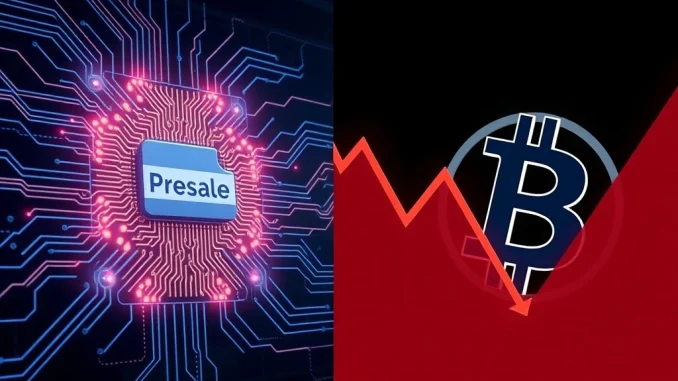
Global, January 2026: The cryptocurrency market begins the new year with a stark contrast in narratives. While early-stage investors scrutinize ambitious presale projects like DeepSnitch AI, which is generating significant discussion around potential 1000X returns, established markets face headwinds. Spot Bitcoin Exchange-Traded Funds (ETFs) have recorded substantial outflows, totaling approximately $166 million in the opening sessions, casting a shadow over the flagship digital asset’s start to 2026. This divergence highlights the complex, multi-layered nature of the digital asset ecosystem, where speculative frontier projects and institutional investment vehicles can experience wildly different sentiments simultaneously.
Crypto Presale 2026: Evaluating the AI Project Landscape
The concept of a ‘presale’ refers to the early funding round for a cryptocurrency project before its tokens are listed on public exchanges. These events are often high-risk, high-reward scenarios that attract investors seeking exponential gains from ground-floor entry. For 2026, a significant portion of presale discussion centers on projects leveraging artificial intelligence (AI). Three names frequently surface in this conversation: DeepSnitch AI, Ozak AI, and Pepenode. It is critical to analyze these not as guaranteed investments, but as case studies within a broader, volatile market segment.
DeepSnitch AI has captured notable attention within niche crypto communities. Its purported focus involves using AI for on-chain analytics and smart contract security auditing—a sector with genuine demand as blockchain complexity grows. The ‘1000X projection’ circulating in forums and social media is not an official forecast from the project’s developers but rather speculative chatter based on ambitious comparisons to early-stage successes in previous market cycles. Such projections are common in presale hype and should be treated with extreme caution, as they rarely account for market saturation, execution risk, or regulatory developments.
Competitive Analysis: Ozak AI and Pepenode
To contextualize the presale landscape, one must examine the competitive field. Ozak AI appears to position itself in the decentralized AI agent space, aiming to create autonomous economic agents that operate on blockchain networks. Pepenode, while less defined in public materials, seems to focus on AI-driven node infrastructure and data oracles. The viability of any presale project hinges on several tangible factors beyond marketing claims.
- Technical Whitepaper & Roadmap: A detailed, technically sound whitepaper and a realistic, phased roadmap are fundamental. Projects lacking clear technical specifications or with unrealistic timelines often falter.
- Team & Advisors: Publicly verifiable team members with relevant experience in both blockchain and AI are a positive signal. Anonymous teams present a higher risk profile.
- Token Utility: The project’s native token must have a clear, essential function within its ecosystem, such as paying for AI services, governing the network, or incentivizing node operators.
- Market Differentiation: With numerous AI-crypto projects, a clear answer to ‘what makes this different?’ is necessary. Solving a verifiable, underserved problem is more sustainable than generic AI integration.
Assessing whether Ozak AI or Pepenode can ‘keep up’ is less about a race and more about which project demonstrates stronger fundamentals in these areas. Presale success is often more dependent on community building and marketing prowess in the short term, while long-term survival depends on the factors listed above.
The Institutional Backdrop: Bitcoin ETF Outflows Explained
The $166 million in net outflows from U.S. spot Bitcoin ETFs is a significant data point for the institutional side of the market. These products, approved in early 2024, provide traditional investors with a regulated way to gain Bitcoin exposure. Outflows can occur for several reasons unrelated to the long-term Bitcoin thesis.
First, profit-taking after a strong quarterly or yearly finish is a common phenomenon. Second, macroeconomic factors like shifting interest rate expectations or strength in traditional equity markets can trigger portfolio rebalancing away from volatile assets. Third, specific geopolitical or regulatory news can cause short-term risk aversion. It is essential to view these flows as part of a longer trend rather than an isolated event; a single week of outflows does not define a market’s trajectory. Analysts will monitor whether this represents a brief consolidation or the start of a more sustained trend of institutional caution.
Historical Context and Market Cycles
The current dichotomy between presale hype and ETF outflows fits a historical pattern. Cryptocurrency markets often see capital rotate between different risk tiers. During periods of consolidation or uncertainty in large-cap assets like Bitcoin (BTC) and Ethereum (ETH), some speculative capital seeks higher potential returns in earlier-stage projects. Conversely, when major cryptocurrencies enter strong bullish trends, capital often flows back into these more liquid, established assets from the riskier presale and altcoin sectors.
The 2021 cycle saw immense presale activity followed by a severe market contraction in 2022. The lessons from that period underscore the importance of due diligence. Many projects that promised revolutionary returns failed to deliver a functional product. Today’s investors, particularly after the 2022 downturn, are theoretically more discerning, though the allure of a ‘1000X’ opportunity can still drive fervent speculation.
Risk Assessment for the 2026 Presale Investor
For any individual considering participation in a 2026 crypto presale, a rigorous risk framework is non-negotiable. The space remains largely unregulated, presenting risks of fraud, rug pulls (where developers abandon the project and take funds), and simple failure due to poor execution.
- Capital Allocation: Financial advisors universally warn against investing more than one can afford to lose entirely in such speculative ventures. Presales should represent a tiny fraction of a diversified portfolio.
- Deep Research: Go beyond the promotional website. Scrutinize the smart contract code if possible, review all team member backgrounds on LinkedIn, and search for critical discussions in developer forums, not just hype channels.
- Vesting Schedules: Understand the token release schedule. Projects where team and advisor tokens are locked for a long period align incentives better than those with immediate unlocks.
- Regulatory Awareness: The regulatory environment for crypto and AI is evolving rapidly. A project operating in a legal gray area today could face existential challenges tomorrow.
Conclusion
The opening of 2026 presents a microcosm of the modern cryptocurrency market. On one frontier, the buzz around the crypto presale 2026 scene, led by discussions on DeepSnitch AI and its competitors, represents the enduring search for groundbreaking, high-growth opportunities. On the other, the $166 million in Bitcoin ETF outflows reflects the maturation and integration of crypto into traditional finance, where it is subject to the ebbs and flows of institutional capital management. These two stories are not contradictory but complementary, illustrating the spectrum of risk, innovation, and investment vehicles that now define the digital asset space. Navigating this landscape in 2026 requires separating speculative chatter from substantive development, understanding macroeconomic crosscurrents, and, above all, prioritizing diligent research and risk management over the allure of exponential projections.
FAQs
Q1: What is a cryptocurrency presale?
A cryptocurrency presale is an early funding round where a project sells its tokens to select investors at a discounted price before the public token sale or exchange listing. It carries high risk but offers the potential for significant gains if the project succeeds.
Q2: Why are Bitcoin ETFs seeing outflows?
Bitcoin ETF outflows of $166 million can be attributed to several factors, including short-term profit-taking by investors after prior gains, broader macroeconomic shifts affecting risk appetite, and portfolio rebalancing at the start of a new financial year.
Q3: Should I invest in a presale like DeepSnitch AI based on a 1000X projection?
No. Projections of 1000X returns are almost always speculative community hype, not financial forecasts. Investing based solely on such claims is extremely risky. Thorough due diligence on the project’s team, technology, and tokenomics is essential.
Q4: What is the main difference between AI crypto projects like DeepSnitch AI and Ozak AI?
Based on available information, DeepSnitch AI focuses on AI for blockchain security and analytics, while Ozak AI aims to build decentralized autonomous AI agents. Their core applications and target markets differ, though both intersect AI and blockchain.
Q5: How do Bitcoin ETF flows affect the broader crypto market?
Significant and sustained ETF flows can influence Bitcoin’s price by increasing or decreasing institutional demand. As the largest cryptocurrency, Bitcoin’s price movements often have a knock-on effect on overall market sentiment and altcoin valuations.
This article was produced with AI assistance and reviewed by our editorial team for accuracy and quality.