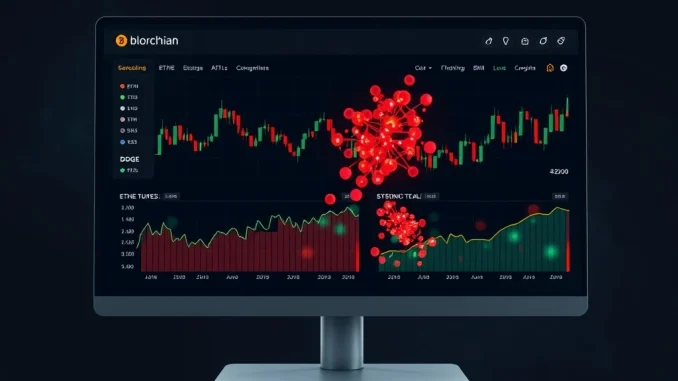
Global, May 2025: A significant buildup of liquidation clusters for Bitcoin (BTC), Ethereum (ETH), Binance Coin (BNB), and Dogecoin (DOGE) is flashing a clear warning to cryptocurrency traders. As Bitcoin consolidates in a tightening range between a formidable $71,422 resistance and a tested $64,500 support level, aggregated data from the past week reveals a dangerous accumulation of leveraged positions. This analysis delves into the mechanics of liquidations, the current market structure, and what historical precedent suggests about the potential for a major price move in the coming days.
Crypto Liquidations Explained: The Fuel for Market Volatility
To understand why analysts are watching liquidation data so closely, we must first define the term. In cryptocurrency margin trading, investors borrow funds to amplify their positions. A liquidation occurs when a trader’s position is automatically closed by the exchange because they no longer have enough collateral to keep it open. This happens when the market moves against them. A ‘liquidation cluster’ forms when a large volume of these leveraged positions sits at a similar price point. When the market price approaches these clusters, it can trigger a cascade of automatic sell or buy orders, exacerbating price swings and creating violent volatility. The current data shows growing clusters for both long (betting on price increases) and short (betting on decreases) positions across major assets, setting the stage for a potential squeeze.
Bitcoin’s Precarious Range: Between $71,422 and $64,500
Bitcoin, the market leader, is currently painting a classic technical picture. After testing the psychologically important $60,000 level and finding strong buying interest, the price has rebounded into a defined consolidation zone. The upper boundary is a stiff resistance wall at approximately $71,422, a level that has rejected multiple bullish attempts. The lower boundary is the $64,500 support, which has held firm during recent pullbacks. This narrowing range indicates a period of equilibrium between buyers and sellers, but it is a tense peace. Analysts note that such tight consolidation periods often precede explosive breakouts. The direction of that breakout, however, is frequently determined by which side of the leveraged trade—the longs or the shorts—gets forced out first in a liquidation event.
The Role of Historical Support and Resistance
The significance of the $64,500 support level is not arbitrary. This zone acted as a key resistance area throughout early 2024 before finally breaking out. In market technical analysis, former resistance often transforms into future support, a principle now being tested. Conversely, the $71,422 level represents the recent local high, where profit-taking has historically emerged. The market’s repeated interaction with these levels builds liquidity and attracts leveraged traders to place bets just beyond them, directly contributing to the liquidation clusters analysts are monitoring.
Ethereum, BNB, and Dogecoin: Altcoins Mirror and Magnify BTC’s Signals
While Bitcoin sets the overall tone, the liquidation data for Ethereum (ETH), Binance Coin (BNB), and Dogecoin (DOGE) provides critical context for the broader market’s health. These assets often exhibit higher volatility—beta—relative to Bitcoin. The presence of substantial liquidation clusters for these major altcoins suggests that speculative activity is not isolated to BTC but is widespread. For instance, Ethereum’s clusters around key DeFi-related price levels and BNB’s activity tied to the Binance Smart Chain ecosystem show that sector-specific narratives are also fueling leveraged bets. Dogecoin, with its strong retail trader base, is particularly susceptible to rapid liquidations that can create outsized price swings. The synchronized buildup across these diverse assets indicates a market-wide increase in risk appetite and leverage, a condition that historically precedes heightened volatility.
Analyzing the Seven-Day Liquidation Data: A Tale of Two Trades
Aggregated data from major derivatives exchanges over the past week reveals a compelling narrative. The following table summarizes the estimated liquidation cluster values for long and short positions near current prices:
| Asset | Long Liquidation Cluster (Est. Value) | Short Liquidation Cluster (Est. Value) | Key Price Zone |
|---|---|---|---|
| Bitcoin (BTC) | High | High | $64,500 – $71,422 |
| Ethereum (ETH) | Moderate-High | Moderate | $3,200 – $3,650 |
| Binance Coin (BNB) | Moderate | Moderate-High | $580 – $635 |
| Dogecoin (DOGE) | High | Low-Moderate | $0.128 – $0.155 |
This data shows a market deeply divided. For BTC and DOGE, the risk of long positions being liquidated (if price falls) appears elevated. For BNB, there is notable risk for short positions (if price rises). ETH shows significant risk on both sides. This imbalance means a move in either direction for Bitcoin could trigger a domino effect, liquidating one set of positions and potentially fueling a momentum-driven move that then cascades into the altcoin markets.
What This Means for Trader Psychology and Market Structure
The buildup of these positions reflects a specific market psychology. Traders are increasingly using leverage to capitalize on what they perceive as a predictable range or an impending breakout. This behavior itself changes market structure by concentrating stop-loss orders and liquidation points. It creates a ‘powder keg’ scenario where a relatively modest price move, perhaps triggered by a macroeconomic news event or a large spot market order, can ignite a chain reaction. Market makers and institutional players are acutely aware of these levels, which can lead to increased short-term volatility as prices are sometimes ‘hunted’ to trigger these liquidations for profit.
Conclusion: Navigating a High-Stakes Consolidation Phase
The confluence of technical factors and on-chain derivatives data presents a clear picture. The cryptocurrency market, led by Bitcoin, is in a high-stakes consolidation phase bordered by clear support and resistance. The significant crypto liquidations data for BTC, ETH, BNB, and DOGE acts as a pressure gauge, showing that leveraged risk within the system is rising. While this does not predict the direction of the next major move, it strongly suggests that the move’s magnitude could be substantial when the breakout finally occurs. For market participants, this environment underscores the importance of prudent risk management, including the careful use of leverage and awareness of the high volatility potential signaled by these growing liquidation clusters. The coming days will test whether the market can absorb this leveraged pressure or if it will be the catalyst for the next significant trend.
FAQs
Q1: What are cryptocurrency liquidation clusters?
Liquidation clusters are concentrations of leveraged trading positions that will be automatically closed if the price reaches a specific level. They represent price zones where a cascade of forced buying or selling can occur, dramatically increasing volatility.
Q2: Why is Bitcoin trading between $64,500 and $71,422 significant?
These levels have established themselves as strong technical support and resistance. $64,500 has held during sell-offs, and $71,422 has capped rallies. This creates a defined range where price discovery pauses before a potential decisive breakout.
Q3: How do altcoins like ETH and DOGE relate to Bitcoin’s price action?
Altcoins often correlate with Bitcoin’s momentum, especially during periods of high volatility. Liquidation events in Bitcoin can trigger rapid capital flows into or out of altcoins, magnifying their price movements.
Q4: Does high liquidation data predict a price crash?
Not necessarily. It predicts high volatility. A large cluster of long liquidations suggests a price drop could be violent, but a cluster of short liquidations suggests a rapid price rise (a ‘short squeeze’) is possible. The data indicates the potential for a large move in either direction.
Q5: What should traders consider in this market environment?
Traders should be aware of increased risk, employ strict stop-loss strategies if using leverage, and consider reducing position sizes due to the heightened potential for sudden, sharp price swings triggered by the liquidation clusters discussed in this analysis.