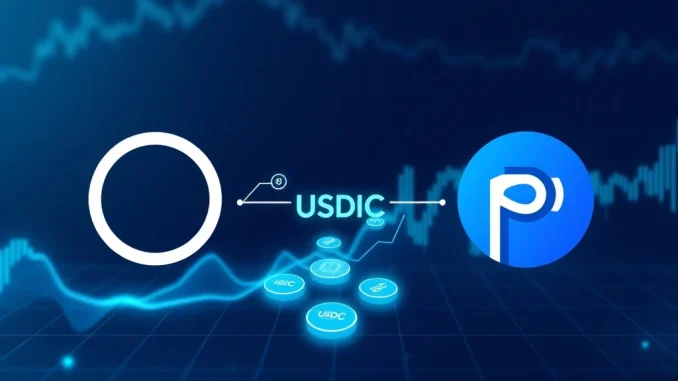
New York, April 2025: In a move signaling a major maturation phase for onchain financial infrastructure, Circle Internet Financial, the issuer of the USDC stablecoin, and Polymarket, the world’s largest blockchain-based prediction market platform, have announced a comprehensive strategic partnership. The core of the agreement designates native USDC as the primary settlement and collateral infrastructure across the Polymarket ecosystem, a decision with profound implications for the stability, scalability, and regulatory posture of decentralized finance.
Anatomy of a Strategic Partnership: USDC as Core Infrastructure
The partnership represents a significant shift from Polymarket’s previous multi-asset settlement model. Under the new framework, the USDC stablecoin, pegged 1:1 to the U.S. dollar and issued by the regulated entity Circle, becomes the default currency for all prediction market contracts, user deposits, withdrawals, and prize settlements. This integration is native, meaning it leverages USDC’s direct presence on multiple blockchains, including Ethereum, Polygon, and Solana, where Polymarket operates. The collaboration extends beyond mere technical integration; it includes joint initiatives on liquidity provisioning, user education regarding stablecoin utility, and exploring new financial products built on this shared infrastructure. For Circle, the partnership embeds its flagship product at the heart of a high-volume, global platform, dramatically expanding its real-world utility beyond trading and remittances into the niche of event-driven financial contracts.
The Evolution and Significance of Prediction Markets
To understand the partnership’s impact, one must first grasp the function of prediction markets. These are speculative platforms where users trade shares based on the predicted outcome of future events—from elections and sports to economic indicators and geopolitical developments. The aggregate price of these shares acts as a probability forecast, often cited for their informational efficiency. Polymarket, founded in 2020, has grown to dominate this space onchain, processing billions of dollars in volume. Its operation on public blockchains offers transparency and global accessibility but has historically faced challenges with settlement asset volatility and regulatory scrutiny. By adopting USDC, Polymarket directly addresses the volatility issue, ensuring all contract values and collateral are denominated in a stable asset. This move enhances user experience by eliminating the need to mentally account for ETH or MATIC price swings and reduces the platform’s operational complexity related to multi-currency management.
Regulatory Context and the Search for Legitimacy
This partnership occurs within a rapidly clarifying global regulatory environment for digital assets. USDC’s standing as a regulated stablecoin, backed by cash and short-dated U.S. Treasuries and subject to periodic attestations, provides Polymarket with a layer of financial legitimacy. Regulatory bodies, particularly in the United States, have expressed concerns over prediction markets and their classification. Aligning with a transparent, compliant financial instrument like USDC could be a strategic step by Polymarket to demonstrate operational seriousness and mitigate regulatory risk. It signals a preference for working within emerging frameworks for stablecoin and market conduct regulation, rather than operating purely in a regulatory gray area. This alignment with regulated entities is becoming a common theme for major crypto-native platforms seeking long-term viability.
Technical and Economic Implications for Onchain Finance
The technical integration underscores a broader trend in decentralized finance (DeFi): the consolidation around a few, highly liquid, and trusted stablecoins as base layers for economic activity. USDC’s deep liquidity across centralized exchanges, decentralized exchanges (DEXs), and lending protocols creates a seamless financial loop for Polymarket users. Funds can move between traditional finance, trading venues, and the prediction market with minimal friction. Economically, this partnership could catalyze greater institutional interest. The predictability of a stable settlement unit makes it easier for funds, trading firms, and sophisticated actors to model risk and allocate capital to prediction markets as a novel asset class. Furthermore, it strengthens the network effects for both entities: every new Polymarket user becomes a potential USDC holder, and every existing USDC holder gains a compelling new use case for their assets.
The table below outlines the key shifts this partnership enables:
| Aspect | Previous State | New State with USDC |
|---|---|---|
| Settlement Asset | Multiple crypto assets (ETH, MATIC, etc.) | Single, stable asset (USDC) |
| Price Risk for Users | Exposed to volatility of collateral asset | Insulated from volatility; pure event risk |
| Regulatory Profile | Associated with volatile, speculative assets | Aligned with a regulated, transparent stablecoin |
| Cross-Platform Liquidity | Fragmented across chains and assets | |
| Institutional Friction | High (accounting complexity, volatility) | Reduced (stable unit of account) |
A Historical Parallel: The Standardization of Settlement
The move mirrors historical financial market evolutions where standardization of a settlement instrument led to increased participation and stability. In traditional finance, the widespread adoption of the U.S. dollar as the primary settlement currency for global oil trades and many international contracts created a reliable benchmark. Similarly, in securities markets, the shift to shorter, standardized settlement cycles (like T+1) reduced risk. For onchain markets, which operate 24/7, the standardization on a transparent, liquid, and stable asset like USDC serves a analogous purpose: it reduces systemic friction, builds trust through predictability, and creates a common language of value for a diverse, global user base. This is a foundational step for more complex onchain financial derivatives and structured products.
Conclusion: A Foundation for the Next Generation of Onchain Markets
The strategic partnership between Circle and Polymarket is more than a simple commercial integration; it is a deliberate architectural choice for the future of onchain financial markets. By cementing USDC as its core settlement infrastructure, Polymarket gains stability, regulatory alignment, and a bridge to broader financial ecosystems. For Circle, it validates USDC’s role as critical plumbing for the next wave of decentralized applications beyond simple payments and trading. This collaboration underscores a maturation in the crypto industry, where leading projects are prioritizing user experience, risk management, and regulatory engagement to build durable, high-utility platforms. The success of this model will likely influence other prediction markets and speculative DeFi applications, potentially establishing a new standard for how value is settled on the global, digital frontier of finance.
FAQs
Q1: What does the Circle and Polymarket partnership mean for current users?
For existing Polymarket users, the primary change is the transition to using USDC for all activities—funding accounts, trading contracts, and receiving payouts. This should simplify the experience by removing exposure to the price volatility of other cryptocurrencies used for collateral. Users will need to acquire USDC, which is widely available on most exchanges, to participate.
Q2: Why is USDC considered a better settlement asset than Ethereum or other cryptocurrencies for this use case?
Prediction markets are about speculating on the outcome of an event, not on the price of cryptocurrency. Using a volatile asset like ETH adds an unnecessary layer of financial risk. USDC, being a stablecoin, maintains a steady value pegged to the U.S. dollar. This allows traders to focus purely on the probability of the event in question, making the markets more efficient and user-friendly.
Q3: Does this partnership make Polymarket more likely to comply with future regulations?
While no partnership guarantees specific regulatory outcomes, aligning with a regulated and transparent entity like Circle is widely viewed as a positive step. It demonstrates a commitment to operating with reputable financial infrastructure, which regulators often consider when evaluating a platform’s legitimacy and long-term intentions.
Q4: How does this affect the overall stability and safety of funds on Polymarket?
The partnership enhances stability by ensuring all contract values are denominated in a stable asset. Regarding safety, user funds on Polymarket are still held in smart contracts as they were before. The change is in the *type* of asset held. USDC itself is backed by reserves held in regulated financial institutions, which adds a layer of traditional financial security to the asset being used.
Q5: Could this partnership model be adopted by other decentralized applications (dApps)?
Absolutely. This model of standardizing on a major, regulated stablecoin for core economic functions is a logical step for any dApp that requires a stable unit of account. This includes lending protocols, decentralized insurance platforms, options and derivatives markets, and even some gaming and NFT ecosystems. The Circle-Polymarket partnership may serve as a blueprint for reducing volatility risk and improving user experience across the DeFi landscape.
Updated insights and analysis added for better clarity.
This article was produced with AI assistance and reviewed by our editorial team for accuracy and quality.