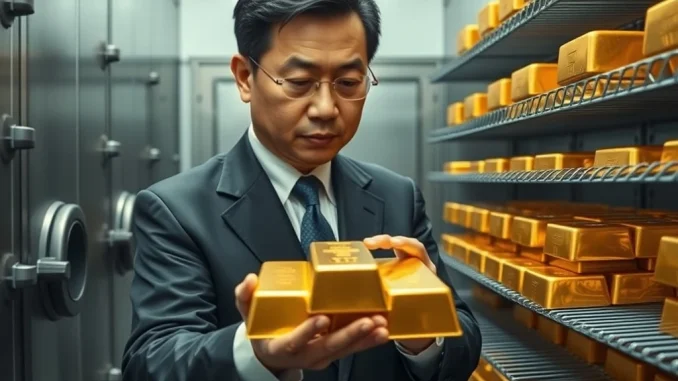
Beijing, February 11, 2026 — China has officially increased its gold reserves for 15 consecutive months, fueling intense speculation about Beijing’s strategic ambitions to position the yuan as a global reserve currency alternative to the US dollar. The People’s Bank of China reported holdings of 2,306 tonnes at the end of 2025, but multiple analysts estimate the actual figure could exceed 5,000 tonnes through covert accumulation. This sustained acquisition occurs despite gold prices reaching record highs throughout 2025, suggesting strategic priorities outweighing market considerations. The development represents the latest move in China’s decades-long campaign to reduce global dependence on the US dollar, with President Xi Jinping recently emphasizing the need for “a strong currency” with global reserve status in official publications.
China’s Official Gold Position Versus Analyst Estimates
The World Gold Council confirms China has purchased gold monthly since December 2024, marking one of the longest sustained accumulation periods by any nation in recent history. Officially, China ranks sixth globally with 2,306 tonnes, behind the United States (8,133 tonnes), Germany, Italy, France, and Russia. However, Jan Nieuwenhuijs, a gold analyst at Money Metals Exchange, presents compelling evidence that China’s actual holdings likely exceed 5,400 tonnes. His analysis incorporates domestic production data, import figures through Shanghai and Hong Kong exchanges, and withdrawals from international vaults. “Covert buying allows the PBoC to buy more gold at lower prices — getting more bang for their buck,” Nieuwenhuijs explains, noting that China’s strategy appears designed to minimize market disruption while accumulating substantial reserves.
Financial writer Dominic Frisby, author of four books on gold and monetary history, offers even more dramatic estimates. During a recent Triggernometry podcast appearance, Frisby suggested China could possess three to ten times its reported reserves, potentially reaching 16,000 tonnes. “I think it’s the biggest story in world finance — China’s accumulation of gold — and nobody is looking at it,” Frisby stated. These estimates gain credibility when examining China’s position as the world’s largest gold producer since 2007, with state-controlled mines contributing significantly to domestic supply.
The Geopolitical Strategy Behind Gold Accumulation
China’s gold strategy forms a critical component of its broader de-dollarization initiative, which has accelerated since trade tensions with the United States intensified in the late 2010s. Charles-Henry Monchau, chief investment officer at Swiss banking group Syz, describes the approach as “a quiet, cumulative tactic” that contrasts sharply with more confrontational measures like dumping US Treasury bonds. “Unlike dumping Treasuries, which could trigger market panic and backfire economically, buying gold is a subtle strategy,” Monchau observes. “It exerts downward pressure on the dollar over time, especially if other nations follow suit.” This method allows China to convert dollar surpluses into tangible assets while gradually reducing the greenback’s dominance in global reserves.
- Monetary Independence: Building gold reserves provides a buffer against potential US financial sanctions and reduces vulnerability to dollar-based financial systems
- Currency Credibility: Substantial gold holdings could support yuan convertibility and increase international trust in China’s currency
- Strategic Timing: Analysts suggest China may reveal its true reserves when the yuan achieves sufficient independence from dollar-based trade
- BRICS Coordination: While a unified BRICS currency faces implementation challenges, China’s unilateral gold accumulation strengthens its position within the bloc
Expert Perspectives on China’s Endgame
Financial analysts diverge on China’s ultimate objectives but agree gold plays a central role. Jeff Currie, chief strategy officer of energy pathways at Carlyle, directly links China’s purchases to “a de-dollarization strategy” in comments to the Financial Times. Meanwhile, Nieuwenhuijs envisions two potential scenarios: either a planned revelation when China achieves dollar independence, or an emergency measure if confidence in the yuan declines. “The PBoC’s gold reserves can support the renminbi and ultimately back it ‘one on one’ with gold,” he notes. Frisby adds a geopolitical dimension, warning that “if they ever go into conflict, you can be sure China will use money as a weapon of war just as America does.”
Historical Context: From Bretton Woods to Modern Currency Competition
China’s strategy echoes historical precedents where gold-backed currencies achieved global prominence. The 1944 Bretton Woods agreement established the US dollar as the world’s primary reserve currency by pegging it to gold at $35 per ounce, creating a system where dollars were “as good as gold” for international trade. That system collapsed in 1971 when President Richard Nixon suspended dollar-gold convertibility amid inflationary pressures and Vietnam War spending. Frisby describes the subsequent arrangement as “money illusion” — maintaining dollar dominance through economic size and network effects rather than tangible backing. China’s approach potentially reverses this dynamic by building substantial gold reserves before challenging dollar hegemony.
| Country | Official Gold Reserves (Tonnes) | Estimated Actual (Analyst Figures) |
|---|---|---|
| United States | 8,133 | 8,133 (No audit since 1953) |
| China | 2,306 | 5,400–16,000 (Various estimates) |
| Russia | 2,332 | 2,332 (Regular reporting) |
| Germany | 3,352 | 3,352 (Held domestically since 2020) |
The Path Forward: Timeline and Implementation Challenges
Most analysts agree a yuan challenge to dollar dominance remains a long-term project rather than an imminent shift. The International Monetary Fund projects China’s GDP will reach $20.7 trillion in 2026 compared to $31.8 trillion for the United States, indicating continued economic disparity. However, China’s gold accumulation could accelerate currency internationalization through several mechanisms. First, substantial reserves could support yuan convertibility guarantees in bilateral trade agreements. Second, gold-backed financial instruments denominated in yuan might attract central bank reserves seeking diversification. Third, during periods of dollar volatility or geopolitical tension, gold-backed yuan assets could appear as safer alternatives. Implementation faces significant hurdles, including capital account liberalization, transparent monetary policy, and building international trust in China’s financial systems.
Market Reactions and Investment Implications
The gold market has responded to sustained central bank demand with record prices throughout 2025, despite higher interest rates that traditionally pressure gold valuations. This anomaly suggests structural shifts in gold’s role within the international monetary system. Simultaneously, cryptocurrency advocates like Robert Kiyosaki have intensified calls for diversification into gold and digital assets as hedges against currency competition. Bitcoin trades at $68,423 as of February 2026, down from previous highs but maintaining significant appreciation from earlier decades. Frisby summarizes this perspective: “Both are money in and of themselves: one is the product of nature, the other the product of extraordinary amounts of computer power. Neither relies on anyone else.”
Conclusion
China’s 15-month gold accumulation represents a strategic financial maneuver with profound geopolitical implications. While official reserves remain modest, substantial evidence suggests covert accumulation far exceeding reported figures. This strategy supports China’s broader de-dollarization objectives and prepares potential foundations for yuan internationalization. The timeline for meaningful dollar challenge extends toward mid-century, requiring continued economic convergence and financial system development. However, gold reserves provide tangible assets that could accelerate this process during periods of dollar weakness or geopolitical realignment. Market participants should monitor China’s gold reporting, yuan internationalization milestones, and BRICS coordination for signals of accelerating currency competition. The ultimate outcome will reshape global financial architecture and determine whether the twenty-first century maintains dollar dominance or transitions toward multipolar currency arrangements.
Frequently Asked Questions
Q1: How much gold does China actually have compared to official reports?
China officially reports 2,306 tonnes, but analysts estimate 5,400–7,000 tonnes based on production, imports, and exchange data. Some extreme estimates suggest up to 16,000 tonnes through covert accumulation.
Q2: Why would China want to challenge the US dollar as global reserve currency?
Dollar dominance gives the US financial leverage, including sanction capabilities. A yuan alternative would increase China’s monetary sovereignty, reduce vulnerability to US policies, and reflect its economic size.
Q3: How could gold support the yuan as a reserve currency?
Substantial gold reserves could back yuan convertibility guarantees, increase international trust, and provide tangible asset backing during initial internationalization phases.
Q4: What is the timeline for yuan challenge to dollar dominance?
Most analysts project meaningful challenge by 2050, requiring continued economic growth, financial market development, and international adoption beyond current bilateral agreements.
Q5: How are other countries responding to China’s gold accumulation?
Several nations, including Russia and some BRICS members, have increased gold reserves. However, most Western nations maintain stable reserves while monitoring long-term implications.
Q6: Should individual investors consider gold given these developments?
Many analysts recommend diversified portfolios including gold as hedge against currency volatility and geopolitical uncertainty, though individual decisions should consider risk tolerance and investment horizons.