Denver, Colorado – February 2025: The cryptocurrency landscape enters a pivotal phase as regulatory developments and technological advancements set the stage for the market’s trajectory into 2026. A Cardano price prediction for February 2026 must now account for significant external factors, including evolving regulatory frameworks from the U.S. Securities and Exchange Commission (SEC) and notable capital movements within the industry. This analysis examines the interconnected market signals, from discussions at major conferences like ETHDenver to the performance of assets like Solana and emerging projects such as DeepSnitch AI, to provide a grounded perspective on potential outcomes.
Cardano Price Prediction: Technical and Fundamental Context for 2026
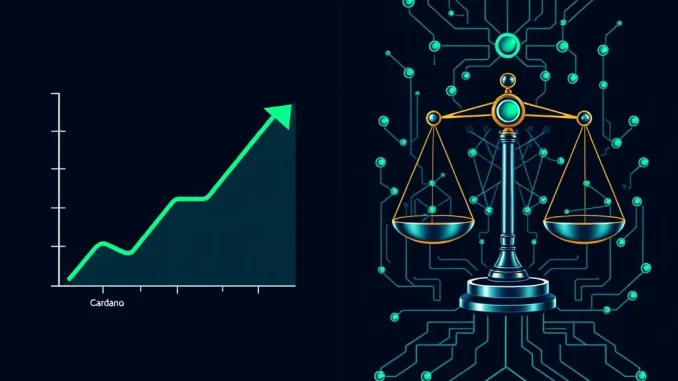
Forecasting the price of Cardano (ADA) for a specific point like February 2026 requires a multi-faceted approach. Analysts must separate short-term volatility from long-term value drivers rooted in the network’s development progress, adoption metrics, and broader macroeconomic conditions. The Cardano ecosystem continues to execute its roadmap, with recent emphasis on scaling solutions like Hydra and the growth of its decentralized finance (DeFi) and real-world asset (RWA) sectors. Historical price action shows Cardano often experiences periods of consolidation followed by significant moves correlated with major network upgrades and broader crypto market cycles. A realistic Cardano price prediction models various adoption-rate scenarios against potential regulatory headwinds or tailwinds.
The SEC’s Evolving Stance on Digital Assets and Tokenization
Recent commentary from SEC officials at industry gatherings, including ETHDenver, has underscored a continued focus on the classification and regulation of digital assets. The concept of “tokenized securities” remains a central theme, with implications for a wide range of blockchain projects. Regulatory clarity, or the lack thereof, directly impacts institutional investment, product development, and overall market sentiment. For proof-of-stake networks like Cardano, specific regulatory guidance on staking rewards could influence validator participation and network security. The movement of $78 million in traditional bank deposits to platforms like Coinbase, as reported, may reflect institutional positioning ahead of anticipated regulatory milestones, indicating a vote of confidence in compliant infrastructure.
Historical Precedents and Market Reactions to Regulation
Market history provides context for how digital asset prices react to regulatory news. Events such as the SEC’s approval of Bitcoin spot ETFs in early 2024 created sustained bullish momentum for the entire asset class. Conversely, announcements of enforcement actions against specific projects have often led to short-term sell-offs in related sectors. The market’s forward-looking nature means prices frequently adjust in anticipation of regulatory decisions. Therefore, a Cardano price prediction must factor in the probability of various regulatory outcomes between now and 2026, including potential legislation from Congress that could provide a more stable framework for blockchain innovation.
Solana’s Market Performance and Ecosystem Resilience
Solana’s (SOL) rally to price points around $84, as noted in recent buzz, demonstrates the asset’s recovery and resilience following the network outages of previous years. This performance is often attributed to several key factors:
- Technological Improvements: Continued upgrades to network stability and client diversity.
- Ecosystem Growth: A thriving landscape of decentralized applications (dApps), particularly in decentralized physical infrastructure networks (DePIN) and consumer crypto.
- Market Sentiment: A broader shift towards narratives around high-throughput blockchains.
Solana’s price action can have a correlative effect on other smart contract platforms like Cardano, as both compete in similar sectors. Strong performance in one can attract general capital into the sector, benefiting others.
The Emergence of AI-Blockchain Convergence: The DeepSnitch AI Case
The closing presale phase for projects like DeepSnitch AI highlights a growing trend of convergence between artificial intelligence and blockchain technology. These projects typically propose using decentralized networks to audit, verify, or provide transparency for AI models and their outputs. The “1000x launch” terminology common in presale marketing refers to aspirational return targets for early investors, which carry significant risk. From a market structure perspective, successful launches of highly anticipated projects can generate positive sentiment and trading volume that spills over into established large-cap assets like Cardano and Solana, as investors rotate profits. However, the long-term viability of any new project depends on delivering functional technology and achieving genuine user adoption, not just presale hype.
Evaluating Capital Flows and On-Chain Metrics
Professional analysts base predictions on more than price charts. They examine on-chain data such as:
- Active Addresses: The number of unique addresses interacting with the Cardano network.
- Total Value Locked (TVL): The amount of capital deposited in Cardano’s DeFi protocols.
- Staking Participation: The percentage of ADA supply actively staked to secure the network.
- Development Activity: The pace of code commits and updates to the core protocol and ecosystem projects.
Sustained growth in these fundamental metrics between now and 2026 would provide a stronger foundation for a positive Cardano price prediction than speculative narratives alone.
Conclusion: A Synthesis of Factors for a 2026 Outlook
Constructing a Cardano price prediction for February 2026 is an exercise in synthesizing technology, regulation, and macro-finance. Cardano’s price will likely be influenced by its own development milestones, the regulatory environment shaped by entities like the SEC, the comparative performance of peers like Solana, and broader capital market conditions. While projects such as DeepSnitch AI represent the innovative frontier of the space, their impact on major layer-1 tokens will be secondary to core adoption drivers. Investors and observers should monitor verifiable on-chain growth, regulatory developments, and macroeconomic indicators for the most reliable signals, rather than short-term price movements or promotional claims. The path to February 2026 will be defined by continued evolution, increasing institutional involvement, and the ongoing search for sustainable utility within the blockchain ecosystem.
FAQs
Q1: What are the main factors influencing a Cardano price prediction for 2026?
The primary factors include the development and adoption of the Cardano network itself (e.g., scaling, dApp growth), broader cryptocurrency regulatory decisions, macroeconomic conditions, the performance of competing smart contract platforms, and overall institutional adoption of digital assets.
Q2: How do SEC discussions about “tokenized securities” affect Cardano?
Clear SEC rules could impact how Cardano’s native token, ADA, and assets built on its network are classified. Favorable or clear regulation could reduce uncertainty and attract investment, while restrictive rulings could pose challenges for certain use cases, particularly in decentralized finance.
Q3: Why is Solana’s price rally relevant to a Cardano prediction?
Solana and Cardano are both major smart contract platforms. Significant price movement in one often affects sentiment and capital flows across the entire sector. A strong Solana can indicate healthy demand for layer-1 blockchain utility, which can be a positive indicator for the broader market, including Cardano.
Q4: What does a project presale like DeepSnitch AI’s mean for the larger market?
Successful presales and launches can generate trading volume and positive sentiment that benefits the wider crypto market. They also represent investor interest in new technological narratives, like AI-blockchain fusion. However, their long-term impact depends on the project’s eventual real-world utility and delivery.
Q5: What on-chain metrics are most important for evaluating Cardano’s health?
Key metrics include the number of daily active addresses, total value locked (TVL) in DeFi, the number and quality of decentralized applications, staking participation rate, and the pace of development activity (GitHub commits). Growth in these areas suggests organic network expansion.
This article was produced with AI assistance and reviewed by our editorial team for accuracy and quality.