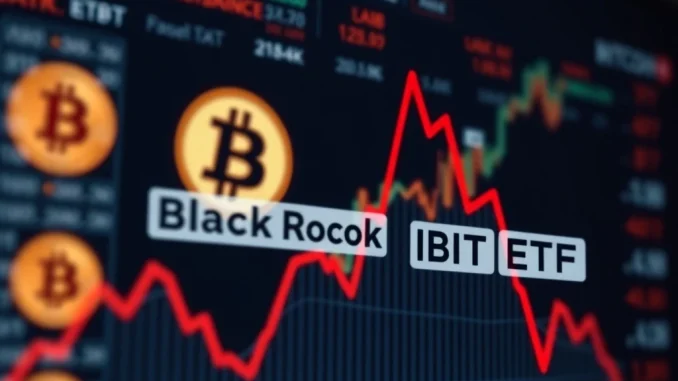
Stunning Reversal: BlackRock’s IBIT Bitcoin ETF Plunges into Negative Territory
New York, February 2025: A stunning reversal is unfolding in the cryptocurrency investment landscape. BlackRock’s iShares Bitcoin Trust (IBIT), once hailed as the vanguard of institutional Bitcoin adoption, has officially slipped into negative dollar-weighted returns. This pivotal shift, confirmed by recent flow and performance data, exposes the profound sensitivity of even the most sophisticated crypto investment vehicles to market timing and sentiment, challenging core narratives about Bitcoin’s stability and role in modern portfolios.
BlackRock’s IBIT Bitcoin ETF: From Record Highs to Negative Returns
The trajectory of BlackRock’s IBIT ETF reads like a case study in market extremes. Launched amid tremendous fanfare, the fund rapidly accumulated assets, becoming a bellwether for institutional acceptance. By October 2024, it had generated a staggering cumulative gain for investors exceeding $35 billion. This period represented the peak of a bullish narrative where Bitcoin, accessed through regulated, familiar vehicles like ETFs, was seen as a maturing asset class.
However, data from late January 2025 onward tells a different story. The dollar-weighted return—a metric that accounts for the timing and size of investor cash flows—has fallen below zero. This critical detail means the average investor who bought into IBIT is now sitting on a loss. The primary driver is clear: a massive influx of capital entered the ETF at elevated Bitcoin price levels. When the market corrected, these late-arriving investments quickly erased the gains accrued by earlier entrants. The average cost basis for IBIT holders now sits above the current spot price of Bitcoin, trapping the fund’s asset management strategy in a cycle of unrealized losses dictated by its own popularity.
The Mechanics of Institutional Flow Reversal
The crypto ETF market, for all its growth, operates with a unique volatility feedback loop. The initial success of products like IBIT was powered by net positive inflows, which required the fund’s issuer to purchase underlying Bitcoin, creating upward price pressure. The reversal of this mechanism is equally powerful. The week of January 25, 2025, served as a stark example. According to consolidated fund flow data, approximately $1.1 billion exited U.S. Bitcoin-focused funds, representing the majority of a total $1.73 billion outflow from the digital asset sector.
This capital flight highlights several key dynamics:
- Concentrated Risk: The outflows were predominantly from U.S. investors, suggesting a region-specific reassessment of risk or disappointment with recent performance.
- Liquidity vs. Conviction: Institutional money, while deep, can be “hot.” It often follows momentum and can exit just as quickly as it entered when that momentum stalls.
- ETF Structure Vulnerability: Unlike a direct Bitcoin holder, an ETF investor is exposed to the market-timing decisions of the collective investor pool. The fund’s performance becomes a function of group behavior, not just asset performance.
The table below illustrates the sharp contrast in flow dynamics between peak accumulation and the recent reversal:
| Period | IBIT Net Flow | Primary Driver | Market Impact |
|---|---|---|---|
| Q4 2024 | Strongly Positive | Institutional adoption narrative, ETF approval momentum | Upward price pressure on BTC |
| Late Jan 2025 | Significantly Negative | Profit-taking, risk-off sentiment, failed safe-haven test | Downward price pressure, increased volatility |
A Failed Safe-Haven Test and the Gold Comparison
Perhaps the most significant implication of IBIT’s downturn is the challenge it poses to Bitcoin’s aspirational role as a digital safe haven or “digital gold.” This narrative gained traction as a reason for institutions to allocate a portion of their portfolios to Bitcoin, especially in environments of high inflation or geopolitical uncertainty. The recent market stress provided a real-time test.
While Bitcoin struggled to maintain its footing, traditional gold demonstrated the behavior long ascribed to it. Gold prices flirted with all-time highs, surpassing $5,400 per ounce, as investors sought proven, non-correlated stores of value. Bitcoin’s concurrent weakness undermined the argument that it behaves as a reliable hedge. Market expectations for supportive macroeconomic conditions, like falling interest rates, failed to catalyze a Bitcoin recovery, revealing that its price drivers remain complex and often dominated by speculative sentiment rather than pure monetary hedge characteristics.
Broader Implications for Crypto Investment Products
The situation with BlackRock’s IBIT is not an isolated incident but a signal for the entire ecosystem of cryptocurrency exchange-traded products. It underscores several critical lessons for investors and the industry:
First, it demonstrates that brand power and scale do not immunize against market forces. BlackRock’s reputation and operational excellence made IBIT the preferred vehicle for many, but it could not decouple from the inherent volatility of its underlying asset. Second, it raises questions about long-term portfolio stabilization. If a core selling point was providing uncorrelated, stabilizing returns, recent performance forces a reevaluation of allocation size and purpose.
Finally, the event serves as a reminder of the crypto market’s predictable unpredictability. Cycles of euphoria and despair are well-documented, and the entry of large institutions was thought to potentially dampen these cycles. The IBIT flows suggest institutions can, in fact, amplify volatility by moving in large, coordinated herds, entering and exiting based on similar risk metrics and market signals.
Conclusion: A Critical Inflection Point for Institutional Crypto
The slide of BlackRock’s IBIT Bitcoin ETF into negative territory marks a critical inflection point. It moves the conversation beyond the initial victory of ETF approval and into the more nuanced phase of real-world performance and integration. The event starkly reveals that the BlackRock IBIT Bitcoin ETF and its peers are not magic bullets but sophisticated conduits that transmit both the potential gains and the undeniable risks of the cryptocurrency market. The fund’s status as a “victim of its own success”—where overwhelming demand at the top created a vulnerable cost basis—is a classic market tale playing out in a digital arena. Whether this correction becomes a buying opportunity for patient capital or a lasting warning that alters institutional strategy will be one of the defining narratives for Bitcoin and crypto investment products in 2025 and beyond.
FAQs
Q1: What does it mean that BlackRock’s IBIT ETF has a negative dollar-weighted return?
A negative dollar-weighted return means that, on average, investors in the fund have lost money when accounting for the specific timing and amount of their investments. It indicates that more capital entered the fund when Bitcoin prices were high, and those investments are now underwater.
Q2: Is the IBIT ETF itself losing Bitcoin or money?
The ETF holds Bitcoin. Its net asset value (NAV) falls when the price of Bitcoin falls. The “negative return” refers to the investor experience, not the fund dissolving. However, significant outflows force the fund to sell Bitcoin to meet redemptions, which can exacerbate price declines.
Q3: Why are investors comparing Bitcoin to gold in this context?
Bitcoin is often called “digital gold” and marketed as a hedge against inflation and market turmoil. Recent events saw gold prices rise while Bitcoin fell, challenging that narrative and disappointing investors who expected similar safe-haven behavior.
Q4: Does this mean Bitcoin ETFs are a bad investment?
Like any investment, they carry risk. This event highlights their specific risk: they are highly sensitive to Bitcoin’s volatility and to the market-timing of the investor pool. They are tools for exposure, not guarantees of returns, and require the same careful timing and risk assessment as buying Bitcoin directly.
Q5: Could this happen to other spot Bitcoin ETFs?
Yes. Any spot Bitcoin ETF that saw large inflows at high price levels faces the same dynamic. IBIT, as the largest, is the most prominent example, but the underlying market forces affect all similar products.
Related News
- Bitcoin Long-Term Holder Supply Rebounds to 14.3 Million BTC, Signaling Potential Mid-Cycle Reset
- Bitcoin Hyper Price Prediction: DeepSnitch AI's Strategic 170% Surge and 2026 Roadmap
- India Crypto KYC: Sweeping New Rules Mandate Real-Time Selfies and Bank Checks for Exchanges
Related: Solana Whale Awakens: 50,000 SOL Shift from Exchanges to Staking Signals Major Confidence
Related: OpenClaw Discord Crypto Ban: The Shocking Policy That Silenced Bitcoin Talk
Related: Essential Analysis: 4 Cryptocurrencies Showing Strong Growth Signals for 2026