Bitcoin Price Decline: Raoul Pal Reveals the Shocking Role of U.S. Liquidity Shortage
Global Financial Markets, May 2025: The recent downturn in Bitcoin’s price has sparked widespread debate, with many pointing to cryptocurrency-specific risks. However, a compelling macro narrative is emerging from veteran investor Raoul Pal, who attributes the Bitcoin price decline primarily to a broader U.S. liquidity shortage. This perspective shifts the focus from the digital asset’s inherent volatility to the complex interplay of global capital flows, Federal Reserve policy, and inter-asset competition, offering a more nuanced explanation for the market’s movements.
Bitcoin Price Decline and the Macro Liquidity Framework
Raoul Pal, CEO of financial media network Real Vision and a former Goldman Sachs executive, has long analyzed Bitcoin through a macroeconomic lens. His recent commentary clarifies that the asset’s price action often correlates less with crypto-native news and more with shifts in the global financial system’s plumbing. According to Pal, Bitcoin and high-growth technology stocks, particularly software-as-a-service (SaaS) companies, share a critical valuation similarity: both are priced on discounted future cash flows and long-term adoption potential. This makes them exceptionally sensitive to changes in the cost of capital and the availability of liquidity. When liquidity contracts, as it has recently, these forward-looking assets typically experience valuation compression first and most sharply. This framework positions the Bitcoin price decline not as a failure of the technology but as a symptom of a tightening financial environment.
Understanding the U.S. Liquidity Shortage Mechanism
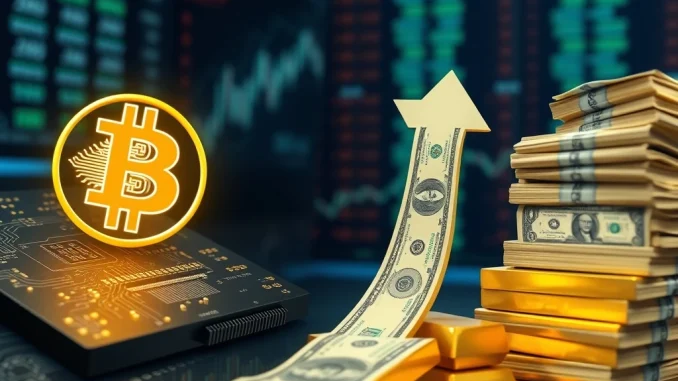
The term “liquidity” in macroeconomics refers to the ease with which capital can move through the financial system. A shortage occurs when this flow is constricted. Pal identifies two primary, interconnected drivers of the current squeeze. First, he points to the remarkable rally in gold prices. As a traditional safe-haven asset, gold has absorbed a significant portion of available capital that might otherwise seek growth in riskier assets like Bitcoin or tech stocks. This represents a classic capital rotation, where funds move from one asset class to another based on perceived risk and macroeconomic signals.
The second, more technical driver is the depletion of the U.S. Treasury’s Reverse Repurchase Agreement (RRP) facility. For years, this facility acted as a multi-trillion-dollar buffer, soaking up excess liquidity in the banking system. Financial institutions parked idle cash there for a safe return. As the Federal Reserve’s quantitative tightening progressed and the Treasury issued more debt to fund government operations, this buffer has rapidly drained. The disappearance of this “parking lot” for cash has accelerated the direct withdrawal of liquidity from the markets. The combined effect of these forces—capital flight to gold and the RRP drawdown—creates the U.S. liquidity shortage that Pal argues is pressuring risk assets.
The Federal Reserve and Interest Rate Outlook
Market anxiety has recently been compounded by speculation about potential leadership changes at the Federal Reserve. Rumors about the possible nomination of Kevin Warsh, a former Fed governor known for historically hawkish views, initially caused concern among investors in growth-sensitive assets. However, Pal offers a counterintuitive prediction. He argues that in the current economic climate, characterized by significant government debt and slowing growth, any Fed chair—including Warsh—would likely prioritize economic stability over aggressive inflation fighting. Pal forecasts that the path forward will involve interest rate cuts and a permissive stance toward growth, a scenario that would eventually replenish market liquidity. This outlook forms the basis for his expectation of a bull market resurgence in the latter half of the year, once the liquidity tide begins to turn.
Historical Context and Market Correlations
This is not the first time Bitcoin has moved in lockstep with macroeconomic indicators. A review of historical data reveals clear periods of correlation.
- 2020-2021 Bull Run: Bitcoin’s historic climb coincided with unprecedented global liquidity injections by central banks in response to the COVID-19 pandemic.
- 2022 Bear Market: The dramatic crypto winter aligned perfectly with the Federal Reserve’s initiation of quantitative tightening and aggressive interest rate hikes.
- NASDAQ Correlation: Studies have shown a fluctuating but persistent correlation between Bitcoin and the NASDAQ index, especially during periods of high macroeconomic uncertainty, underscoring its behavior as a risk-on, tech-adjacent asset.
This pattern reinforces Pal’s thesis. Bitcoin’s sensitivity to liquidity conditions is a feature of its maturation as a macro asset, not an anomaly. The current Bitcoin price decline fits into this established pattern of reacting to central bank policy and capital availability.
Implications for Investors and the Crypto Ecosystem
For investors, Pal’s analysis carries significant implications. It suggests that monitoring traditional macroeconomic indicators—such as Treasury General Account balances, RRP levels, and broad money supply measures—may be as important as tracking blockchain metrics. It also argues for a diversified portfolio approach that acknowledges Bitcoin’s evolving role. For the broader cryptocurrency ecosystem, this macro framing presents both a challenge and an opportunity. The challenge is that short-term price action may remain tethered to forces outside the industry’s control. The opportunity lies in the potential for a powerful rally when liquidity conditions eventually ease, as Pal predicts. Furthermore, this narrative helps distinguish Bitcoin’s value proposition from other digital assets, anchoring it as a monetary innovation deeply connected to global finance.
Conclusion
Raoul Pal’s explanation reframes the recent Bitcoin price decline as a consequence of a systemic U.S. liquidity shortage, driven by capital rotation into gold and the depletion of key monetary buffers. This macro perspective moves beyond simplistic narratives of crypto volatility and instead situates Bitcoin within the complex dynamics of modern finance. While short-term pressures may persist, Pal’s forecast hinges on a shift in Federal Reserve policy toward rate cuts and renewed liquidity, which could catalyze a broad market recovery. Understanding this liquidity framework is crucial for any investor seeking to navigate the increasingly interconnected worlds of digital and traditional assets.
FAQs
Q1: What does Raoul Pal say is the real cause of Bitcoin’s price drop?
Raoul Pal argues the primary cause is a shortage of U.S. dollar liquidity in the financial system, not a problem with Bitcoin itself. He links this to capital moving into gold and the draining of the Federal Reserve’s Reverse Repo facility.
Q2: How are Bitcoin and software stocks related according to this analysis?
Pal states both Bitcoin and high-growth software (SaaS) stocks are valued on their future potential and expected cash flows. This makes them similarly sensitive to changes in interest rates and the overall availability of capital, causing their prices to often move in sync.
Q3: What is the Reverse Repo facility and why does it matter?
The Reverse Repurchase Agreement (RRP) facility is a tool where the Fed borrows money overnight from banks and other institutions. It had been holding trillions in excess cash, acting as a liquidity buffer. Its rapid depletion has directly pulled money out of the financial markets.
Q4: Does Pal think the Federal Reserve will keep raising rates?
No, Pal predicts the opposite. He believes that regardless of who leads the Fed, the need to manage high government debt and support economic growth will lead to interest rate cuts and a more supportive liquidity environment later this year.
Q5: What is the key takeaway for cryptocurrency investors?
The key takeaway is that Bitcoin is increasingly acting as a macro financial asset. Its price is influenced by broad economic forces like liquidity and Fed policy, meaning investors should pay attention to these traditional indicators alongside crypto-specific news.
Related News
- Tether's Strategic Expansion: How USDT Profits Fuel a Major Hiring and Investment Push
- 800k Miners on X1 App – BlockDAG Keynote 3 Sets Tone for 2025 as ONDO & Pepe Look to Surge
- Blockdaemon's Revealing 2026 Solana Playbook Captivates Institutional Investors
Related: Cardano Price Prediction 2026-2030: Analyzing Market Shifts After Parsec Analytics Closure
Related: Parabolic SAR Indicator: The Essential Guide to Spotting Trends and Reversals
Related: Bitdeer Stuns Market: Sells All Bitcoin Holdings While Overtaking Marathon as Top Miner