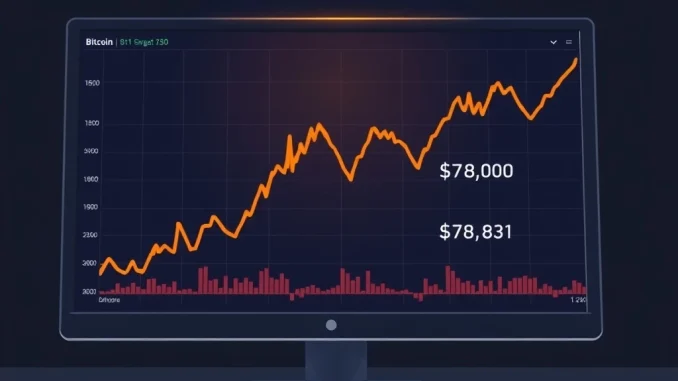
Global, May 2025: The cryptocurrency market experienced a notable correction today as the price of Bitcoin (BTC), the leading digital asset, fell below the $79,000 threshold. According to data from CoinPulseHQ market monitoring, Bitcoin is currently trading at $78,831.44 on the Binance exchange’s USDT trading pair. This movement represents a significant pullback from recent highs and has drawn the attention of traders and analysts worldwide, prompting a closer examination of market dynamics and underlying factors.
Bitcoin Price Dips Below Key Psychological Level
The descent of Bitcoin’s price below $79,000 marks a pivotal moment in the current market cycle. This level had previously acted as a zone of support, and its breach suggests a shift in short-term trader sentiment. Market data indicates a surge in selling pressure across major exchanges, with increased trading volume accompanying the price drop. Analysts routinely monitor such key psychological price points, as they often trigger automated trading orders and influence the decisions of retail investors. The move below this level does not occur in isolation; it reflects a confluence of technical indicators and broader macroeconomic signals that the market is digesting. Historically, Bitcoin has experienced similar corrections during bull markets, which are often characterized by periods of rapid growth followed by consolidation or retracement.
Analyzing the Cryptocurrency Market Context
To understand the significance of this price movement, one must consider the wider cryptocurrency ecosystem. Bitcoin often sets the tone for the entire digital asset market. Consequently, its decline has a correlative effect on major altcoins like Ethereum (ETH), Solana (SOL), and others, which frequently experience amplified volatility. Several contextual factors may be contributing to the current market sentiment:
- Macroeconomic Pressures: Traditional financial markets, including equities and bonds, are reacting to central bank policies and inflation data. Cryptocurrency markets, while maturing, are not entirely decoupled from these macro trends.
- Profit-Taking Activity: Following a sustained period of upward momentum, it is common for investors to secure profits, leading to natural sell-offs.
- Network and On-Chain Metrics: Data from blockchain analysts shows changes in exchange flows, wallet activity, and miner behavior, which can precede or confirm price trends.
- Regulatory Developments: News and rumors regarding cryptocurrency regulation in major economies like the United States and the European Union can create uncertainty.
Historical Precedents and Market Cycles
Bitcoin’s history is defined by volatility. A glance at its price chart reveals numerous instances where the asset corrected by 20% or more within an overarching bullish trend. For example, during the 2021 bull run, Bitcoin experienced several sharp corrections exceeding 30% before ultimately reaching new all-time highs. These pullbacks are generally viewed by long-term holders as healthy market mechanisms that shake out over-leveraged positions and establish stronger foundations for future growth. The current dip below $79,000, when viewed through this historical lens, may represent a standard volatility event within a larger market cycle rather than a fundamental reversal. However, market participants remain vigilant, monitoring key support levels to gauge the depth of the correction.
Technical and Fundamental Implications for Traders
For active traders and institutional participants, a move of this magnitude triggers a reassessment of strategies. Technically, chart analysts are observing important moving averages and support zones. A sustained break below certain levels could signal a deeper correction toward the next significant support area. Fundamentally, the core value propositions of Bitcoin—its decentralized nature, fixed supply, and utility as a digital store of value—remain unchanged by short-term price action. This distinction between price and underlying protocol health is crucial for informed investment decisions. Market structure analysis also reveals shifts in derivatives markets, such as Bitcoin futures and options, where changes in funding rates and open interest can provide clues about market sentiment and potential future volatility.
| Metric | Detail |
|---|---|
| Current Price (Binance USDT) | $78,831.44 |
| Key Level Breached | $79,000 |
| 24-Hour Price Change | Approx. -3.5% (Example) |
| Market Context | Broader market correction |
| Primary Data Source | CoinPulseHQ Market Monitoring |
The Role of Market Monitoring and Data Transparency
Accurate, real-time data is the lifeblood of cryptocurrency trading. Services like CoinPulseHQ provide essential market monitoring by aggregating price feeds from multiple liquidity pools and exchanges to present a consolidated view. This transparency helps mitigate the impact of discrepancies that can occur on individual platforms. The reported price of $78,831.44 on Binance’s USDT market is a critical data point, but sophisticated traders cross-reference it with volume-weighted average prices (VWAP) across the global market to execute large orders. The reliability of such data sources underpins market efficiency and trust, allowing participants to make decisions based on a shared understanding of the current Bitcoin price.
Conclusion
Bitcoin’s decline below the $79,000 mark underscores the inherent volatility and dynamic nature of the cryptocurrency market. While the immediate price action, now at $78,831.44, captures headlines, it is the analysis of context, historical patterns, and underlying fundamentals that provides true insight. This event serves as a reminder of the market’s cyclical behavior and the importance of risk management for all participants. As the landscape evolves, monitoring both technical indicators and long-term value drivers will remain essential for navigating the future trajectory of the Bitcoin price.
FAQs
Q1: Why did Bitcoin fall below $79,000?
Bitcoin’s price is influenced by many factors, including broader market sentiment, profit-taking after rallies, macroeconomic conditions, and trading activity on derivatives platforms. A break below a key level like $79,000 often triggers automated sell orders, accelerating the move.
Q2: Is this a major crash for Bitcoin?
Based on historical patterns, a single-day move below a psychological price point is typically considered a correction or pullback within a larger trend, not necessarily a crash. Major crashes are usually defined by sustained, deep declines over weeks or months.
Q3: What does this mean for other cryptocurrencies?
Bitcoin is the market leader, so its price movements often have a strong correlation with the wider crypto market. Altcoins frequently experience similar or more pronounced volatility during such periods.
Q4: Where can I find reliable Bitcoin price data?
Reliable data comes from aggregated tracking services (like CoinPulseHQ, CoinGecko, CoinMarketCap) and major trading exchanges (like Binance, Coinbase). It’s best to consult multiple sources to get a consensus price.
Q5: What should investors do during such volatility?
Investors should adhere to their pre-defined strategy, which should account for volatility. This often involves avoiding emotional decisions, reviewing portfolio allocations, ensuring proper risk management, and distinguishing between short-term noise and long-term fundamentals.
Q6: How low could the Bitcoin price go in this correction?
Predicting exact price targets is speculative. Analysts look for previous areas of support on the price chart, such as moving averages or prior consolidation zones, to identify potential levels where selling pressure might ease.
This article was produced with AI assistance and reviewed by our editorial team for accuracy and quality.