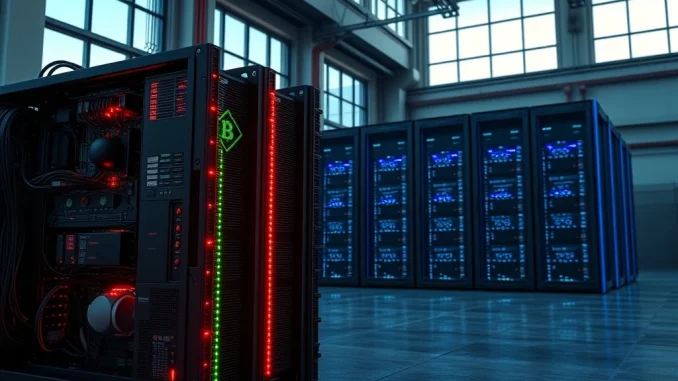
In a significant strategic shift reshaping the cryptocurrency landscape, major Bitcoin mining corporations are accelerating the sale of their BTC reserves. This move, observed throughout late 2025 and early 2026, directly funds a rapid industry pivot toward constructing artificial intelligence (AI) data centers and high-performance computing (HPC) projects. The trend, confirmed by financial disclosures and on-chain analytics, stems from compressed mining profitability following Bitcoin’s steep price decline since its October 2025 peak. Consequently, firms like Marathon Digital, Riot Platforms, and Core Scientific are now directing capital away from pure-play mining expansion. Instead, they are investing heavily in the infrastructure demanded by the generative AI boom. This recalibration represents one of the most substantial capital reallocations in the sector’s history, with profound implications for Bitcoin’s market dynamics and the future of digital infrastructure.
Bitcoin Miners Accelerate BTC Sales as Margins Shrink
Publicly traded mining companies have significantly increased their BTC treasury liquidations over recent months. For instance, Marathon Digital’s February 2026 operational update revealed it sold approximately 60% of its monthly Bitcoin production in January, up from a historical average of around 30%. Similarly, Riot Platforms reported redirecting a substantial portion of its Q4 2025 proceeds toward its new 400-megawatt HPC facility in Texas. The primary catalyst is economic. Following the 2024 halving event, which cut block rewards in half, and a subsequent 40% decline in Bitcoin’s price from its October 2025 high, the industry’s average profit margin per mined coin has fallen below 30% for many operators. This squeeze makes the stable, contract-based revenue models of AI cloud services and HPC colocation increasingly attractive. Analysts at JPMorgan noted in a recent report that the capital expenditure required for next-generation mining hardware now rivals that for AI-optimized servers, forcing a clear ROI comparison.
This is not a sudden reaction but the culmination of a multi-year trend. Mining companies began diversifying their business models as early as 2022, exploring opportunities in energy curtailment services and compute hosting. However, the explosive demand for AI training compute, coupled with Bitcoin’s price volatility, has accelerated these plans from exploratory to central. The timeline is critical. Company earnings calls throughout 2025 consistently highlighted “strategic reviews” and “portfolio optimization.” Now, in Q1 2026, those reviews have turned into concrete action, marked by increased BTC sales and ground-breaking on new data center builds.
The AI Data Center Gold Rush: Impact on Crypto and Compute
The pivot’s impact is twofold, affecting both the cryptocurrency market and the broader digital infrastructure sector. Firstly, the accelerated selling of BTC reserves adds consistent sell-side pressure to the market. While individual sales are often planned and disclosed to avoid market disruption, the aggregate volume from multiple large players can dampen price recovery. Secondly, it redirects gigawatts of power and billions in capital away from proof-of-work consensus. This could alleviate political and environmental scrutiny on the Bitcoin network in certain regions. Conversely, the move floods the specialized data center market with new, large-scale entrants possessing deep expertise in managing high-density, high-power compute environments.
- Market Liquidity and Price Pressure: The structured selling of thousands of BTC monthly provides liquidity but also establishes a near-term ceiling on price rallies, as markets anticipate continued treasury drawdowns.
- Infrastructure Competition: Miners are now competing directly with traditional data center REITs and hyperscalers like Amazon and Microsoft for power contracts, chip allocations (GPUs, NPUs), and skilled personnel.
- Geographic Shift: Mining operations, often located near cheap, intermittent power, must now secure stable, high-capacity grid connections suitable for 24/7 AI workloads, potentially shifting the geographic center of the industry.
Expert Analysis on the Strategic Recalibration
Industry leaders and financial analysts are framing this not as an abandonment of Bitcoin, but as a necessary diversification. “This is a classic case of capital seeking its highest and best use,” stated Lucas Pipes, a senior equity analyst at T.D. Cowen covering infrastructure and energy. “The risk-adjusted returns for providing AI compute under long-term contracts currently appear more predictable than speculative Bitcoin mining rewards. Miners are leveraging their core competency—building and operating massive compute farms—and applying it to the hottest market in tech.” This sentiment is echoed in corporate communications. Fred Thiel, CEO of Marathon Digital, stated in a recent investor presentation, “Our strategy is to be a leader in the digital asset compute space, which includes both Bitcoin mining and high-value compute hosting. We are allocating capital to the segments that promise the strongest, most durable returns for our shareholders.” For authoritative context, the Cambridge Bitcoin Electricity Consumption Index (CBECI) team has begun tracking the compute-power migration, noting early data suggests a measurable percentage of exahash is being physically repurposed or relocated for alternative compute tasks.
Historical Context and Industry Benchmark Comparison
This strategic shift finds precedent in other tech-adjacent industries, such as semiconductor fabrication or renewable energy development, where firms pivot based on subsidy landscapes and demand cycles. However, the speed and scale within Bitcoin mining are unprecedented. The table below contrasts key operational metrics between traditional Bitcoin mining and the emerging AI/HPC hosting model pursued by these firms.
| Operational Metric | Traditional Bitcoin Mining | AI/HPC Data Center Hosting |
|---|---|---|
| Revenue Model | Volatile; tied to BTC price & block rewards | Predictable; multi-year fixed-price contracts |
| Capital Intensity | High (ASIC miners, infrastructure) | Very High (GPU/NPU servers, advanced cooling) |
| Power Profile | Often interruptible/flexible load | Must be 99.99%+ reliable & stable |
| Hardware Lifecycle | 3-4 years before obsolescence | 2-3 years, with rapid generational turnover |
| Primary Competitors | Other mining pools & companies | Equinix, Digital Realty, hyperscaler clouds |
What Happens Next: The Roadmap for 2026 and Beyond
The forward path is marked by several key milestones. Firstly, market observers will monitor the depletion rates of corporate BTC treasuries. A sustained high sell-rate could signal a longer-term commitment to the pivot. Secondly, the success of initial AI data center projects, measured by contracted capacity and revenue generation, will determine if other miners follow suit en masse. Thirdly, the Bitcoin network’s hash rate and mining difficulty will be critical indicators. A significant migration of hashing power away from the network could lower difficulty, potentially improving margins for remaining miners and altering network security dynamics. Finally, regulatory clarity around digital asset classification and AI infrastructure incentives in regions like the U.S. and the EU will heavily influence capital allocation decisions. Companies have already announced over 1.5 gigawatts of new AI-focused capacity to come online between 2026 and 2027, representing billions in committed investment.
Stakeholder Reactions and Market Sentiment
Reactions within the cryptocurrency community are mixed. Some Bitcoin maximalists view the pivot as a betrayal of the network’s decentralized ethos, fearing consolidation among remaining miners. Others see it as a healthy maturation, where inefficient operators exit, strengthening the network’s economic resilience. Investors have responded cautiously but positively to the diversification narrative, with mining stocks often outperforming Bitcoin itself during recent market downturns, as they are now priced partly as infrastructure plays. Energy providers and local governments, previously wary of mining’s energy use, are more welcoming of AI data centers due to their promise of high-skilled jobs and more stable, grid-supportive load profiles.
Conclusion
The acceleration of BTC sales by major miners marks a definitive inflection point for the industry. It is a calculated response to economic pressure and a strategic bet on the enduring demand for high-performance compute. This pivot from Bitcoin mining to AI data centers will likely continue reshaping the sector’s landscape throughout 2026, influencing Bitcoin’s market structure, redirecting infrastructure investment, and blurring the lines between crypto and traditional tech. The most significant takeaway is the industry’s demonstrated agility. By leveraging their core expertise in large-scale compute management, these firms are not merely exiting a challenging market but are proactively entering a transformative one. Observers should watch corporate treasury reports, network difficulty adjustments, and the pace of new AI facility announcements to gauge the depth and permanence of this historic shift.
Frequently Asked Questions
Q1: Why are Bitcoin miners selling their BTC now?
Miners are accelerating BTC sales primarily to fund capital expenditures for new AI data center facilities. This is driven by shrinking profit margins in Bitcoin mining due to lower coin prices and higher operational costs, making the predictable revenue from AI compute hosting more attractive.
Q2: How will this increased selling pressure affect Bitcoin’s price?
While providing market liquidity, consistent, large-volume sales from corporate treasuries can create a headwind for price appreciation in the near term. Markets must absorb this steady supply, potentially capping rallies until the selling pace slows or new, offsetting demand emerges.
Q3: Does this mean Bitcoin mining is no longer profitable?
Not universally. Mining remains profitable for operators with extremely low energy costs and efficient hardware. However, average industry margins have compressed significantly, pushing larger, publicly-traded firms—who answer to shareholders—to seek more stable and potentially higher returns elsewhere.
Q4: What is an AI data center, and how is it different from a mining farm?
An AI data center houses thousands of graphics processing units (GPUs) or neural processing units (NPUs) optimized for machine learning tasks. Unlike Bitcoin mining ASICs that perform a single function, these servers are flexible and run various AI workloads. They also require more stable power and advanced cooling, like liquid immersion, but generate revenue through service contracts rather than block rewards.
Q5: Is this shift good or bad for the long-term health of the Bitcoin network?
Analysts are divided. It could lead to greater centralization if only a few miners remain, potentially impacting decentralization. Conversely, it may strengthen the network by leaving only the most efficient and committed miners, improving its overall economic and environmental profile.
Q6: How does this affect individual cryptocurrency investors or miners?
For investors, it changes the valuation model of mining stocks, tying them more to tech infrastructure. For small-scale individual miners, the exit of large players could lower the network’s mining difficulty, potentially increasing their share of rewards if they continue operating.
Updated insights and analysis added for better clarity.
This article was produced with AI assistance and reviewed by our editorial team for accuracy and quality.