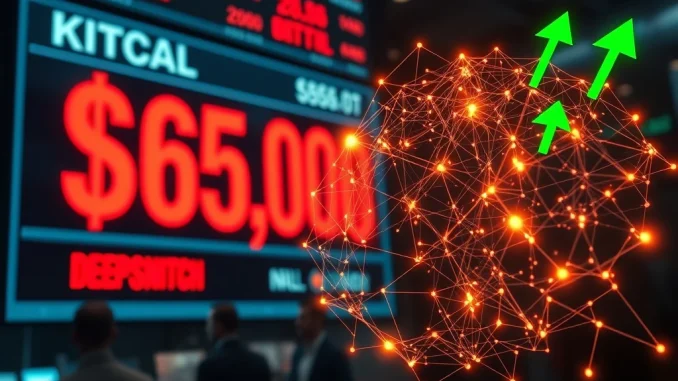
Global Cryptocurrency Markets, May 2025: The cryptocurrency market experienced a severe correction this week, with Bitcoin’s price plunging to approximately $65,000. This decline effectively erased gains accumulated over the previous 15 months, marking one of the most significant pullbacks since the 2022 bear market. Concurrently, the widely monitored Crypto Fear & Greed Index plummeted to 11%, signaling extreme fear among investors. Amid this broad downturn, certain assets, including the AI-driven analytics platform DeepSnitch and privacy-focused cryptocurrencies Zcash (ZEC) and Monero (XMR), demonstrated notable resilience, presenting a complex picture of the current market landscape.
Anatomy of the Bitcoin Crash: A 15-Month Gain Erased
Bitcoin’s descent to the $65,000 level represents a decline of over 20% from its recent cycle highs. Market analysts point to a confluence of factors driving this correction. On-chain data reveals significant profit-taking by long-term holders, often a precursor to increased volatility. Furthermore, macroeconomic headwinds, including shifting expectations around central bank interest rate policies and strengthening traditional equity markets, have diverted institutional capital. The sell-off triggered a cascade of liquidations in the derivatives market, exacerbating the downward pressure. This rapid deleveraging event highlights the interconnected and often fragile nature of modern crypto markets, where leveraged positions can amplify both gains and losses.
The Crypto Fear & Greed Index at 11%: What Extreme Fear Signals
The Crypto Fear & Greed Index is a composite metric that analyzes market sentiment using data sources like volatility, market momentum, social media sentiment, and surveys. A reading of 11% falls squarely into the “Extreme Fear” zone. Historically, such levels of pervasive pessimism have often coincided with local market bottoms, though they are not a guaranteed timing indicator. The current reading suggests a majority of market participants are reacting emotionally to recent price action. Analysts caution that while extreme fear can present contrarian buying opportunities, it also reflects real underlying stress, including potential regulatory uncertainties and concerns about market liquidity depth. The index serves as a barometer of crowd psychology rather than a direct price predictor.
Historical Context of Major Market Corrections
To understand the current environment, it is instructive to review previous cycles. The 2021-2022 bear market saw Bitcoin decline over 75% from its all-time high, with the Fear & Greed Index repeatedly touching single digits. The 2018 downturn followed a similar pattern. Corrections of 20-30% within a broader bull trend are not uncommon; they often serve to shake out speculative excess and establish stronger support levels for the next leg up. The key differentiator in the current 2025 correction is the maturation of the market’s infrastructure, including more robust institutional custody solutions and the integration of spot Bitcoin ETFs, which may alter the traditional recovery dynamics.
Resilient Performers: DeepSnitch AI, Zcash, and Monero in Focus
While the market bled red, several projects exhibited divergent performance. DeepSnitch AI, a platform specializing in real-time blockchain analytics and anomaly detection, reported significant user growth and platform engagement. Its native utility token’s reported gains appear linked to increased demand for its surveillance-resistant transaction monitoring tools during periods of high market stress, as traders and institutions seek advanced on-chain intelligence. Meanwhile, privacy coins Zcash and Monero often demonstrate low correlation with Bitcoin during sharp downturns. Their value proposition centers on transactional privacy, a feature that attracts capital during times of macroeconomic uncertainty or increased regulatory scrutiny on transparent blockchains. Their relative strength suggests a rotation into specific crypto niches perceived as hedges against broader market risks.
- DeepSnitch AI: Provides AI-powered analytics for detecting smart contract vulnerabilities and market manipulation patterns. Its utility may see increased demand in volatile, high-risk environments.
- Zcash (ZEC): Offers selective transparency with its shielded transactions. Its development is supported by a major, well-funded foundation, providing perceived stability.
- Monero (XMR): Provides mandatory privacy for all transactions. It maintains a strong, decentralized community and has demonstrated resilience across multiple market cycles.
The Role of AI and On-Chain Analytics in Modern Trading
The interest in platforms like DeepSnitch AI underscores a broader trend: the increasing sophistication of cryptocurrency analysis. In an era of information overload, AI tools that can parse vast amounts of blockchain data, identify whale wallet movements, or detect unusual exchange flows provide a competitive edge. This technological arms race is changing how both retail and institutional participants navigate the markets, moving beyond simple chart analysis to a more data-centric approach. The performance of such platforms is increasingly tied to their proven utility during crisis events, not just bullish speculation.
Market Implications and the Path Forward
The immediate consequence of this crash is a repricing of risk across the entire digital asset spectrum. Venture capital funding for early-stage projects may tighten, and projects without clear utility or sustainable tokenomics could face existential challenges. For Bitcoin, the $65,000 level is now a critical technical and psychological battleground. A sustained hold above it could suggest the bull market structure remains intact, while a breakdown could signal a deeper, more prolonged correction. The extreme fear reading suggests the market is in a capitulation phase, which often, but not always, precedes a stabilization period. Recovery will likely depend on broader financial conditions, regulatory clarity, and the continued evolution of real-world blockchain adoption.
Conclusion
The recent crypto crash that saw Bitcoin fall to $65,000 and the Fear & Greed Index hit 11% represents a significant stress test for the digital asset ecosystem. It has erased 15 months of gains, forcing a market-wide reassessment of valuations. However, the divergent performance of assets like DeepSnitch AI, Zcash, and Monero illustrates the growing complexity and segmentation within the sector. Markets are not monolithic; different value propositions resonate under different conditions. This event underscores the volatile, maturing, and increasingly nuanced nature of cryptocurrency investing, where understanding underlying technology and use cases becomes as important as tracking price charts.
FAQs
Q1: What does a Crypto Fear & Greed Index reading of 11% mean?
A1: A reading of 11% indicates “Extreme Fear” among market participants. It is a sentiment indicator based on volatility, momentum, social media, and surveys. Historically, such extreme readings have sometimes marked periods of potential opportunity, but they primarily reflect high levels of panic and negative sentiment.
Q2: Why did privacy coins like Monero and Zcash show resilience during the crash?
A2: Privacy coins often have lower correlation with Bitcoin’s price movements. Their core value proposition—transactional privacy—can attract capital during times of macroeconomic uncertainty or when investors seek assets perceived as outside traditional financial surveillance, leading to divergent performance.
Q3: Is a 20%+ drop in Bitcoin considered normal?
A3: Yes, historically. Even within strong bull markets, Bitcoin has frequently experienced corrections of 20-30% or more. These pullbacks are volatile but common events that help shake out excess leverage and can establish new support levels before potential continued upward trends.
Q4: What is DeepSnitch AI, and why is it relevant in this context?
A4: DeepSnitch AI is a platform that uses artificial intelligence to analyze blockchain data for risks, anomalies, and opportunities. Its reported resilience during the crash may stem from increased demand for sophisticated on-chain analytics tools as traders and institutions seek deeper insights during high-volatility periods.
Q5: Does the crash to $65K mean the Bitcoin bull market is over?
A5: Not necessarily. While significant, a single correction does not define a full market cycle. Bull markets are often punctuated by severe corrections. The long-term trend will be determined by broader adoption, institutional inflows, regulatory developments, and macroeconomic factors, not by a single price move.
Updated insights and analysis added for better clarity.
This article was produced with AI assistance and reviewed by our editorial team for accuracy and quality.