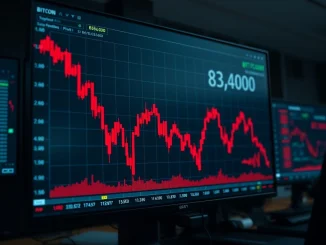
NEW YORK, March 10, 2026 — Global markets face unprecedented volatility as a historic 55% surge in oil prices to $101 per barrel triggers urgent questions about Bitcoin’s near-term trajectory. The dramatic ten-day oil rally, sparked by escalating Middle East tensions, has analysts scrutinizing historical patterns where similar energy shocks preceded 20% gains for the flagship cryptocurrency. With Bitcoin currently trading near $66,000, the critical question dominating trading desks is whether this correlation will propel its price to $79,200 before March concludes. This analysis examines the complex interplay between geopolitical risk, inflationary pressures, and Bitcoin’s evolving market role.
Historic Oil Spike Presents a Critical Test for Bitcoin
The price of West Texas Intermediate (WTI) crude oil surged to $101 on Sunday, marking the largest ten-day percentage gain in recorded history. This shock followed direct military actions between Israel and Iran, creating immediate global economic uncertainty. Consequently, the S&P 500 index fell to its lowest point in ten weeks. Bitcoin initially reacted positively, jumping 16% between February 28 and last Wednesday. However, it completely erased those gains by Sunday, highlighting the market’s fragile sentiment. Traders now confront a volatile landscape where historical precedents offer guidance but no guarantees.
Market analyst Marcel Pechman of Cointelegraph notes the pattern’s significance. “Historical data from four major oil spikes between 2020 and 2025 shows Bitcoin gained an average of 20% over the following four weeks,” Pechman states. “However, each event began with extreme short-term volatility, mirroring what we see now.” The initial reaction often involves a risk-off sentiment that pressures all speculative assets, including cryptocurrencies, before potential decoupling.
Decoding the Oil-Bitcoin Correlation: Data Versus Current Realities
Examining past instances reveals a nuanced, delayed relationship. In June 2025, a 15% weekly oil surge initially pushed Bitcoin down 8%, only for it to rally 10% over the next month. Similarly, the March 2023 oil jump preceded a 12% Bitcoin gain that proved temporary. The most telling case occurred after Russia’s 2022 invasion of Ukraine. A 29% weekly oil rally saw Bitcoin spike 17% in two days, give back all gains within a week, then surge 25% over the subsequent three weeks. This pattern suggests a complex digestion period for geopolitical shocks.
- Delayed Reaction: Gains typically materialize over a four-week horizon, not immediately.
- Initial Volatility: Sharp price reversals are common in the first week post-shock.
- Inflation Hedge Narrative: Persistently high oil prices reignite Bitcoin’s appeal as an inflation hedge, but with a lag.
However, the current market structure differs critically. Bitcoin now exhibits an 81% 30-day correlation with the Nasdaq 100 index, its highest linkage to tech stocks in over a year. This tight coupling means Bitcoin’s fate is currently tied more to the performance of mega-cap tech equities than to commodity markets. If the tech sector remains suppressed by fears of prolonged inflation and weaker consumer spending, Bitcoin may struggle to decouple and follow the historical oil-correlation playbook.
Expert Analysis on Market Mechanics
Ray Salmond, Cointelegraph’s Markets Editor, emphasizes the shifting dynamics. “The 2020-2022 correlation data emerged from a different macro regime with near-zero interest rates,” Salmond explains. “Today, with the U.S. job market showing weakness and the Federal Reserve’s policy path uncertain, Bitcoin is trading more like a high-beta tech stock. The oil signal is still there, but it’s filtered through a much stronger risk-asset channel.” This perspective is echoed by data from analytics firm Glassnode, which shows institutional flows into Bitcoin ETFs remain sensitive to broader equity market sentiment, not just commodity moves.
Geopolitical Timeline and Its Direct Market Impact
The potential for a Bitcoin rally hinges directly on the duration and scale of Middle East hostilities. A rapid de-escalation could see oil prices retreat, relieving inflationary fears and allowing risk assets like tech stocks and Bitcoin to recover. Conversely, a protracted conflict would sustain energy price pressures, potentially forcing central banks to maintain restrictive policies, thereby hurting growth stocks. The following table compares key historical oil spike events with Bitcoin’s subsequent performance, illustrating the variable outcomes.
| Date & Event | WTI Oil Surge | Bitcoin Initial Reaction (1 Week) | Bitcoin 4-Week Outcome |
|---|---|---|---|
| Nov 2020 (Vaccine Hope) | +23% in 9 days | +16% | +45% from $13,500 |
| Feb 2022 (Ukraine Invasion) | +29% in 1 week | +17%, then erased | +25% to $48,000 |
| Mar 2023 (OPEC Cut) | +16% in 8 days | +12% | Returned to $28,000 |
| Jun 2025 (Iran Tensions) | +15% in 1 week | -8%, then recovered | +10% overall |
Forward Outlook: The Path to $79,200 by Month’s End
For Bitcoin to achieve the $79,200 target—a 20% gain from its $66,000 level when the oil rally accelerated—two conditions likely need to align. First, the oil price shock must sustain enough inflationary pressure to bolster Bitcoin’s store-of-value narrative among institutional investors, without crashing the broader equity market. Second, the correlation with the Nasdaq must weaken slightly, allowing Bitcoin to outperform its tech stock peers as it did in past cycles. Monitoring flows into U.S. spot Bitcoin ETFs will provide real-time evidence of this decoupling.
Trader Sentiment and Positioning Data
Derivatives data from major exchanges shows a cautious but opportunistic stance. While short-term futures premiums have normalized, options markets indicate traders are actively hedging against both sharp upside and downside moves over the next three weeks. This reflects the high uncertainty. “The market is pricing in a wider range of outcomes than usual,” says a derivatives trader at a leading exchange who requested anonymity. “There’s recognition of the historical pattern, but also respect for the current macro headwinds. The consensus is that any rally will be choppy, not linear.”
Conclusion
The historic oil price surge presents a classic test of Bitcoin’s evolving identity. Historical data undeniably shows a pattern of Bitcoin strength following major oil spikes, with an average 20% gain materializing over a month. However, the cryptocurrency’s current strong coupling with technology stocks introduces a significant complicating factor. The path to $79,200 by March’s end depends less on a simple repetition of history and more on whether geopolitical tensions foster a flight to alternative assets without severely damaging risk appetite. Investors should watch for early signs of Bitcoin decoupling from the Nasdaq, along with sustained institutional inflows, as the clearest signals that the historical oil-correlation rally is underway.
Frequently Asked Questions
Q1: How strong is the historical correlation between oil prices and Bitcoin?
Analysis of four major oil spikes (15%+ in 10 days) between 2020-2025 shows Bitcoin gained an average of 20% in the subsequent four weeks. However, the correlation is not immediate or perfectly reliable, with initial reactions often being volatile and negative.
Q2: Why is the current situation different for Bitcoin’s price reaction?
Bitcoin currently has an 81% correlation with the Nasdaq 100, its highest linkage to tech stocks in over a year. This means its price is more influenced by tech equity performance than by commodity moves, potentially dampening the direct impact of the oil surge.
Q3: What specific price target are analysts watching for Bitcoin by March end?
The $79,200 level represents a 20% gain from Bitcoin’s approximate $66,000 price on February 28, when the recent oil rally accelerated. This matches the average historical gain following similar oil price spikes.
Q4: What are the main risks that could prevent a Bitcoin rally?
Key risks include a prolonged Middle East conflict triggering a broad risk-off sell-off in all markets, sustained high oil prices forcing aggressive central bank policy that hurts growth assets, and Bitcoin’s continued high correlation with underperforming tech stocks.
Q5: How does high oil price inflation typically affect Bitcoin?
Persistently high oil prices can drive broader inflation, which historically strengthens the narrative of Bitcoin as a scarce, non-sovereign store of value. However, this effect often materializes after initial market panic subsides.
Q6: What should traders monitor to gauge if the rally is starting?
Traders should watch for a decrease in Bitcoin’s correlation with the Nasdaq 100, sustained positive flows into U.S. spot Bitcoin ETFs despite equity market weakness, and Bitcoin price holding key support levels (around $64,000) during initial volatility.