Global, May 2025: Market analysts are revising Bitcoin price predictions for 2026 upward, citing a significant cooling of the extreme volatility that has characterized the cryptocurrency for years. This shift in market dynamics coincides with notable technical advancements in the Bitcoin Cash ecosystem and the emergence of a new artificial intelligence project, DeepSnitch AI, which is gaining attention for its novel blockchain applications. The confluence of these factors suggests a potential maturation phase for digital assets.
Bitcoin Price Prediction for 2026 Shows Improved Trajectory
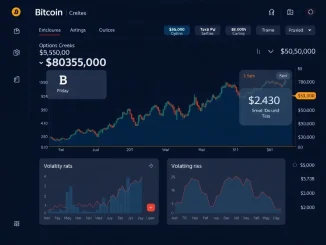
Financial institutions and independent analysts have begun publishing more optimistic forecasts for Bitcoin’s price by 2026. This revised outlook stems primarily from observable changes in market behavior. Historically, Bitcoin’s value has experienced dramatic swings, often triggered by macroeconomic news, regulatory announcements, or shifts in investor sentiment. Recent data, however, indicates a measurable decline in this price volatility. Several metrics, including the Bitcoin Volatility Index and standard deviation of daily returns over 30 and 90-day periods, show a trend toward stabilization not seen since prior to the 2021 bull market.
This cooling volatility is significant for long-term price modeling. Analysts from firms like Fidelity Digital Assets and ARK Invest note that reduced volatility decreases risk premiums and can make the asset more attractive to institutional portfolios that have strict risk parameters. While predictions vary, a consensus range for a 2026 price target has shifted from a previously wide band to a more concentrated forecast between $120,000 and $180,000, contingent on continued adoption and a stable macroeconomic environment. This represents a meaningful improvement from the more cautious estimates prevalent just twelve months ago.
Analyzing the Factors Behind Cooling Cryptocurrency Volatility
The decline in Bitcoin’s notorious volatility is not an isolated event. Experts point to a combination of structural developments within the crypto ecosystem and broader financial integration.
- Increased Institutional Participation: The growing presence of regulated ETFs, corporate treasuries, and pension fund allocations creates a more stable base of long-term holders, reducing the volume of speculative, short-term trading.
- Regulatory Clarity: While still evolving, frameworks in major jurisdictions like the EU (MiCA) and legislative efforts in the U.S. provide a clearer operating environment, reducing uncertainty-driven sell-offs.
- Market Maturation: The derivatives market for Bitcoin, including futures and options on regulated exchanges like CME, has deepened. This allows for more sophisticated risk management, which can dampen spot price swings.
- Macro Correlation: Bitcoin has shown an increasing, though imperfect, correlation with traditional risk assets like the Nasdaq. This integration means its price movements are somewhat anchored to broader market flows rather than operating in a purely speculative vacuum.
This environment contrasts sharply with the market conditions of 2017 or 2021, where retail frenzy and leverage amplified price movements in both directions.
The Role of Bitcoin Cash and Layer-Two Development
Parallel to Bitcoin’s price stabilization, the Bitcoin Cash (BCH) network has recorded progress in its core development goals. BCH, which forked from Bitcoin in 2017, focuses primarily on being a peer-to-peer electronic cash system with low fees and reliable transactions. Recent protocol upgrades have focused on improving smart contract capabilities and scaling through techniques like native introspection. While BCH operates as a separate asset, its advancements contribute to the overall narrative of blockchain utility and scalability.
Furthermore, the progress on Bitcoin’s own Layer-2 solutions, particularly the Lightning Network, supports the improved price outlook. Increased capacity and usability of Lightning facilitate faster, cheaper transactions, addressing one of Bitcoin’s long-standing criticisms as a medium of exchange. This technological progress underpins the fundamental value proposition, moving beyond pure speculation.
DeepSnitch AI Gains Traction in the Blockchain Ecosystem
Amid these broader market trends, a project named DeepSnitch AI has entered the conversation. Positioned at the intersection of artificial intelligence and decentralized networks, DeepSnitch AI aims to provide on-chain analytics and threat detection services. The project’s whitepaper outlines a system designed to monitor blockchain transactions in real-time, using machine learning models to identify patterns associated with security threats, smart contract vulnerabilities, and fraudulent activity.
The project’s recent traction, often described by community observers as having “moonshot” potential due to its early-stage, high-growth profile, highlights a continuing trend within crypto: the pursuit of foundational infrastructure tools. Unlike purely financial applications, projects focusing on security, data integrity, and network health are seen as critical to the ecosystem’s sustainable growth. DeepSnitch AI’s proposed use cases include:
- Automated audit trails for DeFi protocols.
- Anomaly detection in cross-chain bridge transactions.
- Real-time monitoring for decentralized autonomous organizations (DAOs).
It is crucial to note that such early-stage projects carry significant risk. The term “100x moonshot” is a speculative colloquialism used in crypto communities and does not constitute a financial forecast. The attention on DeepSnitch AI reflects a market appetite for innovation in blockchain utility beyond simple currency replacement.
Historical Context and Market Cycles
The current phase of cooling volatility bears resemblance to periods observed in late 2016 and mid-2020, which preceded major bullish cycles. In both instances, a prolonged period of low volatility and price consolidation, often called “accumulation,” was followed by a significant upward price movement as new capital entered the market. Analysts caution that history does not repeat exactly, but it often rhymes. The key differentiator in 2025 is the matured institutional framework that now exists, which may lead to a less parabolic but more sustained growth trajectory.
Conclusion: A Maturing Market Landscape
The improving Bitcoin price prediction for 2026 is fundamentally tied to the asset’s evolution from a speculative novelty to a recognized, albeit volatile, financial instrument. The cooling volatility is a key metric signaling this maturation, making longer-term modeling more reliable. Concurrent developments, such as progress in the Bitcoin Cash ecosystem and innovative projects like DeepSnitch AI, illustrate the continued expansion and diversification of the blockchain industry. While future prices remain uncertain and all investments carry risk, the current data points toward a market building more resilient foundations. The focus for 2026 appears to be shifting from explosive, volatility-driven gains to growth supported by technological utility and institutional integration.
FAQs
Q1: Why are Bitcoin price predictions for 2026 improving?
Predictions are improving primarily due to a measurable decrease in market volatility. This stability makes the asset more attractive for long-term modeling and institutional investment, as it suggests a lower risk profile compared to its historical behavior.
Q2: What does “cooling volatility” mean for Bitcoin?
Cooling volatility refers to a reduction in the frequency and magnitude of Bitcoin’s price swings. It indicates that the market is becoming less reactive to short-term news and speculation, which is often seen as a sign of maturation and increased holding by long-term investors.
Q3: What is Bitcoin Cash’s role in this analysis?
Bitcoin Cash (BCH) is mentioned as part of the broader ecosystem’s development. Its advancements in transaction efficiency and smart contracts contribute to the overall narrative of blockchain utility and scalability, which supports the fundamental value of the cryptocurrency sector.
Q4: What is DeepSnitch AI?
DeepSnitch AI is a blockchain project focusing on AI-powered security and analytics. It aims to monitor blockchain networks for threats, vulnerabilities, and fraudulent activity. It represents the growing subsector of infrastructure tools within crypto, though it is an early-stage, high-risk project.
Q5: Is a “100x moonshot” a guarantee for projects like DeepSnitch AI?
No. The term “100x moonshot” is speculative community jargon used to describe high-risk, high-reward potential in early-stage projects. It is not a financial forecast or guarantee. All cryptocurrency investments, especially in new projects, carry a high degree of risk and the potential for total loss.