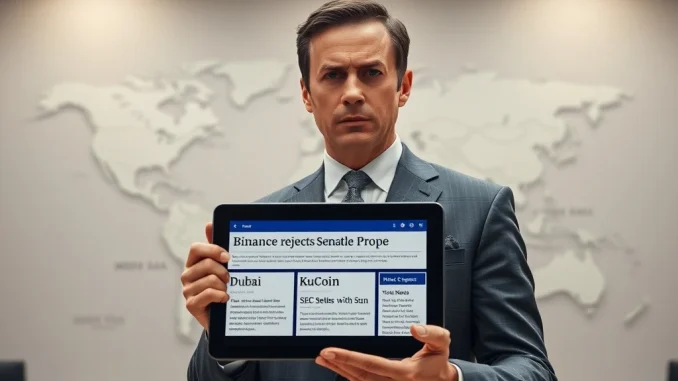
In a significant day for global cryptocurrency regulation on Thursday, March 20, 2026, three major enforcement actions unfolded across the United States and the Middle East. Cryptocurrency exchange Binance formally rejected a U.S. Senate inquiry into alleged Iran-linked transactions, Dubai’s regulator ordered entities behind KuCoin to cease all unlicensed operations in the emirate, and the U.S. Securities and Exchange Commission (SEC) concluded its lawsuit against entrepreneur Justin Sun with a $10 million settlement. These simultaneous developments signal intensifying regulatory scrutiny on multiple fronts, impacting exchange operations, licensing frameworks, and legacy legal battles in the digital asset space. Today’s crypto news underscores a pivotal moment where established players face renewed pressure from lawmakers and watchdogs worldwide.
Binance Formally Rejects US Senate Probe Over Iran Allegations
Binance issued a forceful rebuttal to a bipartisan group of U.S. senators led by Sen. Richard Blumenthal (D-CT), denying allegations that the platform facilitated billions in crypto transactions for Iranian entities. The Senate probe, launched earlier this month, cited reports suggesting Binance may have processed up to $1.7 billion in crypto flows tied to Iran and other sanctioned actors since 2018. In a detailed response letter obtained by news outlets, Binance’s legal team labeled the claims as “false” and “defamatory,” asserting the inquiry relied on outdated and inaccurate reporting. The exchange emphasized its strict compliance controls, stating it does not knowingly permit transactions with sanctioned parties and has continuously strengthened its compliance program. Notably, Binance stated it would cooperate with any legitimate regulatory inquiries, a stance reflecting its ongoing effort to rebuild trust following its landmark $4.3 billion settlement with U.S. authorities in 2023 for anti-money-laundering and sanctions violations.
This confrontation occurs within a delicate political context. The Senate Banking Committee has increased its focus on cryptocurrency’s role in illicit finance, particularly concerning nation-states. A 2025 report from the blockchain analytics firm Chainalysis noted a decrease in overall illicit transaction volume but highlighted the growing sophistication of sanctions evasion techniques. Binance’s response strategically separates the current allegations from its past settlements, arguing its compliance infrastructure is now robust. However, the Senate’s persistence indicates that Binance’s historical operations remain a live political issue, potentially influencing future legislative efforts like the Digital Asset Anti-Money Laundering Act, which has been reintroduced in various forms since 2023.
Dubai’s VARA Orders KuCoin to Cease Unlicensed Operations Immediately
Across the globe, Dubai’s Virtual Assets Regulatory Authority (VARA) issued a sharp investor alert, instructing multiple entities commercially advertising as the KuCoin exchange to halt all unlicensed virtual asset services for Dubai residents. The regulator named Phoenixfin Pte Ltd, MEK Global Limited, Peken Global Limited, and Kucoin Exchange EU GmbH, stating they were potentially providing services “without the necessary regulatory approvals and misrepresenting its licensing status.” VARA’s directive, issued on March 20, 2026, demands an immediate cease-and-desist of all digital asset activities, stressing that KuCoin holds no license to operate in or from Dubai. The authority explicitly warned investors that engaging with the platform carries heightened risk, as its activities breach VARA regulations and wider UAE legislation, including the foundational Dubai Law No. 4 of 2022.
- Regulatory Clarity: VARA’s action demonstrates its active enforcement of a mandatory licensing regime, moving beyond framework announcements to practical oversight.
- Investor Protection: The public alert aims to shield Dubai’s growing retail and institutional investor base from unauthorized and potentially non-compliant service providers.
- Market Signal: The move sends a clear message to all global exchanges that marketing to Dubai residents without a VARA license will not be tolerated, potentially accelerating licensing applications from other major players.
Expert Analysis on Dubai’s Regulatory Posture
“VARA’s action against KuCoin is not surprising but is highly significant,” said Dr. Leila Al-Dabbagh, a senior fellow at the Emirates Institute for Financial Regulation, in a statement to industry media. “It marks the transition from a grace period for adaptation to active enforcement. Dubai is meticulously building its reputation as a regulated hub, and this shows they are willing to police the perimeter aggressively. For exchanges, the choice is now binary: secure a full VARA license or completely exit the Dubai market.” This perspective aligns with VARA’s published compliance objectives, which prioritize market integrity and consumer protection. The regulator has approved only a handful of full operational licenses to date, including to industry giants like Binance and Coinbase, indicating a highly selective process.
SEC Concludes Three-Year Legal Battle with Justin Sun in $10 Million Settlement
In New York, the SEC filed a settlement letter in Manhattan federal court, ending its high-profile lawsuit against Justin Sun and his associated companies, the Tron Foundation and BitTorrent Foundation. The agreement stipulates that Rainberry, one of Sun’s entities, will pay a $10 million fine, while the SEC will drop its claims against Sun and the foundations. The parties did not admit or deny the SEC’s original allegations from March 2023, which accused them of selling unregistered securities via Tronix (TRX) and BitTorrent (BTT) tokens and engaging in manipulative “wash trading” of TRX. The settlement brings closure to a case that had become a bellwether for the SEC’s application of securities law to altcoin distributions and celebrity endorsements in the crypto space.
The path to settlement saw notable political developments. Shortly after Donald Trump’s inauguration in January 2025, Sun acquired a $75 million stake in the Trump family’s crypto venture, World Liberty Financial. A month later, both parties requested the court pause the case for settlement talks. This timeline fueled speculation about the influence of the changing political landscape on regulatory enforcement priorities. In a post on the social media platform X following the settlement, Sun stated the resolution “brings closure” and expressed his intention to “work with the SEC to develop guidance and regulations for crypto going forward.” This cooperative tone contrasts with his initial vehement denial of the charges and may signal a strategic shift towards engagement with regulators.
| Case | Regulatory Body | Key Allegation | Outcome |
|---|---|---|---|
| Binance (2023) | U.S. DOJ, CFTC, FinCEN | AML & Sanctions Violations | $4.3B Settlement, CEO Plea |
| SEC vs. Ripple | U.S. SEC | Unregistered Securities (XRP) | Partial Summary Judgment (2023) |
| SEC vs. Justin Sun | U.S. SEC | Unregistered Securities, Wash Trading | $10M Settlement (2026) |
Broader Implications for Cryptocurrency Regulation in 2026
Collectively, these events paint a picture of a maturing—and fragmenting—global regulatory environment. Jurisdictions are no longer just creating rules but actively enforcing them with distinct priorities. The U.S. continues its focus on securities law enforcement and illicit finance through existing agencies, while hubs like Dubai are building and enforcing bespoke, comprehensive licensing regimes from the ground up. For cryptocurrency businesses, this means navigating a complex patchwork of requirements where non-compliance in one major region can have immediate operational consequences. The KuCoin action, in particular, demonstrates that simply having a global presence is insufficient; localized, full licensing is becoming the cost of entry for key markets.
Industry and Community Reaction
Initial reactions from the crypto industry have been mixed. Some compliance officers view the Dubai action as a positive step that clarifies the rules of engagement. “Certainty, even strict certainty, is better than ambiguity,” noted the head of legal for a Gulf-based exchange. Conversely, some community commentators on social media have criticized the SEC’s settlement with Sun as too lenient compared to actions against other projects, questioning the consistency of enforcement. Meanwhile, Bitcoin’s price showed relative stability through the news cycle, suggesting the market may have already priced in ongoing regulatory pressures as a persistent industry theme.
Conclusion
March 20, 2026, stands as a milestone day highlighting the multi-jurisdictional nature of modern cryptocurrency regulation. The core takeaways are clear: regulatory scrutiny is intensifying and becoming more operationally focused, exchanges must prioritize hyper-local compliance to operate in key markets, and legacy legal disputes from the 2020s are reaching their conclusions, often through settlements. For stakeholders, the imperative is to monitor not just policy announcements but enforcement actions, as seen with VARA’s move against KuCoin. The coming months will reveal whether Binance’s rebuttal satisfies U.S. lawmakers, if other exchanges face similar licensing actions in Dubai, and if the SEC’s settled case against Justin Sun influences its approach to other pending enforcement actions. The era of regulatory implementation is firmly underway.
Frequently Asked Questions
Q1: What exactly is Binance being accused of by the U.S. Senate?
The Senate probe, led by Sen. Blumenthal, is investigating allegations that Binance may have processed up to $1.7 billion in cryptocurrency transactions for Iranian entities and other sanctioned actors, potentially violating U.S. sanctions laws.
Q2: Can KuCoin resume operations in Dubai?
Yes, but only after it successfully applies for and receives the appropriate Virtual Asset Service Provider (VASP) license from Dubai’s VARA. Until then, it must completely cease all services targeted at Dubai residents.
Q3: Does the SEC’s settlement mean Justin Sun admitted guilt?
No. The settlement is a common resolution where the defendant (Rainberry, on behalf of Sun and his companies) pays a fine without admitting or denying the SEC’s allegations. It ends the legal battle but does not establish legal precedent on the securities question.
Q4: How does Dubai’s VARA licensing differ from simply registering a business there?
VARA licensing is a specific, rigorous process for virtual asset service providers that goes far beyond general business registration. It involves demonstrating robust compliance, security, custody, and consumer protection systems tailored to digital assets.
Q5: What is the broader trend connecting these three news stories?
They collectively demonstrate a shift from regulatory rule-making to active enforcement. Authorities worldwide are now moving beyond writing guidelines to taking concrete actions against non-compliant entities, creating a more defined—and challenging—operating landscape.
Q6: How should a crypto investor interpret these regulatory actions?
Investors should view increased enforcement as a long-term positive for market integrity and consumer protection. It emphasizes the importance of using licensed, compliant platforms, especially in regulated jurisdictions like Dubai, to mitigate legal and security risks.