Global, May 2025: The decentralized finance (DeFi) ecosystem faces a dual-pronged shockwave this week, highlighting critical tensions between infrastructure evolution and security fundamentals. In a major strategic shift, Coinbase’s Layer 2 network, Base, has announced plans to decouple its core technology from the OP Stack, the open-source codebase developed by Optimism. Simultaneously and unrelatedly, the lending protocol Moonwell has suffered a devastating $1.78 million exploit, with initial investigations pointing to a critical vulnerability in AI-generated smart contract code. These concurrent events have sent ripples through the industry, forcing a sober reassessment of scalability roadmaps and the nascent role of artificial intelligence in protocol development.
Base Announces Strategic Decoupling from OP Stack
Base, one of the largest and most active Layer 2 scaling solutions on Ethereum, has formally declared its intention to forge its own technological path. The network will begin a phased separation from the OP Stack, the standardized development framework that has powered it since its launch. This decision marks a significant moment for the “Superchain” vision, where multiple chains share a common stack for interoperability.
Officials at Base and its parent company, Coinbase, have framed the move as a natural evolution driven by scale and specific user needs. “Our growth has revealed unique technical requirements and product roadmaps that necessitate a more customized underlying architecture,” a Base engineering lead stated in a technical briefing. The company emphasized that this is not a competitive divorce but a technical divergence. Base will remain a client of OP Labs’ enterprise services and continue to participate in the Optimism Collective’s governance, contributing a portion of its sequencer fees as initially pledged.
Industry analysts point to several potential drivers for the split:
- Performance Bottlenecks: At peak usage, Base’s transaction volume has sometimes strained the generic OP Stack architecture, prompting a need for bespoke optimizations.
- Feature Roadmap: Base’s planned integrations with Coinbase’s centralized exchange and other financial products may require low-level changes incompatible with the standard stack.
- Governance Autonomy: Controlling its entire codebase allows Base to implement upgrades and fixes on its own timeline without coordinating with the broader OP Stack governance process.
The decoupling process is expected to be gradual, taking place over several protocol upgrade cycles to ensure network stability and security for the billions of dollars in user funds locked on the chain.
The Moonwell Exploit: A $1.78M Wake-Up Call on AI-Generated Code
As the industry digested Base’s announcement, a more immediate crisis unfolded. The Moonwell protocol, a multi-chain lending platform, was exploited for approximately $1.78 million in digital assets. Blockchain security firms like CertiK and PeckShield quickly identified the root cause: a critical flaw in the price oracle mechanism for Coinbase’s Wrapped Staked ETH (cbETH).
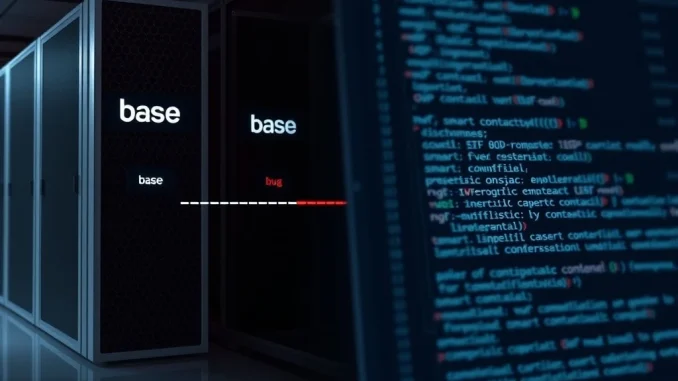
The vulnerability was not in a standard, manually audited contract. Instead, it resided in a supplemental price feed contract that, according to developers’ admissions in community channels, was initially drafted using an AI coding assistant. The AI-generated code contained a logic error that, under specific market conditions, allowed an attacker to manipulate the reported price of cbETH. By depositing a small amount of cbETH at an artificially inflated reported value, the attacker could borrow other assets far exceeding their collateral’s true worth, draining the protocol’s reserves.
“This exploit underscores a dangerous misconception: that AI can replace rigorous audit processes,” said a lead auditor at a top security firm, speaking on background. “AI is a powerful tool for boilerplate code and brainstorming, but it lacks the contextual understanding of economic incentives and attack vectors that define DeFi security. The code had a semantic bug—it was syntactically correct but logically flawed—which automated tools can miss.”
The Moonwell team has paused affected markets, initiated negotiations with the exploiter, and launched a full security review of all protocol components, especially those developed with AI assistance.
Contextualizing the Crises: Infrastructure Maturation vs. Security Debt
While coincidental in timing, these two events bookend the current state of DeFi. Base’s move represents the sector’s maturation, where leading projects outgrow one-size-fits-all solutions and invest in proprietary, high-performance infrastructure. It reflects a shift from mere survival to optimized scaling.
Conversely, the Moonwell hack exposes the lingering “security debt” the industry accumulates when chasing innovation speed. The pressure to deploy new features, support new assets, and reduce development costs has led some teams to experiment with AI code generation without establishing robust guardrails. This incident serves as a stark case study for the entire ecosystem, likely prompting stricter internal policies on the use of AI coding tools, particularly for financial logic governing value.
The timeline of events is telling:
- Q4 2024: AI coding assistants see widespread adoption in Web3 developer circles.
- January 2025: Moonwell deploys updated price feed contracts, including AI-assisted components.
- Early May 2025: Base engineers finalize decision to begin OP Stack decoupling.
- May 15, 2025: Base makes its strategic announcement.
- May 16, 2025: Attacker identifies and executes the Moonwell exploit.
- May 17, 2025: Exploit becomes public; security firms publish analyses.
Implications for the Future of DeFi Development
The fallout from this week will shape DeFi development for the foreseeable future. For Layer 2 networks, Base’s decision may inspire other large chains to consider similar forks, potentially leading to a more fragmented but specialized scaling landscape. The “Superchain” model will be tested, needing to prove that interoperability can survive technical divergence.
On the security front, the Moonwell hack is a canonical warning. Expect to see:
- Enhanced audit requirements specifically for AI-generated or AI-assisted code.
- The rise of new security tools designed to detect logical flaws and economic vulnerabilities, not just code bugs.
- A potential slowdown in the deployment of new, complex financial instruments as teams double-check their foundations.
- Increased scrutiny from regulators on the development practices of major DeFi protocols.
The industry’s response will be measured by its ability to learn. Can it build more resilient, independent infrastructures like Base aims to, while also enforcing more conservative, thorough security practices than those that failed Moonwell? The two challenges are intertwined; advanced infrastructure is meaningless without ironclad security.
Conclusion
The simultaneous news of Base’s OP Stack decoupling and the $1.78 million Moonwell AI code hack presents a defining moment for decentralized finance. One story is about strategic independence and technological maturation; the other is a cautionary tale about innovation outpacing security rigor. Together, they highlight the dual tracks on which DeFi must travel: aggressively building the scalable, user-friendly infrastructure of tomorrow while conservatively safeguarding the value entrusted to it today. The industry’s long-term success depends on its ability to navigate both paths without faltering. The Moonwell exploit, a direct result of over-reliance on unvetted AI-generated code, serves as a costly reminder that in the high-stakes world of DeFi, there is no substitute for human expertise, thorough auditing, and relentless vigilance.
FAQs
Q1: What does it mean for Base to “decouple” from the OP Stack?
It means Base will stop using the standard, shared OP Stack codebase as its core software and will develop its own independent, proprietary version. This allows for custom optimizations and features but requires more in-house engineering effort. Base will still use some OP services and contribute to the collective.
Q2: Was the Moonwell hack directly caused by an AI?
The primary vulnerability was in a smart contract that developers initially drafted using an AI coding assistant. The AI introduced a logical flaw that human reviewers and automated audit tools subsequently missed. The AI is a tool; the ultimate responsibility for the bug lies with the development and audit process.
Q3: Are these two events connected?
No, they are coincidental in timing but thematically linked. They represent two major, concurrent challenges in DeFi: scaling infrastructure (Base’s move) and maintaining security amid new development practices (Moonwell’s hack).
Q4: What is cbETH, and why was it targeted?
cbETH is Coinbase’s wrapped token representing staked Ethereum on its platform. It was targeted because the AI-generated bug was specifically in the price feed oracle for that asset, allowing its value to be misreported to the lending protocol.
Q5: What should DeFi users learn from this week’s events?
Users should understand that even prominent protocols face complex technical and security challenges. It reinforces the need to practice risk management, avoid over-concentration in any single protocol, and recognize that innovative technology (like AI-assisted coding or new L2 architectures) carries both promise and unanticipated risks.
This article was produced with AI assistance and reviewed by our editorial team for accuracy and quality.