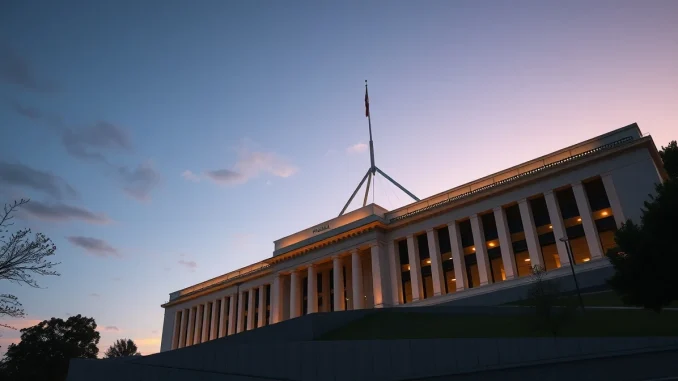
CANBERRA, Australia — March 16, 2026 — A key Australian Senate committee has recommended passing legislation that would impose a financial services licensing regime on cryptocurrency exchanges and custody platforms. The move aims to close regulatory gaps exposed by high-profile industry failures.
Committee Backs Digital Assets Framework
The Senate Economics Legislation Committee issued a report on March 16 supporting the Corporations Amendment (Digital Assets Framework) Bill 2025. The bill, introduced by Assistant Treasurer and Financial Services Minister Daniel Mulino in November 2025, would classify “digital asset platforms” (DAPs) and “tokenised custody platforms” (TCPs) as financial products.
This classification would bring most centralized exchanges and custody businesses holding client assets under the Australian Financial Services Licence (AFSL) regime. These platforms would then fall under the oversight of the Australian Securities and Investments Commission (ASIC).
Licensed platforms must meet ASIC custody standards and follow specific conduct rules. The framework includes exemptions for small providers with annual transactions below 10 million Australian dollars (approximately $7 million) and some public blockchain infrastructure.
Industry Raises Concerns Over Definitions
While supporting regulatory clarity, industry groups warned the bill’s definitions could be overly broad. Submissions cited in the committee’s report expressed concern.
Law firm Piper Alderman cautioned that tests for “digital token” and “factual control” might inadvertently regulate wallet software and infrastructure providers. This includes setups involving multi-party computation (MPC), where control of assets is shared.
Ripple Labs argued that while “control” was the right basis for regulation, the bill must better accommodate modern security architectures like MPC wallets. The company warned a strict reading could misclassify a technology provider holding a single key shard as a regulated custodian.
Ripple urged lawmakers to clarify that an entity must have unilateral power to transfer an asset without client cooperation to be considered in control. The committee acknowledged these concerns but agreed with the Treasury’s approach to refine the rules through future regulations rather than rewriting the core bill.
Coinbase Warns of Debanking Risk
Coinbase Australia director and APAC managing director John O’Loghlen welcomed the committee’s recommendation in a statement. He called it an important step for Australia’s role in the global digital economy.
“Australia has the capital and talent to lead in digital assets,” O’Loghlen stated. He argued clear rules are needed to unlock this potential.
O’Loghlen also highlighted an ongoing issue. He warned that “the anti-competitive practice of debanking is rampant” despite government measures endorsed in 2022 to address it. He urged the government to prioritize implementing recommendations from the Council of Financial Regulators.
Path Forward for the Bill
With the committee’s endorsement, the bill now proceeds to the full Senate for debate and a final vote. The proposed framework represents Australia’s most significant step yet to formalize oversight of the digital asset sector.
The push for regulation followed several high-profile collapses in the industry. These events highlighted risks for consumers when platforms holding customer assets fail. The government’s goal is to establish clear standards for custody, disclosure, and governance.
For further details on the legislative process, you can review the official Australian Parliament committee page. Information on the existing Australian Financial Services Licence regime is available from ASIC.
This article was produced with AI assistance and reviewed by our editorial team for accuracy and quality.