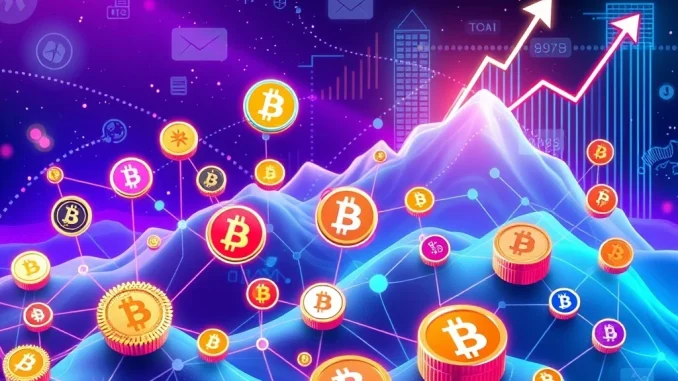
The cryptocurrency landscape is constantly evolving, and while Bitcoin often dominates headlines, a quiet revolution is underway: altcoin investments are reshaping portfolios and offering unparalleled opportunities for growth. As we look towards 2025, the strategic diversification into these innovative digital assets is becoming not just an option, but a pivotal necessity for investors aiming to capitalize on the next wave of blockchain innovation.
Why Are Altcoin Investments Crucial for Your Portfolio?
Altcoins, or “alternative coins,” are cryptocurrencies other than Bitcoin. Initially viewed as speculative plays, they have matured into a diverse ecosystem powering the future of decentralized technology. Unlike Bitcoin, which primarily serves as a digital store of value, altcoins offer varied utility:
- Powering Decentralized Applications (dApps): Many altcoins are the native tokens of smart contract platforms, essential for running decentralized applications.
- Enabling Cross-Border Payments: Some focus on faster, cheaper international transactions.
- Facilitating Decentralized Finance (DeFi): They underpin lending, borrowing, and trading protocols without intermediaries.
- Integrating Emerging Technologies: Altcoins are at the forefront of AI, gaming, metaverse, and Real-World Asset tokenization.
This utility-driven approach creates opportunities for potentially higher returns and direct exposure to cutting-edge technological advancements, making altcoin investments a compelling part of any forward-thinking crypto strategy.
Navigating the Dynamic Altcoin Ecosystem: Where Are the Opportunities?
The altcoin market is vast and categorized by distinct functionalities, each addressing specific market needs. A well-rounded portfolio often combines exposure across these categories to align with multiple growth narratives:
- Smart Contract Platforms: These are the foundational layers for dApps. Examples include Ethereum (ETH), Cardano (ADA), and Solana (SOL).
- Decentralized Finance (DeFi) Tokens: Powering decentralized financial services like lending, borrowing, and trading. Uniswap (UNI) and Aave (AAVE) are prime examples.
- AI and Analytics Tokens: Integrating artificial intelligence and machine learning with blockchain for autonomous decision-making and data analysis. Fetch.ai (FET) and platforms like Token Metrics AI are leading this charge.
- Meme Coins: Driven primarily by community and social media trends, such as Dogecoin (DOGE) and Shiba Inu (SHIB). While volatile, they can offer significant, albeit risky, returns.
- Layer 2 Solutions: Designed to enhance the scalability and efficiency of existing blockchains, including Polygon (MATIC) and Arbitrum (ARB).
Understanding these categories is fundamental to making informed altcoin investments and building a diversified digital asset portfolio.
How is DeFi AI Revolutionizing Crypto Investment?
The convergence of Decentralized Finance (DeFi) and Artificial Intelligence (AI) is creating a powerful synergy that promises to transform how investors approach the crypto market. DeFi AI refers to the application of AI technologies to analyze, optimize, and automate processes within the DeFi ecosystem.
AI-powered platforms, like Token Metrics, are becoming indispensable tools for investors. They leverage sophisticated algorithms to:
- Analyze Project Fundamentals: Sifting through whitepapers, tokenomics, and team backgrounds.
- Monitor On-Chain Activity: Tracking transaction volumes, active addresses, and developer commits to gauge project health.
- Gauge Market Sentiment: Analyzing social media, news, and forums to understand public perception.
- Predict Market Movements: Using historical data and real-time feeds to forecast price trends.
By providing data-driven insights, DeFi AI helps investors make more informed decisions, identify high-potential altcoin investments, and manage risk more effectively in a volatile market.
The Rise of Real-World Assets (RWA) in Crypto
One of the most exciting frontiers in blockchain is the tokenization of Real-World Assets (RWA). This involves bringing tangible assets, such as real estate, art, commodities, and even intellectual property, onto the blockchain as digital tokens. This innovation bridges the gap between traditional finance and the decentralized world, offering numerous benefits:
- Increased Liquidity: Traditionally illiquid assets can be traded 24/7 on global markets.
- Fractional Ownership: Making high-value assets accessible to a broader range of investors.
- Transparency and Efficiency: Blockchain’s immutable ledger ensures clear ownership and streamlines transactions.
- Broader Investment Opportunities: Investors can gain exposure to diverse asset classes within their crypto portfolios.
Projects focusing on RWA tokenization are poised to attract significant institutional capital and mainstream adoption, making them a key area for strategic altcoin investments in the coming years.
Crafting a Robust Crypto Diversification Strategy for 2025
Diversification is paramount in the volatile crypto market. A well-thought-out crypto diversification strategy goes beyond simply holding multiple altcoins; it involves a calculated approach to portfolio allocation and risk management. Here are key steps:
- Research-Driven Decisions: Utilize AI-powered platforms and independent analysis to deeply understand project fundamentals, team credibility, and market viability.
- Balanced Portfolio Allocation:
- Large-Cap Tokens: Provide relative stability (e.g., Ethereum).
- Mid-Cap Tokens: Offer growth potential with established use cases.
- Small-Cap Tokens: Present higher risk but also higher potential returns.
Balancing these categories helps manage overall portfolio risk.
- Active Monitoring and Rebalancing: The crypto market is fast-paced. Regularly review your portfolio and adjust allocations based on market conditions, technological advancements, and regulatory changes.
- Passive Income Opportunities: Explore staking and yield farming to earn additional returns on your holdings. However, always prioritize projects with rigorous smart contract audits to mitigate security risks.
A smart crypto diversification strategy is your shield against volatility and your pathway to sustainable growth.
What Does the 2025 Crypto Outlook Hold for Altcoins? Challenges and Opportunities
While the potential for altcoin investments is immense, investors must be aware of the inherent challenges, particularly as we move into the 2025 crypto outlook. Volatility remains a constant, and project-specific risks, such as smart contract vulnerabilities in DeFi, are real concerns.
A significant development expected in 2025 is the tightening of global regulatory oversight. Governments worldwide are increasing their focus on the crypto space, leading to:
- Increased KYC/AML Compliance: Stricter Know Your Customer (KYC) and Anti-Money Laundering (AML) requirements for exchanges and platforms.
- Clarity on Taxation: More defined guidelines on how crypto assets are taxed.
- Licensing Requirements: Greater scrutiny and licensing for crypto businesses.
These regulations, while potentially slowing immediate growth, are crucial for long-term stability and mainstream adoption. Investors are advised to prioritize robust security measures, such as using hardware wallets for storing assets and diversifying platform usage to mitigate exchange-specific risks.
Altcoins vs. Bitcoin: A Synergistic Approach
Comparing altcoins to Bitcoin highlights their distinct roles in a balanced portfolio. Bitcoin, with its established network and broad adoption, offers a degree of stability and acts as a primary store of value in the digital realm. Altcoins, on the other hand, are the engines of innovation, offering sector-specific utility and exposure to emerging technologies.
A balanced approach often combines Bitcoin’s defensive attributes with the growth potential of altcoins. For instance, tokens integrating AI capabilities and those focused on tokenizing Real-World Assets are uniquely positioned to lead the next wave of blockchain adoption, driven by demand for scalable solutions and data-driven analytics. This synergy allows investors to participate in both the foundational security and the revolutionary growth aspects of the crypto market.
How to Select High-Potential Altcoins for Your Portfolio?
Selecting the right altcoins requires more than just following trends. It demands thorough evaluation and a keen eye for sustainable projects. Key metrics and considerations include:
- Market Capitalization and Liquidity: Larger market caps generally imply more stability, while high liquidity ensures you can buy and sell easily.
- Team Credibility and Roadmap: Research the development team’s experience and track record. A clear, achievable roadmap signals long-term vision.
- On-Chain Metrics: Analyze active wallet counts, transaction volumes, and developer activity. These signal genuine usage and project health.
- Community Engagement: A vibrant and active community can be a strong indicator of a project’s resilience and potential for growth.
- AI Analytics Tools: Leverage platforms that use AI to identify patterns, predict trends, and flag potential risks, aiding in the discovery of high-potential altcoin investments.
In 2025, the focus is increasingly shifting towards projects with strong governance models and clear utility, as regulatory clarity and technological advancements reduce uncertainty.
Conclusion: Unlocking the Future of Finance with Altcoins
The journey into altcoin investments in 2025 is an exciting one, driven by the transformative potential of DeFi, AI, and the tokenization of Real-World Assets. These sectors are not just buzzwords; they represent fundamental shifts in how we interact with finance, data, and ownership.
While the path ahead may present challenges, particularly concerning market volatility and evolving regulations, the opportunities for significant growth and technological exposure are undeniable. For investors, a disciplined approach—combining thorough research, strategic crypto diversification, and proactive risk mitigation—remains essential. By embracing these principles, you can position yourself to capitalize on altcoins’ revolutionary potential and play a part in shaping the future of decentralized finance.
Frequently Asked Questions (FAQs) About Altcoin Investments in 2025
Q1: What are the primary drivers for altcoin growth in 2025?
A1: The primary drivers include advancements in Decentralized Finance (DeFi) protocols, the integration of Artificial Intelligence (AI) into blockchain applications, and the increasing adoption of Real-World Asset (RWA) tokenization. These technologies are expanding the utility and demand for various altcoins.
Q2: How can AI help me with my altcoin investments?
A2: AI-powered platforms can assist by analyzing vast amounts of data, including project fundamentals, on-chain metrics, and market sentiment, to identify high-potential altcoins and predict market trends. This helps investors make more informed, data-driven decisions and manage risk effectively.
Q3: What are Real-World Assets (RWA) in the context of crypto, and why are they important?
A3: Real-World Assets (RWA) refer to tangible assets like real estate, art, or commodities that are tokenized and brought onto the blockchain. They are important because they bridge traditional finance with crypto, offering increased liquidity, fractional ownership, and new investment opportunities within the digital asset space.
Q4: What are the biggest risks associated with altcoin investments?
A4: The biggest risks include high market volatility, smart contract vulnerabilities in DeFi projects, and increasing regulatory scrutiny (e.g., KYC/AML compliance). Investors should prioritize thorough research, security measures like hardware wallets, and careful risk management.
Q5: Should I invest in Bitcoin or altcoins, or both?
A5: A balanced approach is often recommended. Bitcoin provides stability and serves as a digital store of value, while altcoins offer innovation and higher growth potential through their diverse utilities in sectors like DeFi, AI, and RWA. Combining both can create a well-diversified portfolio that balances risk and reward.
Q6: How do I ensure my altcoin portfolio is diversified effectively?
A6: Effective diversification involves spreading your investments across different altcoin categories (e.g., smart contract platforms, DeFi tokens, AI tokens, Layer 2 solutions), balancing large-cap, mid-cap, and small-cap tokens, and regularly rebalancing your portfolio based on market conditions and your risk tolerance.
Source: [Altcoins Investment: A Comprehensive Guide for 2025]