The cryptocurrency world constantly watches for shifts in the Bitcoin market. This week, several critical elements demand close attention from investors and analysts alike. Understanding these factors is essential for anyone navigating the dynamic landscape of digital assets. We will explore four key indicators that could significantly influence Bitcoin’s price and broader crypto volatility in the coming days.
Understanding Bitcoin’s Price Recovery and Government Influence
Bitcoin recently showed a notable recovery, reaching the $106,000 mark. This rebound occurred amid growing expectations for an end to the U.S. government shutdown. Historically, traditional financial markets often react negatively to political uncertainties like government shutdowns. These events can create a climate of apprehension, influencing investor confidence across various asset classes, including cryptocurrencies. When government operations face disruption, the ripple effect can extend to broader economic sentiment. This often translates into cautious investment behavior.
Conversely, the resolution of such impasses tends to restore market stability. Investors often view political certainty as a positive signal. This can encourage a return to riskier assets. Bitcoin, while often seen as a hedge against traditional finance, still exhibits some correlation with broader market sentiment. Therefore, the anticipated resolution of the U.S. government shutdown likely contributed to the positive momentum observed in Bitcoin’s price. A stable political environment generally fosters a more predictable economic outlook. This stability often encourages greater investment in digital assets.
Inflation Indicators: CPI, PPI, and Crypto Volatility
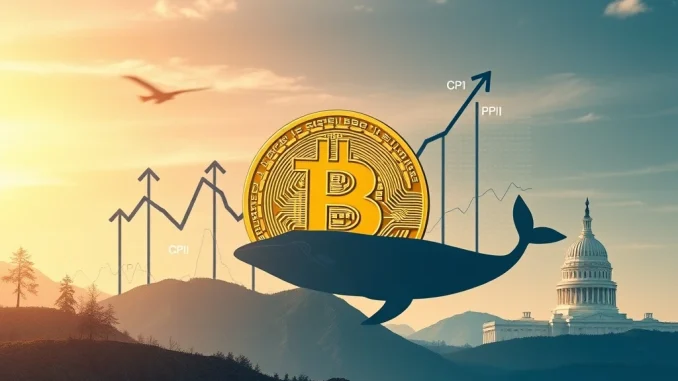
The release of major U.S. inflation indicators, specifically the Consumer Price Index (CPI) and Producer Price Index (PPI), always brings the potential for increased crypto volatility. These economic reports provide crucial insights into the health of the economy and inflationary pressures. The CPI measures the average change over time in the prices paid by urban consumers for a market basket of consumer goods and services. On the other hand, the PPI measures the average change over time in the selling prices received by domestic producers for their output.
When inflation data comes in higher or lower than expected, it can trigger significant market reactions. Central banks, like the Federal Reserve, closely monitor these figures. Unexpectedly high inflation might prompt the Fed to consider more aggressive monetary tightening policies, such as interest rate hikes. Such policies can make traditional investments more attractive, potentially drawing capital away from risk assets like Bitcoin. Conversely, lower-than-expected inflation could signal a more dovish stance, potentially boosting interest in cryptocurrencies. Consequently, the upcoming CPI and PPI releases are critical events for the entire Bitcoin market. Traders and investors will watch these numbers closely for any signs of economic shifts.
Derivatives Market Fear and Bitcoin’s Price Ceiling
A persistent sense of fear continues to grip the derivatives market. This sentiment is evident in the low betting interest on a rally past the $120,000 level. The derivatives market, encompassing futures and options, provides valuable insights into collective investor sentiment. When traders show reluctance to bet on higher prices, it suggests a lack of conviction in an immediate bullish breakout. This fear often manifests in various ways, including:
- Skewed Options Pricing: Put options (bets on price declines) might become relatively more expensive than call options (bets on price increases).
- Funding Rates: Negative funding rates in perpetual futures contracts can indicate a bearish bias among leveraged traders.
- Open Interest Distribution: A concentration of open interest at lower price levels, with less at higher strikes, suggests limited upside expectations.
The $120,000 level likely represents a significant psychological or technical resistance point. Traders may view this as a strong ceiling for Bitcoin’s price in the near term. Overcoming such a barrier would require substantial buying pressure and a significant shift in market sentiment. Until then, the derivatives market suggests a cautious outlook, indicating that many participants anticipate a consolidation or even a retracement before a sustained upward move.
Whales Selling Pressure and Long-Term Investor Holdings
Another crucial factor is the continued selling pressure from large-scale investors, commonly known as whales selling. These whales, holding substantial amounts of Bitcoin, can significantly influence market dynamics with their large transactions. When whales sell, they often create downward price pressure. Their movements are closely tracked by on-chain analysts, who look for signs of accumulation or distribution.
The question remains whether holdings among long-term investors will recover. Long-term investors, or ‘hodlers,’ are typically less reactive to short-term price fluctuations. Their accumulation often signals confidence in Bitcoin’s future value. Conversely, if long-term holders begin to distribute their holdings, it could signal a broader lack of confidence. Analysts use metrics like ‘hodler waves’ and ‘supply held by long-term holders’ to assess this trend. A recovery in long-term investor holdings would provide a strong fundamental underpinning for Bitcoin’s price stability and future growth. This accumulation would absorb some of the selling pressure from whales. Therefore, monitoring the behavior of both whales and long-term holders is vital for understanding the underlying health of the Bitcoin market.
Navigating the Week Ahead in the Bitcoin Market
As the week progresses, market participants will undoubtedly scrutinize these four factors. The resolution of the U.S. government shutdown could provide a much-needed boost to overall market sentiment. Furthermore, the upcoming CPI and PPI data releases will offer clarity on inflation trends, directly impacting monetary policy expectations and potentially leading to significant crypto volatility. The sentiment in the derivatives market will also serve as a barometer for investor confidence, especially regarding Bitcoin’s ability to break key resistance levels. Finally, observing the actions of large investors and the accumulation patterns of long-term holders will provide crucial insights into the fundamental demand for Bitcoin. These combined forces will shape the trajectory of Bitcoin’s price in the days to come. Vigilance and informed decision-making remain paramount for navigating this complex market environment.
FAQs About Bitcoin Market Dynamics
What is the Consumer Price Index (CPI) and why is it important for Bitcoin?
The CPI measures the average change over time in the prices paid by urban consumers for goods and services. It is crucial for Bitcoin because it indicates inflation. High inflation can prompt central banks to raise interest rates, potentially making traditional assets more attractive and increasing crypto volatility. Conversely, low inflation might encourage investment in risk assets like Bitcoin.
How do ‘whales’ influence Bitcoin’s price?
Whales are large-scale investors holding significant amounts of Bitcoin. Their buying or selling activities can cause substantial price movements due to the sheer volume of their transactions. When whales selling occurs, it often creates downward pressure on Bitcoin’s price, while accumulation can signal bullish sentiment.
What does ‘persistent fear in the derivatives market’ imply for Bitcoin?
Persistent fear in the derivatives market, often seen through metrics like options pricing and funding rates, suggests a lack of confidence among traders in a significant upward price movement. It indicates that many investors are hedging against declines or do not expect Bitcoin’s price to break key resistance levels soon, potentially leading to stagnation or further downside.
How does a U.S. government shutdown affect the Bitcoin market?
A U.S. government shutdown introduces political and economic uncertainty. This uncertainty can dampen overall market sentiment, leading investors to become more cautious. While Bitcoin often acts as a decentralized alternative, it can still experience a correlation with broader market fear or recovery, impacting its price movements.
Why is the $120,000 level significant for Bitcoin in the derivatives market?
The $120,000 level appears to be a significant psychological or technical resistance point in the derivatives market. Low betting interest on a rally past this level indicates that traders perceive it as a strong ceiling. Overcoming this barrier would require substantial positive catalysts and a shift in market sentiment to push Bitcoin’s price higher.
What is the difference between short-term and long-term Bitcoin investors?
Short-term investors typically react quickly to price fluctuations, aiming for quick profits. Long-term investors, or ‘hodlers,’ hold Bitcoin for extended periods, often years, with the belief in its future appreciation. Their accumulation patterns are seen as a strong indicator of fundamental confidence in the Bitcoin market, contrasting with the more volatile behavior of short-term traders and whales selling.