Universal MCP: DFlow’s Revolutionary Bridge Between AI Agents and Solana’s Trading Infrastructure
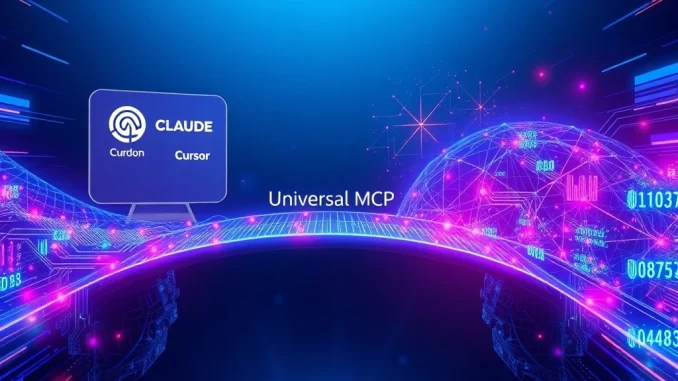
San Francisco, May 2025: In a significant development for decentralized finance and artificial intelligence, infrastructure provider DFlow has officially launched its universal Model Context Protocol (MCP) on the Solana blockchain. This launch marks a pivotal step in empowering AI agents, such as those from Anthropic’s Claude and the Cursor IDE, with direct, precision access to high-performance, production-ready trading execution. The move addresses a critical gap in the Web3 ecosystem, providing a standardized, secure conduit for autonomous AI systems to interact with complex financial markets.
DFlow’s Universal MCP: A Technical Bridge for Autonomous Agents
The core innovation lies in DFlow’s implementation of a universal Model Context Protocol. In computational terms, an MCP functions as a standardized framework that allows external applications, data sources, and tools to communicate seamlessly with large language models (LLMs) and the AI agents they power. Prior to this development, AI agents operating in the cryptocurrency space often relied on fragmented APIs, custom integrations, or manual oversight, creating bottlenecks and limiting their operational scale and reliability.
DFlow’s protocol is ‘universal’ because it provides a common language and set of primitives specifically designed for financial actions on-chain. It translates high-level AI intents—such as “execute a DCA strategy for SOL with minimal slippage” or “arbitrage this price discrepancy between two decentralized exchanges”—into a series of precise, auditable, and executable transactions on Solana. This abstraction layer handles the complexities of wallet management, transaction signing, gas optimization, and real-time market data, which are traditionally challenging for autonomous agents to manage robustly.
Why Solana’s Infrastructure is the Foundational Layer
The choice of Solana as the foundational blockchain is not incidental; it is a strategic decision driven by technical necessity. AI agents, particularly those designed for trading, require ultra-low latency, high throughput, and predictable, low-cost transaction finality to operate effectively. Solana’s architecture, capable of processing thousands of transactions per second with sub-second block times, provides the performance substrate that makes AI-driven trading strategies technically viable beyond simple experimentation.
Comparatively, executing complex, multi-step DeFi transactions on networks with higher latency and variable costs can render many AI strategies economically unfeasible or too risky. DFlow’s MCP leverages Solana’s native speed to offer what the company terms “production-ready” execution. This implies the infrastructure meets the reliability, speed, and consistency standards required for live, value-bearing operations, not just proof-of-concept demonstrations. The integration taps directly into Solana’s existing decentralized exchange (DEX) liquidity, oracle networks, and composable smart contract ecosystem, giving AI agents a rich and fast environment to operate within.
The Evolution of AI in Crypto: From Analysis to Action
The launch reflects a broader industry trend: the evolution of AI’s role in cryptocurrency from a passive analytical tool to an active participant. For years, AI and machine learning models have been used for market prediction, sentiment analysis, and risk assessment. However, the loop from analysis to action remained largely manual. Projects like DFlow’s MCP are closing that loop, enabling a new class of autonomous financial agents.
This shift carries significant implications. It promises to increase market efficiency by automating complex strategies 24/7. It also raises important questions around regulatory compliance, security, and the ethical design of autonomous financial systems. DFlow’s approach, by creating a standardized and transparent protocol, aims to provide a framework where these agent actions are clear, verifiable, and built upon secure execution infrastructure, potentially setting a benchmark for responsible development in this nascent field.
Practical Implications for Developers and the DeFi Ecosystem
For developers building AI agents, the universal MCP dramatically reduces integration complexity. Instead of writing and maintaining custom code for every trading venue, wallet provider, and blockchain interaction, developers can connect their agent to DFlow’s MCP server. The protocol offers a standardized set of tools, or “contexts,” for financial actions. This can include:
- Market Data Contexts: Real-time price feeds, liquidity depth, and historical data from Solana DEXs.
- Execution Contexts: Tools to place limit orders, market orders, and set up advanced order types across multiple venues.
- Portfolio Contexts: Functions to query wallet balances, track P&L, and manage asset allocations.
- Risk Management Contexts: Pre-configured modules for slippage control, transaction simulation, and compliance checks.
This standardization could accelerate innovation, allowing AI developers to focus on strategy logic and model training rather than the intricacies of blockchain interaction. For the broader Solana DeFi ecosystem, an influx of sophisticated, AI-driven liquidity and trading activity could enhance liquidity depth, improve price discovery, and attract further developer interest to the network.
Security and Transparency in an Agent-Driven Environment
A paramount concern with autonomous AI agents executing financial transactions is security and intent fidelity. DFlow’s protocol architecture addresses this by design. The MCP server acts as a controlled gateway; the AI agent proposes an action through the protocol, but the actual signing and broadcasting of the transaction can be governed by predefined rules, human oversight mechanisms, or multi-signature setups. Every action initiated through the MCP is inherently logged and traceable on the Solana blockchain, providing a transparent audit trail. This contrasts with opaque, off-chain trading algorithms prevalent in traditional finance, offering a new paradigm of verifiable DeFi activity.
Conclusion: A Foundational Step Towards Autonomous Finance
The launch of DFlow’s universal Model Context Protocol on Solana represents more than a product release; it is a foundational step towards a more automated and intelligent financial landscape. By creating a robust, high-performance bridge between advanced AI reasoning and Solana’s trading infrastructure, DFlow is enabling a future where autonomous agents can participate securely and efficiently in decentralized markets. The success of this infrastructure will depend on its adoption by AI developers, its proven security, and its ability to foster new, valuable use cases that demonstrate the tangible benefits of merging artificial intelligence with high-speed blockchain execution. This development firmly positions Solana as a leading network for the next wave of financial innovation, driven by autonomous intelligence.
FAQs
Q1: What is the Model Context Protocol (MCP)?
The Model Context Protocol is a standardized framework that allows external tools and data sources to connect to and be used by large language models (LLMs) and AI agents. DFlow’s universal MCP is a specialized implementation that provides financial tools and execution capabilities on the Solana blockchain to AI systems.
Q2: How does DFlow’s MCP benefit AI developers?
It drastically reduces development complexity by providing a single, standardized interface for AI agents to access market data, execute trades, and manage portfolios on Solana. Developers no longer need to build custom integrations for every exchange or wallet, allowing them to focus on core AI strategy and logic.
Q3: Why is Solana specifically chosen for this protocol?
Solana offers the high transaction throughput, low latency, and minimal fee structure required for AI trading agents to operate effectively. Strategies that depend on speed and cost predictability are only viable on a high-performance blockchain like Solana, making it the necessary infrastructure layer for production-ready AI execution.
Q4: Is it safe for AI agents to execute trades autonomously?
DFlow’s architecture is designed with security in mind. The MCP server facilitates the intent, but transaction signing can be governed by rules, human approval, or multi-signature controls. All actions are recorded on the public Solana blockchain, creating transparency and an audit trail not always present in traditional algorithmic trading.
Q5: What does “production-ready” execution mean in this context?
It signifies that the trading infrastructure meets the reliability, speed, and consistency standards required for live, real-world deployment where real financial value is at stake. It is not a testnet or simulation environment but a system built for sustained, operational use by AI agents.
Related News
- TRX Price Prediction: Astonishing Bullish Momentum Continues, No Peak Yet
- Bitcoin Long-Term Holders Unleash Intensified Selling Pressure, Market Data Confirms
- OKX LIT Listing: Strategic Expansion as Exchange Adds LIT/USDT Spot Trading on January 15, 2025
Related: MWX Staking Portal Launches, Unlocking Revolutionary DeFi Utility for MWXT Token
Related: Michael Saylor's Unwavering Strategy: MicroStrategy Nears 100th Bitcoin Purchase Milestone