Jambo Jarvis: The Revolutionary Solana-Powered Agentic Mobile Device Unveiled
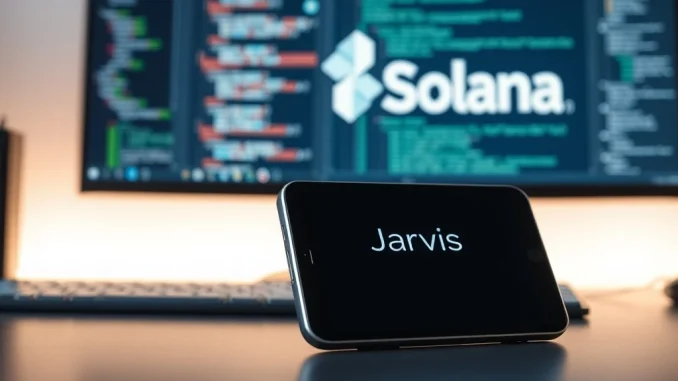
San Francisco, May 2025: Jambo Technology, a company with significant backing from the Solana ecosystem, has officially unveiled ‘Jarvis,’ a pioneering agentic mobile device. This launch marks a strategic move to redefine human-computer interaction by enabling direct, streamlined communication with AI agents, fundamentally bypassing the traditional app-based model that dominates current smartphones. The announcement signals a potential shift in how users access decentralized applications (dApps) and AI services, positioning the device at the intersection of advanced artificial intelligence and blockchain infrastructure.
Jambo Jarvis and the Vision for App-Less Interaction
Jambo Technology’s Jarvis represents a distinct departure from conventional smartphone architecture. The core proposition centers on ‘agentic’ interaction, where the device itself hosts or seamlessly connects to autonomous AI agents capable of executing complex tasks based on natural language commands. Instead of navigating through a labyrinth of individual applications, users theoretically engage with a unified AI interface. This model aims to reduce friction, consolidate workflows, and provide a more intuitive user experience. The integration with Solana suggests a primary use case focused on the Web3 economy, where agents could manage digital assets, execute smart contracts, or interact with decentralized protocols directly through conversational prompts, without needing separate wallet or trading apps.
Technical Architecture and Solana Integration
The operational success of Jarvis hinges on its underlying technical framework. While full specifications are pending broader release, industry analysis points to several critical components. The device likely requires robust on-device processing or ultra-low-latency cloud connectivity to power its AI agents. Its integration with the Solana blockchain is presumably deep-seated, potentially featuring a secure element for private key storage, a native Solana virtual machine (SVM) runtime environment, and optimized connectivity to the high-throughput network. This design would allow AI agents operating on Jarvis to perform blockchain transactions—such as token swaps, NFT purchases, or staking operations—as fluidly as sending a text message. The move aligns with a growing trend of embedding blockchain functionality directly into hardware, moving beyond software wallets and browser extensions.
Contextualizing the Mobile Device Landscape
The introduction of Jarvis enters a competitive and evolving hardware arena. It follows other blockchain-centric mobile initiatives, such as the Solana Saga phone, which focused on Android integration with crypto features. However, Jambo’s emphasis on an ‘agentic’ AI layer presents a different value proposition. Comparatively, major tech firms are advancing AI assistants, but typically within the confines of existing app ecosystems. Jambo’s attempt to build a device where the AI agent is the primary interface, especially one leveraged for crypto-economic activity, is a novel experiment. Its success will depend on the reliability and capability of its AI, the security of its financial integrations, and its ability to attract a developer community to build for its unique agentic platform.
Implications for Developers and the Web3 Ecosystem
For developers, Jarvis potentially introduces a new paradigm for dApp deployment and interaction. Instead of designing front-end applications, developers may create ‘agent skills’ or deploy smart contracts that are specifically optimized for discovery and execution by the device’s AI. This could lower barriers for user adoption, as the complexity of navigating dApp interfaces is abstracted away by natural language. However, it also raises important considerations around standardization, agent security, and the transparency of on-chain actions initiated by AI. The Solana Foundation’s backing provides Jambo with significant ecosystem support, which could accelerate the creation of a dedicated agent toolkit and grant programs to foster this new development landscape.
Key potential impacts include:
- User Onboarding: Simplifying Web3 interaction for non-technical users through conversational AI.
- New Security Models: Requiring advanced frameworks for authorizing AI-agent-driven transactions.
- Market Niche: Positioning against general-purpose smartphones by offering a specialized Web3 and AI-first device.
Market Reception and Future Challenges
Initial reactions from the technology and cryptocurrency sectors have been a mixture of curiosity and cautious optimism. Analysts recognize the ambitious fusion of two cutting-edge fields but note the significant execution challenges. These include achieving reliable and trustworthy AI agency, ensuring enterprise-grade security for financial assets, and creating a user experience compelling enough to justify carrying a potentially specialized device alongside a primary smartphone. Furthermore, the device must navigate a regulatory landscape that is increasingly scrutinizing both AI autonomy and digital asset management. Jambo’s roadmap, pricing strategy, and carrier partnerships will be critical factors in determining whether Jarvis transitions from a visionary prototype to a commercially viable product.
Conclusion
The unveiling of the Jambo Jarvis agentic mobile device marks a notable experiment in converging artificial intelligence with blockchain utility. By aiming to eliminate app-based constraints and facilitate direct human-AI interaction for Solana-powered activities, Jambo Technology is challenging entrenched mobile computing models. While substantial technical and market hurdles remain, the project underscores a growing direction in the Web3 industry: the pursuit of seamless, intuitive, and integrated hardware solutions. The development and reception of the Jarvis device will be a key case study in whether agentic AI can become a practical gateway to decentralized technologies and redefine our daily interaction with digital assets.
FAQs
Q1: What is the Jambo Jarvis device?
The Jambo Jarvis is a new mobile device announced by Jambo Technology. Its defining feature is an ‘agentic’ AI interface designed to let users interact with services and perform tasks through natural language, reducing reliance on traditional mobile applications, with a particular focus on Solana blockchain operations.
Q2: How is Solana involved with the Jarvis device?
Jambo Technology has backing from the Solana ecosystem. The Jarvis device is built with deep integration of the Solana blockchain, likely featuring native support for secure asset management and the ability for its AI agents to directly execute transactions and interact with smart contracts on the Solana network.
Q3: What does ‘agentic’ mean in this context?
In this context, ‘agentic’ refers to the capability of the AI on the device to act autonomously or semi-autonomously to accomplish user-defined goals. Instead of being a simple voice assistant, it implies an AI that can plan, execute multi-step tasks (like trading assets or managing schedules), and operate across different functions without constant, granular user input.
Q4: Will the Jarvis phone replace my current smartphone?
It is positioned as a specialized device, particularly for users deeply engaged in the Solana and Web3 ecosystem. While it may handle communication and basic tasks, its primary value proposition is AI-agent-driven interaction and blockchain utility. It may serve as a companion device or a primary phone for a niche audience, rather than a direct replacement for general-purpose smartphones like iPhones or Android devices at launch.
Q5: What are the main challenges facing the Jambo Jarvis?
Key challenges include proving the reliability and security of its AI agents, especially when managing financial assets; creating a developer ecosystem for its unique platform; differentiating itself in a crowded mobile market; and navigating the complex regulatory environment surrounding both AI and cryptocurrency.
Related News
- Old Glory Bank SPAC Merger: A Bold Leap for Crypto-Friendly Banking in the US
- Two Weeks to Go: iGaming Studio Summit 2025 Set to Ignite Innovation in Riga
- Unpacking Bitcoin’s On-Chain Trends
Related: NAKA Crash: $23.6B Erased in Stunning 99% Plunge After Bitcoin Treasury Gamble
Related: Cardano Price Prediction 2026-2030: Analyzing Market Shifts After Parsec Analytics Closure
Related: Parabolic SAR Indicator: The Essential Guide to Spotting Trends and Reversals