RWA TVL Milestone: How Securitize, Ondo, and Syrup Achieved the Crucial $1B Breakthrough
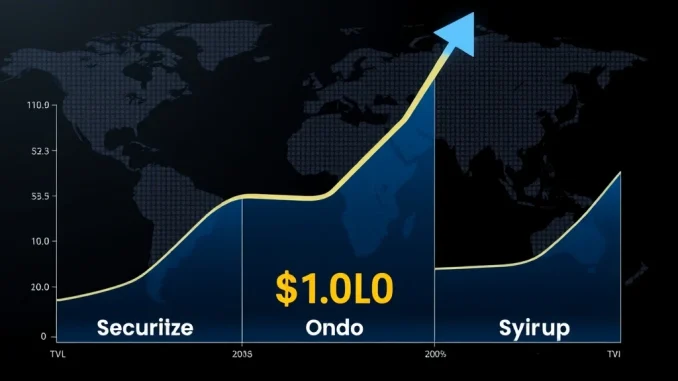
Global, May 2025: The tokenization of real-world assets (RWAs) has reached a definitive inflection point. Recent data from CryptoDep reveals that multiple projects have now cleared the critical $1 billion threshold in Total Value Locked (TVL), with Securitize leading the charge at $3.21 billion. This collective milestone represents more than just capital accumulation; it signals a fundamental shift in how institutional and retail investors perceive blockchain’s utility for traditional finance. The sustained momentum behind RWA TVL growth underscores a maturing market that is finally gaining tangible, real-world traction.
RWA TVL Momentum Reaches a Tipping Point
The concept of bringing real-world assets like treasury bills, real estate, and private credit onto blockchain networks is not new. Proponents have discussed its potential for nearly a decade. However, the consistent growth in TVL across several major platforms throughout 2024 and into 2025 indicates the thesis is now materializing. Total Value Locked serves as the primary metric for gauging adoption and trust in decentralized finance protocols. When applied to RWAs, it measures the dollar value of traditional assets that have been tokenized and are actively managed or traded on-chain.
Crossing the $1 billion mark for a single project was once a distant goal. Today, having multiple projects achieve this simultaneously creates a powerful network effect. It validates the underlying technology, attracts regulatory clarity, and builds confidence among a broader investor base. This surge is not driven by speculative crypto-native assets but by the digitization of stable, yield-generating instruments from the traditional economy. The capital is real, and its movement on-chain represents a silent revolution in financial infrastructure.
Breaking Down the Leaders in Tokenized Asset TVL
CryptoDep’s latest snapshot provides a clear hierarchy in the burgeoning RWA landscape. The data reveals which protocols are successfully capturing market share and trust.
- Securitize ($3.21B TVL): Often cited as a pioneer in digital asset securities, Securitize has built a comprehensive platform focusing on compliance and institutional onboarding. Its leading position likely stems from early partnerships with major asset managers and a strong emphasis on regulatory technology (RegTech). Their TVL is comprised of tokenized equity, funds, and credit products offered to accredited investors.
- Ondo Finance (Close behind): Ondo has gained significant attention for its focus on tokenizing U.S. Treasury products and high-quality bonds. By offering easy access to these yield-bearing assets via its OUSG token, it has appealed to DeFi natives seeking stable yields. Its growth reflects a high demand for “safe” yield in the crypto ecosystem, bridged directly from traditional markets.
- Syrup Finance (Close behind): Syrup takes a slightly different approach, often categorized as a “yield vault” or structured product protocol. It leverages RWAs as a core component of its strategies to generate sustainable returns. Its presence among the leaders highlights the demand for automated, sophisticated financial products that use tokenized real-world assets as foundational building blocks.
The close clustering of TVL among these top players suggests a competitive but healthy market. It indicates that different value propositions—compliance-first access, pure treasury yields, and structured products—are all finding substantial product-market fit.
The Driving Forces Behind the Capital Inflow
Several concurrent factors explain this accelerated capital allocation toward RWA protocols. First, the macroeconomic environment of relatively high interest rates has made yield-generating assets like short-term treasuries attractive. Blockchain provides a frictionless avenue to access this yield. Second, regulatory frameworks, particularly in jurisdictions like the UAE, Singapore, and parts of Europe, have advanced, providing clearer guidelines for tokenization. Third, major financial institutions, from BlackRock to JPMorgan, have launched their own blockchain initiatives, lending immense credibility to the entire sector.
Furthermore, the technological infrastructure has improved. Issues that plagued earlier attempts—such as poor interoperability between blockchains, clumsy custody solutions, and slow transaction finality—have seen notable advancements. The rise of institutional-grade custodians and the maturation of chains like Ethereum, Polygon, and Solana for enterprise use have created a more robust pipeline for asset tokenization and management.
Implications for Traditional and Decentralized Finance
The breach of the $1 billion TVL level by multiple projects carries profound implications for both the traditional finance (TradFi) and decentralized finance (DeFi) worlds. For TradFi, it represents a viable new distribution channel and a potential reduction in settlement and administrative costs. Assets can be fractionalized, enabling smaller investment minimums and increasing liquidity for traditionally illiquid markets like real estate or private equity.
For DeFi, the influx of RWAs provides something it has historically lacked: intrinsic, non-speculative yield derived from the global economy. This makes DeFi ecosystems more resilient and stable. It also bridges the gap between crypto and traditional investors, as the underlying asset is something familiar. The risk profiles change, moving away from pure protocol smart contract risk to include counterparty and real-world performance risk, necessitating a new breed of risk assessment tools.
Historical Context and the Road Ahead
To appreciate this moment, one can look back at the evolution of DeFi TVL. The first major surge in 2020-2021 was built on speculative lending and trading of volatile crypto assets. The 2022 downturn exposed the fragility of systems based primarily on reflexive speculation. The current growth phase, led by RWAs, is fundamentally different. It is built on bringing external, real-world value on-chain. This pattern mirrors the early internet’s evolution from an information network to a commercial platform.
Looking forward, the next milestones will likely involve greater regulatory integration, cross-chain interoperability for tokenized assets, and the tokenization of more complex asset classes like carbon credits, intellectual property, and fine art. The challenge will be maintaining decentralization and transparency principles while interfacing with highly regulated traditional systems. Scalability and privacy solutions will also become increasingly critical as more sensitive institutional transactions move on-chain.
Conclusion
The collective achievement of surpassing $1 billion in RWA TVL by Securitize, Ondo, and Syrup Finance marks a pivotal chapter in financial technology. It is no longer a niche experiment but a demonstrably scalable model attracting real capital. This RWA TVL momentum validates years of development and positions tokenization as a cornerstone for the future convergence of traditional and digital finance. As the infrastructure continues to mature and regulatory landscapes solidify, this billion-dollar benchmark will likely be remembered as the moment real-world asset tokenization moved from promise to proven practice.
FAQs
Q1: What does RWA TVL mean?
A1: RWA TVL stands for Real-World Asset Total Value Locked. It is a metric that measures the total dollar value of traditional, off-chain assets (like bonds, real estate, or commodities) that have been tokenized and are deposited or locked within a specific blockchain protocol or platform.
Q2: Why is crossing $1 billion in TVL significant for RWA projects?
A2: Crossing $1 billion is a major psychological and practical milestone. It signals substantial market validation, attracts institutional interest, provides protocols with significant fee revenue to sustain operations, and demonstrates that the technology can handle real-scale financial value, increasing overall trust in the model.
Q3: What types of assets are typically tokenized as RWAs?
A3: Common tokenized RWAs include U.S. Treasury bills and bonds, private credit and loans, real estate equity and debt, private equity fund shares, physical commodities (like gold), and increasingly, carbon credits and other environmental assets.
Q4: How does investing in a tokenized RWA differ from buying a traditional asset?
A4: Investing via tokenization often allows for smaller minimum investments (fractional ownership), potentially 24/7 trading on secondary markets, faster settlement times, and automated compliance and dividend distributions via smart contracts. However, it may involve different custodial arrangements and requires understanding the underlying blockchain platform’s risks.
Q5: What are the main risks associated with RWA protocols?
A5: Key risks include smart contract vulnerabilities in the protocol, counterparty risk with the entity holding the underlying real-world asset, regulatory uncertainty or changes in key markets, and potential liquidity risk if secondary markets for the tokens are underdeveloped.
Related News
- Deepsnitch AI Scam? The Critical Trust Questions as Privacy Laws Intensify and AI Outpaces Dogecoin
- Bitcoin's Alarming Weakness Against Gold Challenges Digital Gold Narrative
- 🃏 Best Online Casinos in India 2025 – Top 9 Real Money Sites Compared
Related: GOHOME Token's Strategic Integration with TokenPlay Unlocks Real Web3 Utility for Meme Culture
Related: XRP Exchange Reserves Drop: On-Chain Data Reveals Quiet Accumulation Despite Weak Momentum
Related: Japan's Pivotal Move: XRP Set for Financial Product Classification by 2026