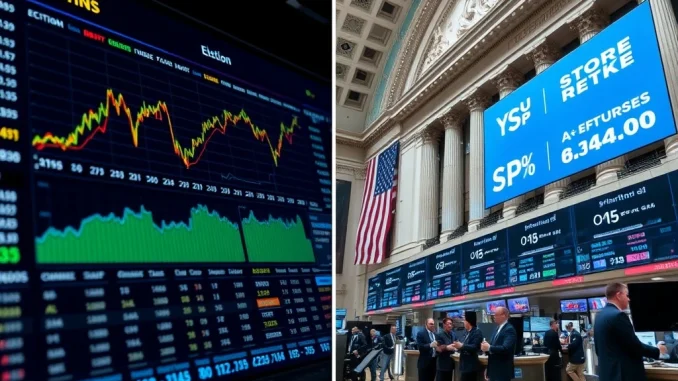
Polymarket Election Bet: NYSE President Reveals Stunning Link to Market Surge
New York, April 2025: A startling connection between blockchain-based prediction markets and traditional financial indices has emerged from the highest echelons of Wall Street. NYSE President Lynn Martin has publicly stated that betting activity on the platform Polymarket, specifically its shifting odds for the 2024 U.S. presidential election, preceded a noticeable spike in S&P 500 index futures. This revelation, coupled with the news that Intercontinental Exchange (ICE) invested a staggering $2 billion in Polymarket, signals a pivotal moment where decentralized information markets are beginning to influence the world’s most established financial systems. The implications for traders, regulators, and the future of market intelligence are profound.
Polymarket Election Bet Preceded Traditional Market Movement
In detailed remarks, NYSE President Lynn Martin pointed to a specific sequence of events in early 2024. On the Polymarket platform, a contract concerning the outcome of the U.S. presidential election saw a significant and rapid increase in the probability assigned to a victory for former President Donald Trump. This shift, driven by the collective bets of thousands of users aggregating disparate information, occurred just hours before a corresponding upward move in S&P 500 futures contracts. Martin’s analysis suggests that sophisticated market participants, including hedge funds and institutional traders, were monitoring these prediction markets as a leading sentiment indicator. They then acted on that intelligence within traditional equity derivatives markets. This isn’t mere correlation, according to financial analysts reviewing the timeline; it represents a new, real-time feedback loop where crowd-sourced foresight on geopolitical events can trigger capital flows in multi-trillion-dollar asset classes.
The Mechanics and Rise of Blockchain Prediction Markets
To understand this impact, one must first grasp how platforms like Polymarket function. Unlike traditional polls or analyst reports, these are peer-to-peer betting markets built on blockchain technology, typically using cryptocurrencies like USDC for stakes.
- Event Contracts: Users trade shares in the outcome of specific events (e.g., “Donald Trump wins the 2024 election”).
- Price as Probability: The trading price of a “YES” share directly reflects the market’s collective probability of that event occurring.
- Incentive for Accuracy: Participants profit by being correct, creating a powerful financial motive to uncover and act on accurate information.
- Global and Permissionless: Anyone with an internet connection and crypto can participate, potentially capturing insights outside traditional media or financial circles.
This model, known as a “prediction market,” has academic roots in the concept of the “wisdom of crowds” and the efficient market hypothesis. The blockchain component ensures transparency, immutability of trades, and global accessibility, removing intermediaries and allowing for continuous, 24/7 trading on world events.
ICE’s $2 Billion Bet on the Future of Information
The credibility of this nexus was massively amplified by the strategic investment from Intercontinental Exchange (ICE). As the parent company of the New York Stock Exchange, ICE is a bedrock institution of global finance. Its decision to commit $2 billion in capital to Polymarket is not a speculative gamble on a crypto startup; it is a strategic acquisition of next-generation market data infrastructure. ICE understands that the real-time, financially-incentivized information aggregation happening on prediction markets could become a valuable commodity. This investment validates the entire sector and suggests a future where data feeds from platforms like Polymarket are integrated directly into the analytical tools used by institutional investors, potentially alongside traditional news wires and economic reports.
Historical Context and Regulatory Crossroads
The relationship between prediction and financial markets is not entirely new. For decades, political futures contracts traded on exchanges like the Iowa Electronic Markets have shown remarkable forecasting accuracy. However, their scale was limited and their reach academic. The innovation of blockchain has removed scalability and regulatory constraints, creating global markets with significant liquidity. This rapid growth now places the technology at a regulatory crossroads. The Commodity Futures Trading Commission (CFTC) has previously engaged with Polymarket, leading to a settlement over offering unregistered event-based swap contracts. The current activity exists in a nuanced space—is it gambling, a financial derivative, or a novel form of information service? Lynn Martin’s comments will undoubtedly intensify scrutiny from the Securities and Exchange Commission (SEC) and CFTC, as the demonstrated impact on regulated securities markets forces a reevaluation of their classification and oversight.
Implications for Traders and Market Efficiency
For professional traders and asset managers, Martin’s statement is a clarion call. Prediction markets are evolving from a niche curiosity to a must-watch data source. Their potential advantages are clear:
- Leading Indicator: They can incorporate unconventional data and global perspectives faster than traditional polling or analyst consensus.
- Sentiment Gauge: They provide a pure, price-based measure of market sentiment on binary geopolitical risks.
- Arbitrage Opportunities: Disconnects between prediction market odds and the pricing of related assets (like sector-specific ETFs or volatility indices) may create new arbitrage strategies.
However, risks abound. These markets can be volatile and susceptible to manipulation or misinformation campaigns. Their liquidity, while growing, is minuscule compared to traditional futures, meaning large trades can skew odds. The critical lesson is that market efficiency is being redefined; information is now flowing from decentralized crypto networks into the heart of Wall Street, and ignoring this flow could mean missing pivotal market moves.
Conclusion
The revelation from NYSE President Lynn Martin that a Polymarket election bet served as a canary in the coal mine for S&P futures is a landmark event in financial history. It empirically demonstrates that blockchain-based prediction markets have matured beyond theoretical exercises to become tangible influencers of capital allocation. The subsequent $2 billion investment by ICE provides monumental institutional validation. As these two worlds—decentralized crypto information markets and centralized traditional finance—continue to converge, market participants must adapt. Regulators face complex new challenges, while traders gain powerful, if volatile, new tools. The market surge linked to Polymarket is more than a price movement; it is a signal that the future of market intelligence is being crowdsourced, tokenized, and traded in real-time on the blockchain.
FAQs
Q1: What exactly did the NYSE President say about Polymarket?
NYSE President Lynn Martin stated that observable activity on the Polymarket prediction platform, specifically a shift in odds for the 2024 U.S. presidential election, occurred just prior to a measurable spike in S&P 500 index futures. She cited this as evidence that blockchain-based betting platforms are beginning to influence traditional financial markets.
Q2: Why is ICE’s $2 billion investment in Polymarket significant?
Intercontinental Exchange (ICE) is the parent company of the NYSE and a cornerstone of global financial infrastructure. Its massive investment signals that major institutional players view prediction market data as a strategically valuable asset class and information service, not merely a crypto novelty. It grants immense credibility to the entire sector.
Q3: How do prediction markets like Polymarket work?
Users trade event outcome shares (e.g., “YES” or “NO” on a specific event) using cryptocurrency. The market price of a “YES” share represents the collective, financially-incentivized probability the market assigns to that event happening. Profits go to those who correctly predict the outcome.
Q4: Are prediction markets accurate?
Academic studies and historical track records, such as from the Iowa Electronic Markets, suggest well-designed, liquid prediction markets often outperform polls and experts in forecasting elections and other events. Their accuracy stems from the “wisdom of crowds” effect and the profit motive for being correct.
Q5: What are the main regulatory concerns surrounding prediction markets?
Key concerns include determining whether they constitute illegal gambling, unregulated securities trading, or off-exchange futures contracts. Their potential for manipulation, impact on real-world events, and now, demonstrated influence on regulated securities markets, complicates the regulatory landscape for bodies like the CFTC and SEC.
Related News
- Bitcoin Price Plummets: BTC Falls Below $83,000 in Sudden Market Shift
- Bithumb Unveils Exciting Camp Network (CAMP) Listing for Robust KRW Trading
- Crypto Investment 2026: Security Challenges and AI Opportunities Reshape Blockchain Landscape
Related: Modular Financial Infrastructure: The Revolutionary End of Monolithic Banking Systems
Related: Pivotal SEC Decision Looms for T. Rowe Price's XRP-Inclusive Crypto ETF