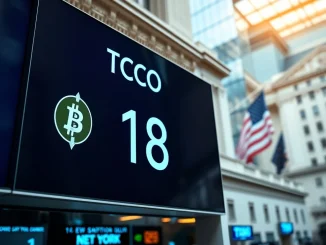
Bitwise Prediction Market ETF: The Groundbreaking 2028 U.S. Election Fund Filing Explained
New York, April 2025: In a landmark move for both finance and political technology, asset manager Bitwise has filed with the U.S. Securities and Exchange Commission (SEC) for a prediction market Exchange-Traded Fund (ETF) specifically targeting the 2028 United States elections. This filing represents a pivotal moment, marking the first serious attempt to bring regulated, exchange-traded exposure to political event contracts to the mainstream public markets. The proposed fund, tied to Bitwise’s newly launched PredictionShares platform, signals a dramatic institutional embrace of prediction markets beyond their traditional crypto and niche academic roots.
Bitwise Prediction Market ETF: Decoding the SEC Filing
The filing, submitted on Form N-1A, outlines a fund designed to track an index of political event contracts. These contracts would function as binary options on specific, verifiable outcomes related to the 2028 presidential, congressional, and gubernatorial elections. For example, a contract might pay out if a particular candidate wins a party’s nomination or secures a specific state’s electoral votes. The core mechanism relies on the aggregation of crowd-sourced probability estimates, a concept long studied in academic circles for its accuracy. Bitwise’s proposal argues that by packaging these contracts into an ETF structure, it provides several key advantages:
- Regulated Access: Investors gain exposure through a familiar, SEC-registered vehicle, bypassing the regulatory gray areas of offshore prediction markets.
- Liquidity and Transparency: The ETF would trade on major U.S. exchanges like the NYSE Arca, offering daily liquidity and full transparency into holdings and prices.
- Diversification: The fund would hold a basket of contracts, mitigating the risk associated with any single electoral outcome.
This move is not Bitwise’s first foray into innovative funds. The firm, initially known for its cryptocurrency index funds and Bitcoin ETF, is strategically expanding its product suite. The prediction market ETF filing demonstrates a clear thesis: that event-driven financial instruments are the next frontier for asset management.
The PredictionShares Platform and the Institutional Demand Driving the Move
Concurrent with the ETF filing, Bitwise has launched PredictionShares, a dedicated platform for these political event contracts. The platform is designed to be the underlying engine that creates, prices, and settles the contracts the proposed ETF would track. Industry analysts point to several factors converging to create demand for such a product. The 2020 and 2024 election cycles saw unprecedented volumes in political betting on offshore platforms and decentralized prediction markets like Polymarket. This activity, however, remained largely inaccessible to regulated institutional capital due to compliance and custody concerns.
“The filing is a direct response to pent-up institutional demand,” explains financial analyst Michael Chen of FinTech Insights Group. “Pension funds, hedge funds, and family offices have watched the predictive accuracy of these markets but lacked a compliant on-ramp. Bitwise is building that bridge. They are not creating a casino; they are creating a new asset class based on information aggregation.” The following table contrasts traditional political betting with the proposed ETF model:
| Aspect | Traditional Political Betting | Bitwise Prediction Market ETF |
|---|---|---|
| Regulatory Status | Largely unregulated or offshore | SEC-registered, exchange-traded |
| Accessibility | Restricted by jurisdiction, often for individuals | Available to all investors via brokerage accounts |
| Primary Function | Gambling / Speculation | Price discovery & risk hedging |
| Transparency | Low; odds set by bookmakers | High; prices set by market participants |
| Underlying Asset | Betting slip | Financial contract on a verifiable event |
The Regulatory Hurdles and Historical Context of Prediction Markets
The path to approval is fraught with regulatory challenges. The SEC and the Commodity Futures Trading Commission (CFTC) have historically viewed event contracts with skepticism, often equating them with gambling. A key precedent is the CFTC’s rejection of similar contracts proposed by KalshiEX in 2023, citing concerns over the “gambling” nature of political event derivatives. Bitwise’s approach appears designed to navigate these concerns by emphasizing the ETF’s role in providing regulated exposure to a market that already exists informally.
The intellectual foundation for prediction markets dates back decades. The Iowa Electronic Markets, operated by the University of Iowa, have run as a research project since 1988, allowing limited trading on election outcomes. Academic studies have consistently shown these markets to be as accurate, or more accurate, than traditional polls in forecasting results. Bitwise’s model commercializes this academic concept at scale, arguing that a liquid, regulated market would serve a public good by providing a real-time, dollar-weighted snapshot of election probabilities.
Implications for Investors, Politics, and Financial Markets
If approved, the Bitwise prediction market ETF would create novel dynamics. For investors, it offers a pure-play hedging tool. A political advocacy group concerned about a policy outcome could theoretically short the relevant contract. A corporation could hedge regulatory risk tied to a specific election result. This moves beyond speculation into the realm of practical risk management.
For the political ecosystem, the implications are profound. A transparent, high-stakes market could become a leading indicator watched as closely as polling data. It could also attract scrutiny regarding potential market manipulation or the ethical questions of “putting a price” on democratic processes. Proponents counter that the price discovery function is inherently democratic, aggregating global intelligence.
Finally, for financial markets, this represents a significant expansion of what an ETF can be. ETFs have evolved from tracking stock and bond indices to holding physical commodities and cryptocurrencies. Tracking the collective wisdom on future events is a logical, albeit radical, next step. Success could open the door to ETFs for other major event categories, from corporate earnings to climate milestones.
Conclusion
The filing by Bitwise for a prediction market ETF targeting the 2028 U.S. elections is more than a financial product launch; it is a test case for the integration of collective intelligence into the regulated capital markets. By leveraging the ETF wrapper and the new PredictionShares platform, Bitwise is challenging regulators and the investment community to reimagine the boundary between information markets and asset markets. While significant hurdles remain, the filing undeniably marks a watershed moment, reflecting intense institutional interest in gaining regulated exposure to political and event-driven risk. The coming months of SEC review will determine whether this innovative vision for a 2028 election fund becomes a tradable reality.
FAQs
Q1: What exactly is a prediction market ETF?
A prediction market ETF is an exchange-traded fund designed to track the value of financial contracts based on the outcome of future events, like elections. Instead of holding stocks, it would hold contracts that pay out if a specific, verifiable event occurs.
Q2: How is Bitwise’s proposed ETF different from gambling on the election?
The key differences are regulation and structure. The ETF would be registered with the SEC, trade on a national exchange, and provide transparency and investor protections absent from offshore betting sites. Its proponents frame it as a tool for price discovery and hedging, not mere speculation.
Q3: What is the PredictionShares platform?
PredictionShares is Bitwise’s proprietary platform for creating, trading, and settling event contracts. It is the underlying engine that would generate the contracts the proposed ETF aims to track, providing the liquidity and market infrastructure.
Q4: What are the main regulatory obstacles to this ETF being approved?
The primary obstacle is the longstanding view by U.S. regulators like the SEC and CFTC that event contracts resemble gambling. The agencies must be convinced that these contracts serve a legitimate economic purpose (hedging, price discovery) and can be offered without fraud or manipulation.
Q5: Could this ETF influence the actual 2028 election?
Analysts debate this. A transparent, liquid market could become a highly visible indicator of candidate viability, potentially influencing media narrative and donor behavior. However, like any market, it reflects existing information and sentiment rather than dictating votes directly.
Related News
- Pump.fun Deposits $148M in Stablecoins to Kraken: Unraveling the Massive Crypto Transaction
- 7 Altcoins With Room To Grow in Cryptocurrency Market
- Urgent: Binance RUNE Deposits Halted for Critical Network Upgrade
Related: Centrifuge and Pharos Forge Pivotal Alliance to Scale Institutional Assets Onchain
Related: High-Performance Stablecoin Payments: xMoney Integrates USDC on Hedera for Enterprise Merchants
Related: Quantum Threat Bitcoin: CryptoQuant Founder Issues Stark Warning About Satoshi's Vulnerable BTC