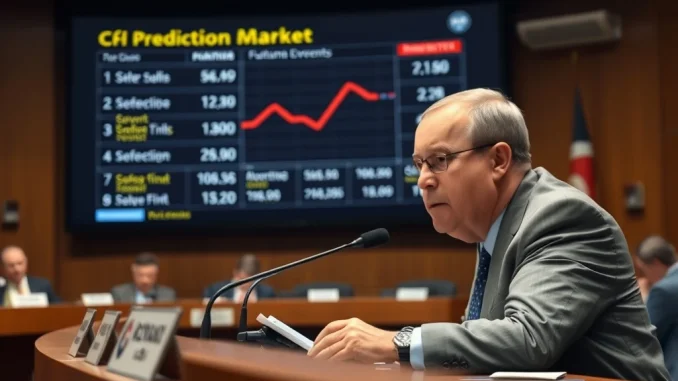
CFTC Chair Michael Selig Vows to Defend Federal Oversight of Prediction Markets
Washington, D.C., April 2025: In a significant move that underscores a growing regulatory clash, Commodity Futures Trading Commission (CFTC) Chairman Michael Selig has formally intervened to defend the agency’s authority over prediction markets. The chairman filed an amicus brief and made public statements affirming the CFTC’s commitment to federal oversight, a stance that directly challenges several state-level lawsuits and ongoing scrutiny from the U.S. Senate. This action places the future of event-based trading platforms, which allow users to speculate on political, economic, and entertainment outcomes, at the center of a complex legal and jurisdictional debate.
CFTC Chairman Asserts Federal Jurisdiction Over Prediction Markets
Chairman Michael Selig’s intervention represents a clear and authoritative statement from the nation’s primary derivatives regulator. The amicus brief, a legal document filed by a non-litigant with a strong interest in the subject matter, argues that prediction markets offering binary options or futures contracts on event outcomes fall squarely under the CFTC’s regulatory purview as established by the Commodity Exchange Act. This federal framework, Selig contends, preempts conflicting state laws that might seek to ban or criminalize such platforms. The chairman’s remarks emphasize that consistent federal oversight is crucial for market integrity, consumer protection, and preventing fraud—objectives that could be undermined by a patchwork of disparate state regulations. This position is not new but has gained renewed urgency as specific platforms face legal challenges in states like Texas and New York, where attorneys general have alleged they constitute illegal gambling operations.
The Legal and Political Battle Surrounding Event Contracts
The core of the dispute hinges on the legal classification of prediction markets. Are they sophisticated financial instruments for hedging and price discovery, or are they merely sophisticated forms of gambling? The CFTC’s historical stance, reinforced by Selig, leans decisively toward the former. The agency has previously approved designated contract markets (DCMs) to list event contracts on non-economic indicators, such as election results or weather events, provided they meet specific criteria. However, this regulatory approach has faced persistent opposition. Key points of contention include:
- Senate Scrutiny: A bipartisan group of senators, led by Senators Jon Tester and Chuck Grassley, has repeatedly expressed concerns. They argue that allowing betting on elections, for example, could undermine democratic processes and are pushing for legislation like the Predictable Markets Act to explicitly ban such contracts.
- State Lawsuits: Several state attorneys general, operating under local gambling statutes, have filed suits against prediction market platforms. They argue these platforms operate without state licenses and facilitate wagering, not investment.
- Regulatory Precedent: The CFTC points to its successful oversight of similar derivatives for decades, arguing its expertise and existing rules are sufficient to manage the unique risks of event contracts without needing an outright ban or ceding control to states.
Historical Context and the Path to This Showdown
The current conflict has roots in regulatory decisions made over the past 15 years. In 2012, the CFTC granted North American Derivatives Exchange (Nadex) the ability to offer event binary options. Later, in 2020, the commission allowed KalshiEX to become a designated contract market for event contracts, a decision that was narrowly approved (3-2) and immediately drew criticism. Chairman Selig, who served as counsel for the committee that drafted the Dodd-Frank Act, brings a deep understanding of legislative intent to his role. He argues that Congress, through the Dodd-Frank Act, empowered the CFTC to regulate swaps and futures broadly, a mandate that encompasses the novel structures of prediction markets. This experience-driven perspective informs his current defense, framing state lawsuits not just as legal challenges, but as threats to a coherent national market structure.
Implications for Innovation, Markets, and Participants
The outcome of this regulatory standoff will have tangible consequences for multiple stakeholders. For financial technology innovators, a victory for federal oversight provides a clearer, singular rulebook for launching and operating prediction platforms in the United States. Conversely, a shift toward state control or a congressional ban would stifle this niche of fintech development. For traders and institutions, the CFTC’s model offers protections like:
- Capital and margin requirements for operators.
- Transparency through exchange listing and price reporting.
- Surveillance for market manipulation and insider trading.
- Clear dispute resolution mechanisms.
These safeguards are largely absent in unregulated or state-regulated gambling frameworks. Furthermore, academics and economists who support prediction markets argue they are valuable tools for aggregating information and forecasting, providing data often more accurate than polls. A ban or severe restriction, they contend, would eliminate a legitimate source of economic intelligence.
Conclusion: A Defining Moment for Market Regulation
CFTC Chairman Michael Selig’s vow to defend federal oversight of prediction markets marks a critical juncture in the integration of novel financial technologies into the existing regulatory landscape. His action, grounded in the agency’s expertise and statutory authority, sets the stage for a potentially landmark legal and legislative battle. The resolution will determine whether prediction markets evolve as a regulated financial instrument under the watchful eye of the CFTC or are relegated to the shadows by a combination of state lawsuits and federal prohibition. The core principles of market integrity, innovation, and federalism are now in the balance, with the CFTC firmly stating its case for a unified national approach.
FAQs
Q1: What are prediction markets?
Prediction markets are exchange-traded platforms where participants can buy and sell contracts whose payout is tied to the outcome of a specific future event, such as an election result, economic data release, or awards show winner. They are used for hedging, speculation, and as a collective forecasting tool.
Q2: Why is the CFTC involved in regulating them?
The CFTC asserts jurisdiction because these contracts often function like binary options or futures contracts, which are derivative instruments under the Commodity Exchange Act. The agency regulates derivatives markets to ensure transparency, prevent fraud and manipulation, and protect participants.
Q3: What is the main argument of the state lawsuits?
State attorneys general argue that these platforms constitute illegal gambling or bookmaking under state law because users are essentially wagering on events without a material interest in the underlying outcome, and the platforms are not licensed as gambling operators.
Q4: What is an amicus brief, and why did Chairman Selig file one?
An amicus curiae (“friend of the court”) brief is a legal document filed by an entity not party to a case but with a strong interest in its outcome. Chairman Selig filed one to formally present the CFTC’s expert view on why federal law preempts state law in this area, aiming to influence the court’s decision.
Q5: What happens if the states win their lawsuits?
If state lawsuits succeed, prediction market platforms could be banned or forced to shut down operations in those specific states, creating a fragmented U.S. market. It could also encourage other states to file similar suits, potentially making nationwide operation untenable without a change in federal law.
Related News
- U.S. Spot Bitcoin ETFs See Longest Inflow Streak Since February
- Exclusive: Binance HAEDAL Listing & HODLer Airdrop Unlocked
- Major US Stock Indices Open Lower: S&P 500, Nasdaq, and Dow All Decline at Bell
Related: Bittensor Dominates AI Crypto Social Rankings as LimeWire, Virtuals, and Venice Compete for Voice
Related: Stablecoin Yield Orchestration Platform: Ymax Opens Crucial Early Access to DeFi Users
Related: Crypto Investment Volume Surges: SUI and ZRO Lead Weekly Capital Inflows