XRP Price News: EU Digital Euro Endorsement Coincides with Market Pressure as AI Presale Gains Attention
Brussels, Belgium, March 2025: The European Union’s formal endorsement of a digital euro represents a watershed moment for financial technology, creating immediate ripples across the cryptocurrency landscape. This significant regulatory and technological development arrives during a period of notable pressure for several major digital assets, including XRP, while projects like DeepSnitch AI approach critical milestones in their development roadmaps. The convergence of these events provides a clear snapshot of a maturing, complex market where traditional finance and digital innovation increasingly intersect.
XRP Price News and Market Context
The price of XRP has experienced a period of downward momentum in recent trading sessions, a trend that market analysts attribute to a confluence of factors beyond any single event. While the digital euro announcement captures headlines, traders and long-term holders are assessing a broader environment. Key influences include general market sentiment, which often sees correlated movements across major cryptocurrencies, and ongoing regulatory clarity, or lack thereof, in various global jurisdictions. The asset’s performance must be viewed within its historical context, having weathered significant legal challenges and market cycles since its inception. Technical analysis indicates key support and resistance levels that institutional and retail traders are monitoring closely, with trading volume and on-chain activity providing deeper insights into holder behavior than price alone.
The EU Digital Euro: Implications for Cryptocurrency
The European Central Bank’s move to endorse a digital euro is not a sudden development but the culmination of years of research, consultation, and pilot programs. A central bank digital currency (CBDC) like the digital euro differs fundamentally from decentralized cryptocurrencies. It is a digital form of sovereign currency, issued and backed by the ECB, designed for stability and integration with the existing euro financial system. Its primary goals include ensuring monetary sovereignty in a digital age, improving payment system efficiency, and providing a secure digital payment option for citizens. For the broader crypto market, the endorsement signals a critical shift: the formal acknowledgment by a major economic bloc that the future of money is digital. This legitimizes the underlying technology while simultaneously introducing a regulated, state-backed competitor to private payment tokens and stablecoins.
Comparative Analysis: CBDCs vs. Cryptocurrencies
Understanding the distinction is crucial for market analysis. The following table outlines the core differences:
| Feature | Digital Euro (CBDC) | Cryptocurrencies (e.g., XRP, Bitcoin) |
|---|---|---|
| Issuer | European Central Bank (Centralized) | Decentralized Network or Private Entity |
| Backing | Full faith and credit of the EU | Algorithm, Utility, or Market Demand |
| Primary Goal | Monetary Policy, Payment Efficiency | Various (Payments, Store of Value, Smart Contracts) |
| Volatility | Designed for Price Stability (1:1 with Euro) | Typically High Price Volatility |
| Regulatory Status | Fully Regulated Financial Instrument | Evolving Regulatory Frameworks |
This development may pressure cryptocurrencies that position themselves primarily as payment rails, pushing them to demonstrate unique value propositions beyond what a state-backed digital currency can offer, such as cross-border settlement speed or programmability.
Cardano’s Market Position and Development Focus
While the XRP price news highlights volatility, Cardano (ADA) has exhibited relative price stability, described in trading parlance as ‘flatlining.’ This stability often reflects a period of consolidation, where the asset’s price moves within a narrow band. For Cardano, this coincides with its continued focus on long-term, peer-reviewed development rather than short-term market movements. The Cardano ecosystem is actively building out its layer-2 scaling solution, Hydra, and fostering growth in its decentralized application (dApp) landscape. Market observers note that such periods of low volatility can precede significant moves, either upward or downward, depending on broader market catalysts or project-specific news. The project’s methodical approach aims to build a robust and secure blockchain foundation, a strategy that appeals to a different segment of investors than those focused on high-frequency trading.
DeepSnitch AI Presale and the Q1 2026 Horizon
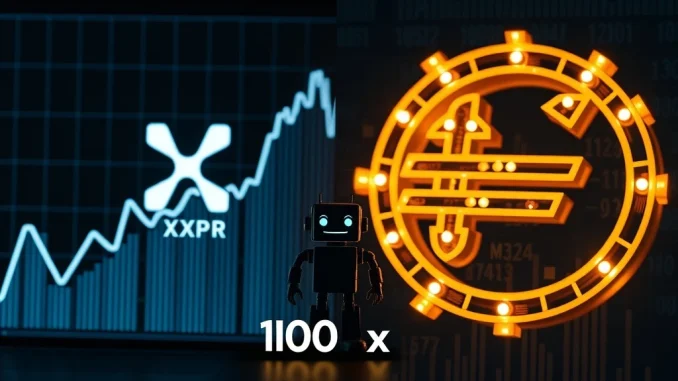
Amidst the movements of established assets, the presale phase for DeepSnitch AI represents a different facet of the cryptocurrency market: early-stage project fundraising. The project, which integrates artificial intelligence with blockchain mechanisms for smart contract auditing and security, is approaching a key token generation event (TGE) and exchange listing targeted for Q1 2026. Presales allow projects to raise capital from early supporters before a public launch. The cited “1000x” potential is a common, though highly speculative, narrative in presale marketing, referring to the possibility of significant returns from the initial price. Investors conduct due diligence on such projects by examining:
- The Team: Background and experience in AI and blockchain.
- The Problem: Does it address a genuine need, like smart contract security?
- The Technology: Whitepaper clarity and technical feasibility.
- The Tokenomics: Supply, distribution, and utility of the token.
- The Roadmap: Achievable milestones and development timeline.
The Q1 2026 launch date provides a long runway, during which the team must deliver on development promises amidst a potentially very different macroeconomic and regulatory climate.
The Role of AI in Blockchain’s Future
The emergence of projects like DeepSnitch AI highlights a growing convergence between artificial intelligence and blockchain technology. Potential applications extend beyond security to include:
- Automated market making and decentralized finance (DeFi) strategies.
- Data analysis for on-chain analytics and investment insights.
- Optimization of blockchain network operations and governance.
This trend suggests that future cryptocurrency valuations may increasingly factor in a project’s innovative use of adjacent technologies like AI, not just its core blockchain functionality.
Conclusion
The current XRP price news cycle, occurring alongside the EU’s historic endorsement of a digital euro, underscores a market in transition. Established assets like XRP and Cardano navigate complex waters defined by regulation, competition from state-backed digital currencies, and evolving investor expectations. Simultaneously, the presale market for innovative projects like DeepSnitch AI continues to attract capital seeking high-growth opportunities, albeit with commensurate risk. For observers and participants, the key takeaway is the increasing sophistication of the digital asset space, where macroeconomic policy, technological innovation, and market sentiment are inextricably linked. Understanding these connections, rather than reacting to isolated price movements, is essential for navigating the future of finance.
FAQs
Q1: What is a digital euro, and how is it different from Bitcoin or XRP?
The digital euro is a Central Bank Digital Currency (CBDC). It is a digital form of cash issued and guaranteed by the European Central Bank, making it a sovereign currency. Unlike decentralized cryptocurrencies like Bitcoin (a store of value) or XRP (a payment rail), it is centralized, regulated, and designed for price stability, mirroring the physical euro’s value.
Q2: Why would the EU digital euro affect XRP’s price?
The digital euro introduces a major, state-backed competitor in the digital payments space. If investors perceive that a CBDC could reduce the future utility or adoption of private payment-focused cryptocurrencies, it may influence market sentiment and selling pressure, contributing to price declines. However, many factors influence price, and correlation does not equal causation.
Q3: What does it mean for Cardano to “flatline”?
In financial markets, “flatlining” refers to a period of very low price volatility, where an asset’s value trades within a very narrow range. It indicates a lack of strong directional momentum from either buyers or sellers and is often a period of consolidation before the next significant price move, based on new information or market shifts.
Q4: What is a cryptocurrency presale, and what does “1000x” mean?
A presale is an early fundraising round where a new blockchain project sells its tokens to select investors before a public launch. The “1000x” terminology is speculative marketing, suggesting the token’s value could theoretically multiply by one thousand times from its initial presale price if the project becomes wildly successful. It represents high-risk, high-reward potential.
Q5: When is DeepSnitch AI scheduled to launch?
Based on available information, DeepSnitch AI is targeting a full token generation and exchange listing event in the first quarter of 2026 (Q1 2026). This is a forward-looking projection, and such dates in the cryptocurrency space are subject to change based on development progress, regulatory considerations, and market conditions.
Related News
- On-Chain Vault Market Poised to Double, Bitwise Reveals Stunning Growth Forecast
- Binance Futures Unleashes Massive Web3 Expansion: ZORAUSDT, TAGUSDT & DELABS TGE
- Bithumb Announces Crucial Bitlayer (BTR) Listing: Exciting New KRW Trading Opportunity
Related: Revealing: Coinbase CEO Stock Sale of $550 Million Coincides with Market Turbulence