Dogecoin Price Prediction: Analyzing Market Sentiment as DeepSnitch AI Presale Reaches $1.46M
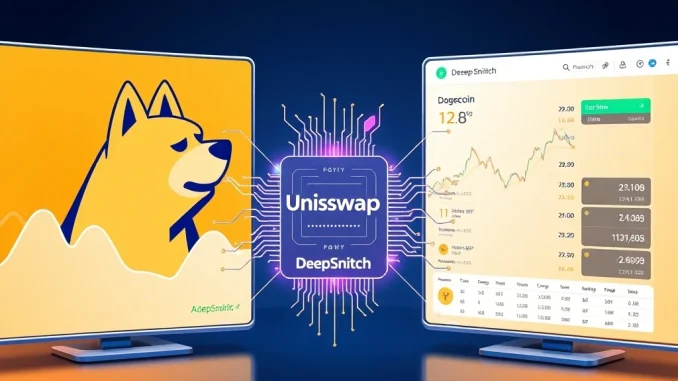
Global Cryptocurrency Markets, May 2025: Recent market activity shows Dogecoin (DOGE) and Uniswap (UNI) traders monitoring emerging developments in the artificial intelligence sector, particularly the DeepSnitch AI project that has reportedly secured $1.46 million in its ongoing presale phase. This intersection of meme coin markets, decentralized finance platforms, and AI-driven analytics tools presents a complex landscape for cryptocurrency investors seeking to understand broader market dynamics.
Current Dogecoin Market Analysis and Price Trajectory
Dogecoin, the proof-of-work cryptocurrency that originated as a meme in 2013, continues to demonstrate significant volatility within the broader digital asset ecosystem. As of May 2025, DOGE maintains its position among the top fifteen cryptocurrencies by market capitalization, though its price has experienced fluctuations characteristic of assets with strong retail investor participation. Market analysts typically examine several key indicators when assessing Dogecoin’s potential trajectory, including trading volume patterns, whale wallet movements, and broader cryptocurrency market sentiment.
Historical data reveals that Dogecoin’s price movements often correlate with social media trends and celebrity endorsements, though this relationship has become more nuanced in recent years as institutional participation has increased. The cryptocurrency’s inflationary supply model, with approximately 5 billion new DOGE entering circulation annually, represents a fundamental factor that distinguishes it from Bitcoin’s fixed supply and influences long-term valuation models. Technical analysts currently monitor support and resistance levels established throughout 2024, with particular attention to how DOGE responds to movements in Bitcoin’s price, given the continued high correlation between major cryptocurrencies.
Uniswap Market Dynamics and DeFi Integration
Uniswap, the leading decentralized exchange operating on the Ethereum blockchain, represents a cornerstone of the decentralized finance (DeFi) ecosystem. UNI token holders participate in governance decisions for the protocol, which facilitates automated token swaps through liquidity pools rather than traditional order books. Recent market data indicates sustained trading volume across Uniswap’s various versions, with particular strength in Ethereum-based token pairs and growing activity on layer-2 scaling solutions.
The relationship between Uniswap and tokens like Dogecoin exists primarily through wrapped versions of DOGE that operate on the Ethereum blockchain, enabling DeFi applications including lending, yield farming, and liquidity provision. This interoperability between different blockchain ecosystems has created new utility pathways for assets originally designed for simpler transactional purposes. Market observers note that UNI token valuation often reflects broader DeFi adoption metrics, including total value locked (TVL), user growth, and protocol fee generation, providing a fundamentally different investment thesis compared to meme-based cryptocurrencies.
- Protocol Revenue: Uniswap generates fees through a percentage of each trade executed on its platform, distributing a portion to liquidity providers.
- Governance Activity: UNI holders vote on proposals affecting fee structures, treasury management, and protocol upgrades.
- Multi-Chain Expansion: Uniswap has deployed on multiple blockchain networks beyond Ethereum, potentially increasing its addressable market.
DeepSnitch AI Presale Context and Technology Overview
The DeepSnitch AI project represents a developing segment within cryptocurrency markets: AI-driven analytics platforms designed to process blockchain data, identify trading patterns, and provide market intelligence. The reported $1.46 million presale achievement indicates investor interest in tools that might offer analytical advantages in increasingly complex digital asset markets. According to available documentation, DeepSnitch AI proposes to utilize machine learning algorithms to analyze on-chain transactions, social sentiment, and technical indicators across multiple cryptocurrency assets.
Similar AI analytics platforms have emerged throughout 2024, with varying degrees of adoption among professional trading firms and retail investors. The fundamental value proposition centers on processing vast amounts of blockchain data more efficiently than human analysts, potentially identifying trends or anomalies that might inform trading decisions. However, cryptocurrency analysts emphasize that AI tools represent analytical aids rather than predictive guarantees, as market movements continue to be influenced by unpredictable variables including regulatory developments, macroeconomic factors, and technological breakthroughs.
Interconnected Market Movements and Trader Behavior
The simultaneous attention from DOGE and UNI traders toward the DeepSnitch AI presale highlights evolving strategies within cryptocurrency markets. Dogecoin traders, traditionally focused on social momentum and community-driven campaigns, appear increasingly interested in sophisticated analytical tools. Meanwhile, Uniswap participants operating within the DeFi ecosystem naturally engage with emerging technologies that promise enhanced market intelligence, given the complex interdependencies between various DeFi protocols and assets.
This convergence suggests a maturation within certain segments of cryptocurrency trading, where meme coin enthusiasts and DeFi participants both seek informational advantages in competitive markets. Historical parallels exist in traditional finance, where retail investors gradually adopted tools previously exclusive to institutional players. The specific interest in AI-driven analytics reflects broader technological trends across financial markets, where machine learning applications have become increasingly prevalent for pattern recognition, risk assessment, and automated trading systems.
| Metric | Dogecoin (DOGE) | Uniswap (UNI) | AI Analytics Sector |
|---|---|---|---|
| Primary Use Case | Transactional / Meme | Governance / DeFi | Market Intelligence |
| Market Cap Category | Large Cap | Mid-Large Cap | Emerging / Niche |
| Price Drivers | Social Sentiment, BTC Correlation | DeFi Adoption, Protocol Fees | Technology Adoption, Accuracy |
| Investor Profile | Mixed Retail/Institutional | DeFi Native, Institutional | Technologically Focused |
Regulatory and Market Risk Considerations
All cryptocurrency investments, including those in established assets like Dogecoin and Uniswap or emerging projects like DeepSnitch AI, carry inherent risks that investors must carefully evaluate. Regulatory developments continue to shape cryptocurrency markets globally, with varying approaches to classification, taxation, and oversight across different jurisdictions. The United States Securities and Exchange Commission and other regulatory bodies worldwide have increased scrutiny of cryptocurrency offerings, particularly those involving presales or token distributions that might constitute securities offerings under existing laws.
Market participants should consider several risk factors when evaluating cryptocurrency opportunities. Volatility remains substantially higher than traditional asset classes, with price swings of 10-20% within single trading sessions occurring regularly. Technological risks include smart contract vulnerabilities, blockchain network congestion, and potential security breaches. Furthermore, the emerging nature of AI analytics platforms means limited track records for evaluating performance claims, requiring particularly diligent due diligence from interested participants.
Conclusion
The intersection of Dogecoin price prediction discussions, Uniswap market activity, and interest in the DeepSnitch AI presale illustrates the multidimensional nature of contemporary cryptocurrency markets. While each represents distinct segments with different fundamental characteristics—meme coin, DeFi governance, and AI analytics—their convergence in trader attention reflects the interconnected ecosystem that digital assets have become. Responsible market participation requires understanding these distinct value propositions, risk profiles, and technological foundations rather than pursuing exaggerated return projections. As cryptocurrency markets continue evolving toward greater sophistication, the integration of advanced analytical tools with established trading communities represents a natural progression in market development, though always within the context of substantial volatility and uncertainty that defines this asset class.
FAQs
Q1: What factors typically influence Dogecoin’s price movements?
Dogecoin’s price responds to several factors including broader cryptocurrency market trends (particularly Bitcoin’s price), social media sentiment and celebrity mentions, trading volume patterns, and developments within its ecosystem. Its inflationary supply model, with approximately 5 billion new DOGE created annually, also represents a fundamental consideration for long-term valuation.
Q2: How does Uniswap generate value for UNI token holders?
Uniswap generates protocol fees from trades executed on its decentralized exchange. While these fees primarily reward liquidity providers, UNI token holders govern the protocol through voting rights on proposals that can include fee distribution changes, treasury management, and technical upgrades. The token’s value derives from this governance utility and expectations of future protocol adoption.
Q3: What is a cryptocurrency presale and how does it work?
A presale involves offering tokens to early investors before a public launch, typically at a discounted price. Projects use presales to raise development funds and build community support. Participants usually send cryptocurrency to a specified address and receive tokens later when the project launches, though this carries risks including project failure or regulatory challenges.
Q4: How do AI analytics tools like DeepSnitch AI propose to help cryptocurrency traders?
AI analytics platforms typically use machine learning algorithms to process large datasets including blockchain transactions, social media sentiment, trading volumes, and price history. They aim to identify patterns, correlations, or anomalies that might inform trading decisions, though their effectiveness varies and they cannot guarantee predictions in inherently volatile markets.
Q5: What are the main risks associated with emerging cryptocurrency projects?
Key risks include technological vulnerabilities (smart contract bugs, security breaches), regulatory uncertainty (changing classification or compliance requirements), market volatility (extreme price fluctuations), liquidity constraints (difficulty buying/selling), and project execution risk (team capability, roadmap delivery). Thorough due diligence is essential before participating.
Related News
- Meme Coin Mania Faces Its Biggest Test Yet as Trump’s Tariffs Shake the Market—5 Picks to Rebound This Week
- American Entrepreneur Anthony Pompliano Advises Investors To Use Bitcoin Dips For Buying
- Bybit Delisting: Crucial Changes for Seven Spot Trading Pairs Announced
Related: Bitcoin Price at $64K: Why Cautious Traders Await Market Confirmation
Related: Stablecoin Plan: Board of Peace Proposes Digital Currency for Gaza's Postwar Future
Related: Xyber Genesis Sale on Solana: The Critical Infrastructure Launch for Autonomous AI Agents