Global, April 2025: In a significant development for the decentralized finance (DeFi) ecosystem on Solana, the leading aggregator Jupiter has formally integrated with the prediction market platform Polymarket. This integration, first reported by The Block, embeds Polymarket’s services directly within Jupiter’s interface, providing millions of users streamlined access to trade on the outcomes of real-world events. The move capitalizes on surging interest in prediction markets and represents a strategic expansion of Jupiter’s utility beyond traditional token swaps.
Jupiter Integrates with Polymarket: The Mechanics of the Deal
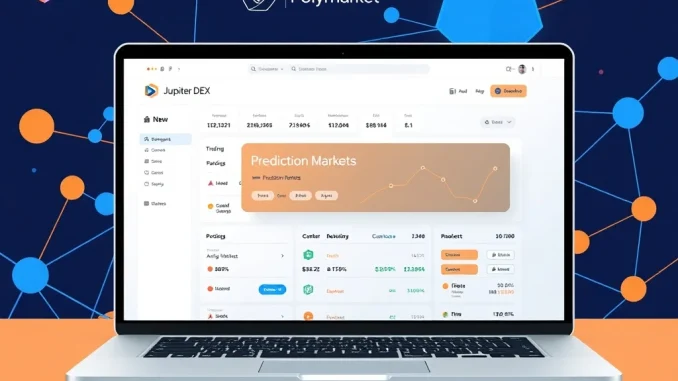
The integration is operational through a dedicated “Prediction Markets” tab within the Jupiter application. This is not a superficial link but a deep technical integration that leverages Jupiter’s existing routing infrastructure and liquidity. Users can now connect their Solana-compatible wallets, such as Phantom or Solflare, and seamlessly access Polymarket’s array of event contracts. The process mirrors Jupiter’s core swap functionality: users select a market, choose a position (e.g., “Yes” or “No”), and execute the trade. Jupiter handles the transaction routing and settlement on the Solana blockchain, while Polymarket provides the market-making and oracle resolution for the events. This collaboration effectively turns Jupiter from a pure exchange aggregator into a more comprehensive DeFi portal.
The Rising Tide of Prediction Markets in Crypto
This integration arrives during a period of remarkable growth for the prediction market sector. Platforms like Polymarket, which operates on Polygon and Arbitrum but is now accessible via Solana through this partnership, have seen trading volumes multiply. This surge is driven by several key factors. First, global events—from elections to macroeconomic announcements—create natural demand for hedging and speculation. Second, decentralized prediction markets offer transparency and censorship resistance that traditional platforms cannot match. Third, the integration of real-world data through decentralized oracles has matured, increasing trust in market resolutions. The table below illustrates the growth trajectory of major prediction market platforms over the last year.
| Platform | Primary Blockchain | Notable Growth Driver |
|---|---|---|
| Polymarket | Polygon, Arbitrum | High-profile political and event markets |
| Augur | Ethereum | Long-established, decentralized protocol |
| PlotX | Polygon | Non-custodial, automated market making |
Jupiter’s move is a direct response to this trend, aiming to capture a share of this growing user activity by lowering the barrier to entry for its existing massive user base.
Strategic Implications for the Solana DeFi Landscape
The integration carries substantial implications for both Jupiter and the broader Solana network. For Jupiter, it is a clear play for increased user engagement and fee revenue. Prediction markets typically have longer holding periods than instant swaps, potentially increasing user retention within the Jupiter ecosystem. For Solana, it represents a diversification of its DeFi offerings. While known for its high-speed, low-cost swaps and nascent lending protocols, Solana has had fewer dedicated prediction market applications. This partnership effectively imports a leading product category onto the chain through one of its most popular gateways. It also tests Solana’s capacity to handle more complex financial instruments that rely on timely oracle updates for event settlement.
Expert Analysis: Why This Integration Matters Now
Industry observers note that the timing of this integration is not coincidental. The convergence of several factors made this partnership logical. Technically, cross-chain communication and wallet infrastructure have evolved to a point where such integrations are relatively seamless from a user perspective. Economically, the search for sustainable yield and novel DeFi use cases beyond farming has intensified. Prediction markets offer a form of informational trading that appeals to a different segment than yield farmers or NFT collectors. Furthermore, regulatory clarity in certain jurisdictions, while still evolving, has begun to delineate how these platforms might operate, giving larger projects like Jupiter more confidence to explore the space. The integration is less an experiment and more a calculated expansion into an adjacent, proven vertical.
User Experience and Security Considerations
For the end-user, the primary benefit is convenience. There is no need to bridge assets to another chain or navigate to a separate website. All activities remain within the familiar Jupiter interface, using SOL or SPL tokens. However, this integration also introduces new considerations. Users must now understand the specific mechanics of prediction markets:
- Market Resolution: Outcomes are determined by decentralized oracles, and users must trust this process.
- Liquidity: Some niche markets may have lower liquidity, affecting the ability to enter or exit positions.
- Asset Custody: Funds remain in the user’s self-custodied wallet, aligning with DeFi principles, but the smart contract risk profile includes both Jupiter’s and Polymarket’s code.
Jupiter and Polymarket have likely conducted extensive security audits on the integrated components, but as with any DeFi activity, understanding the underlying risks is paramount.
Conclusion
The integration of Polymarket into the Jupiter platform marks a pivotal evolution for one of Solana’s most critical DeFi applications. It is a direct response to measurable growth in prediction market trading volume and reflects a strategic ambition to aggregate more forms of financial activity. By providing a seamless gateway, Jupiter not only enhances its own utility but also strengthens the Solana ecosystem by attracting users interested in speculative markets on real-world events. This move underscores a broader trend in DeFi: the convergence of specialized protocols into unified, user-friendly aggregators. As the space matures, the platforms that successfully integrate complementary services while maintaining security and simplicity are poised to become the dominant portals for the next generation of decentralized finance.
FAQs
Q1: What exactly does the Jupiter and Polymarket integration allow users to do?
It allows users of the Jupiter decentralized exchange aggregator on Solana to access and trade contracts on Polymarket’s prediction markets directly from a dedicated tab within the Jupiter interface, using their Solana wallet.
Q2: Do I need to bridge assets to another blockchain to use Polymarket through Jupiter?
No. The integration is designed so that users can participate using assets already on the Solana blockchain, such as SOL or SPL tokens. Jupiter’s infrastructure handles the interaction with Polymarket’s markets, which primarily exist on Polygon and Arbitrum, in the background.
Q3: Why are prediction markets seeing increased trading volume recently?
Several factors contribute, including heightened interest in using crypto-native tools to speculate on or hedge against major global events (elections, economic data), improved reliability of decentralized oracles, and a general search for new DeFi use cases beyond simple swapping and lending.
Q4: Is trading on prediction markets through Jupiter riskier than normal token swapping?
It involves different risks. While the security of your self-custodied wallet remains, you are exposed to the specific smart contract risks of both platforms and the accuracy of the oracle that resolves the market event. Market liquidity can also vary, potentially impacting trade execution.
Q5: What does this integration mean for the future of Jupiter?
It signals Jupiter’s intent to expand beyond being a pure DEX aggregator into a more comprehensive DeFi dashboard or portal. By integrating complementary services like prediction markets, Jupiter aims to increase user engagement, retention, and platform utility, solidifying its position as a central hub on Solana.