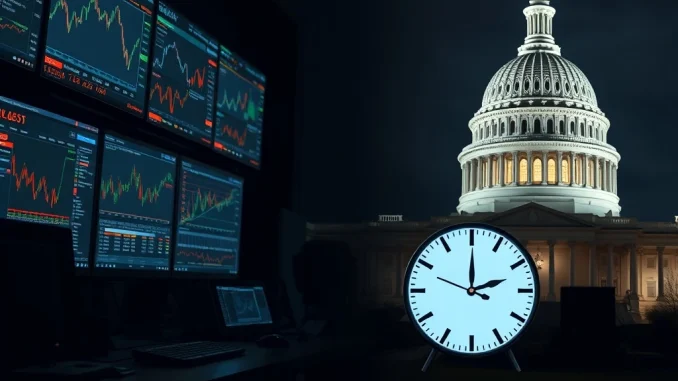
Washington D.C., January 2025: The imminent threat of a partial U.S. government shutdown, set to begin on January 31st, has triggered more than just political gridlock. It has laid bare fundamental and potentially crippling structural flaws within the burgeoning world of prediction markets. As reported by CoinDesk, platforms like Polymarket and Kalshi are descending into chaos, not because of the political outcome itself, but due to a foundational failure: the inability to agree on what that outcome actually means. This crisis highlights a critical vulnerability that strikes at the very heart of these markets’ promise to forecast real-world events.
Prediction Markets Confront a Reality Check
The core mechanics of a prediction market are elegantly simple. Traders buy and sell shares based on the predicted likelihood of a specific event. If the event occurs, shares for “Yes” pay out; if not, “No” shares win. This entire system hinges on one non-negotiable element: a clear, binary, and universally agreed-upon resolution criteria. The current US government shutdown drama has shattered this assumption. While the U.S. Senate passed a stopgap funding bill, the House of Representatives failed to complete a vote before the deadline, technically triggering a funding lapse. However, the practical impact of a brief weekend shutdown is minimal for most Americans. This ambiguity has created a nightmare for contract resolution.
Different contracts on platforms like Polymarket use varying definitions to constitute an official shutdown. Some may rely on a formal declaration from the Office of Management and Budget (OMB). Others might use the commencement of a federal agency contingency plan or a major news outlet’s declaration. This lack of standardization means two contracts betting on the same fundamental event—”Will the U.S. government shut down on January 31st?”—could resolve in opposite directions based on their fine print. Traders are left navigating a landscape of conflicting interpretations, where the rules of the game change depending on which specific contract they purchased.
The Anatomy of Contract Ambiguity
This is not a minor technical glitch; it is a systemic failure of contract specificity. For a prediction market to function as a reliable information aggregation tool, its contracts must be watertight. The ambiguity exposed by the shutdown threat reveals several critical weaknesses:
- Source of Truth: Markets lack a single, authoritative “oracle” or data feed for complex political events. Unlike a sports score or election result certified by a central body, a government shutdown involves multiple moving parts and interpretations.
- Temporal Definitions: What defines the start and end of a shutdown? Is it the second funding lapses at midnight? Is it when the first federal employee is furloughed? Does a shutdown that lasts only a few hours over a weekend count the same as one that spans weekdays?
- Operational vs. Technical: There is a stark difference between a technical funding lapse and an operational shutdown where agencies close and services halt. Most contracts fail to distinguish between these states clearly.
The table below illustrates how different resolution criteria could lead to contradictory outcomes for the same real-world scenario:
| Contract Resolution Criteria | Scenario: Funding Lapses Friday Night, Bill Passed Saturday Morning | Likely Resolution |
|---|---|---|
| OMB formally declares a shutdown. | OMB may not issue a formal declaration for a short lapse. | NO |
| Major news networks (CNN, Fox) headline “Government Shutdown.” | Networks likely run shutdown headlines at midnight. | YES |
| At least one federal agency implements its contingency plan. | Most agencies have plans for a lapse but may not activate them instantly for a weekend. | UNCLEAR / NO |
A Historical Precedent and a Growing Problem
This is not the first time prediction markets have stumbled on political definitions. Past markets on events like “Will Brexit happen?” or “Will the debt ceiling be raised?” faced similar challenges around defining the event’s precise nature and timing. However, the frequency and financial scale of these markets have grown exponentially, magnifying the consequences of poor contract design. The 2024 election cycle saw record volumes on platforms like Polymarket, bringing in a new wave of retail participants who may not scrutinize contract details with the rigor of institutional traders. When high-profile, ambiguous events occur, these users are most at risk of loss due to unclear terms.
The situation creates a perverse incentive. Savvy traders might exploit ambiguities by buying contracts on multiple platforms with different criteria, effectively hedging against the resolution process itself rather than the underlying event. This behavior distorts the market’s primary function of price discovery and truth-seeking, turning it into a meta-game about legalistic interpretation.
The Path Forward for Prediction Markets
For prediction markets to mature and gain mainstream trust as a tool for forecasting and hedging, the industry must address this structural flaw head-on. The shutdown chaos serves as a stark warning. Solutions are complex but necessary:
- Standardization Bodies: The industry may need to develop independent committees or adopt standards for defining common event types (elections, legislative actions, economic indicators).
- Enhanced Oracle Networks: Developing more sophisticated decentralized oracle networks that pull from multiple, verified sources and use logic-based resolution (e.g., “If X, Y, and Z occur, then resolve YES”) could reduce ambiguity.
- Ultra-Specific Contract Language: Market creators must move beyond simple questions. Contracts should explicitly define the triggering authority, the required duration, and the specific evidence needed for resolution, treating contract design like legal drafting.
- Regulatory Clarity: As these markets grow, regulatory bodies like the CFTC may provide guidance or rules on contract standardization for markets operating in legal gray areas or under specific exemptions.
The immediate fallout from the January shutdown threat will likely be a series of disputed resolutions, frustrated traders, and platform arbitration processes. The long-term consequence, however, should be a concerted industry effort to build more robust infrastructure. The credibility of prediction markets as a novel financial and informational technology depends on their ability to cleanly and fairly resolve real-world complexity. The U.S. government, in its dysfunction, has provided a perfect stress test—one that these markets, in their current form, are visibly failing.
Conclusion
The looming US government shutdown has done more than highlight political division; it has performed a critical audit on the infrastructure of prediction markets. The resulting chaos on platforms like Polymarket underscores that the greatest threat to these decentralized forecasting tools is not regulatory pressure or liquidity, but internal ambiguity. The core issue of contract specificity is now an unavoidable challenge. For this sector to evolve beyond a niche for crypto-native speculators and become a widely trusted mechanism for aggregating collective intelligence, it must develop the legal and technical precision to match the complexity of the world it seeks to predict. The events of January 2025 may be remembered as the moment prediction markets were forced to grow up.
FAQs
Q1: What is a prediction market?
A prediction market is a platform where participants trade contracts based on the outcome of future events. Prices reflect the crowd’s collective probability estimate of that event occurring.
Q2: Why is the US government shutdown causing problems for prediction markets?
Different prediction contracts use different criteria to define what officially constitutes a “shutdown.” This lack of a standard definition leads to conflicting resolutions for the same real-world event, creating confusion and potential unfairness for traders.
Q3: What platforms are most affected?
Decentralized platforms like Polymarket (which uses cryptocurrency) and regulated platforms like Kalshi have both reported chaos and disputed contracts related to the shutdown event.
Q4: What is the core structural flaw exposed by this event?
The flaw is a lack of standardized, unambiguous contract language and resolution sources for complex real-world events. Markets often fail to define the “source of truth” and specific conditions required for a contract to pay out.
Q5: What does this mean for the future of prediction markets?
This event is a major stress test that highlights the need for the industry to develop better standards, more precise contract design, and robust oracle systems to resolve events fairly. Their long-term credibility depends on solving this problem.
Q6: Can traders lose money even if they predict the event correctly?
Yes. If a trader correctly anticipates a funding lapse but buys a contract that defines a shutdown based on a formal OMB declaration (which may not happen), their contract could resolve as a loss despite the real-world occurrence they predicted.