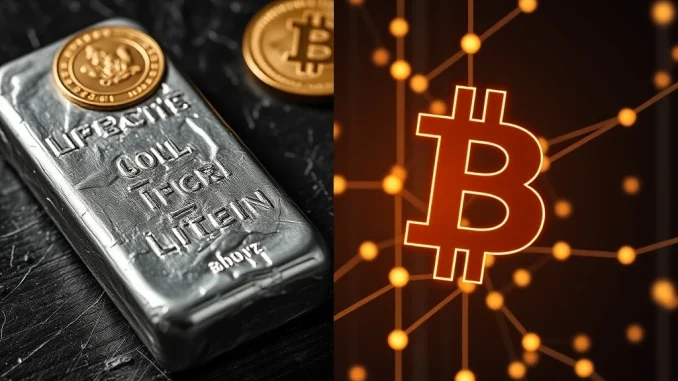
Crypto Volatility: Changpeng Zhao’s Revealing Comparison to Gold and Silver Proves Industry is Still Nascent
Global Markets, May 2025: Recent dramatic corrections in the gold and silver markets have sparked a revealing commentary from one of cryptocurrency’s most prominent figures. Binance founder Changpeng Zhao pointed to the sharp decline in these ancient stores of value as a crucial context for understanding the volatility inherent in digital assets like Bitcoin. His analysis suggests that crypto volatility, often cited as a mark of immaturity, is a characteristic shared even by millennia-old markets, reinforcing his view that the cryptocurrency sector remains in its formative years.
Changpeng Zhao frames crypto volatility within a historical context
Following a significant market downturn that saw gold retreat approximately 15% from its all-time high and silver plummet by as much as 38%, Zhao offered a perspective that challenges conventional financial narratives. He noted that such substantial price swings can and do occur in physical asset markets with thousands of years of established history and global recognition. This observation serves as a direct counterpoint to critics who point to Bitcoin’s price fluctuations as evidence of a speculative bubble or a flawed asset class. Zhao’s argument hinges on a relative timeline: Bitcoin, as a technological innovation in money, is merely 17 years old and spent much of its early existence operating in a regulatory and institutional environment that was often hostile or dismissive. Other cryptocurrencies, by extension, are even younger technologies. The inherent volatility, therefore, may not signal failure but rather the expected growing pains of a nascent financial paradigm.
Analyzing the scale of the precious metals correction
The market move that prompted Zhao’s comments was not a minor blip. The combined gold silver prices decline erased an estimated $15 trillion in global market capitalization, a staggering sum that underscores the sheer scale and interconnectivity of modern commodity markets. This event provides a tangible, recent case study in traditional market risk. To understand the context, analysts point to several contributing factors:
- Macroeconomic Shifts: Changing interest rate expectations and a strengthening U.S. dollar can diminish the appeal of non-yielding assets like gold.
- Technical Selling Pressure: After a prolonged bull run, markets often experience profit-taking and the triggering of automated sell orders.
- Liquidity Dynamics: Even deep, established markets can experience violent re-pricing when large institutional players adjust their portfolios simultaneously.
The rapidity and depth of this correction demonstrate that established asset classes are not immune to the types of volatility often attributed solely to crypto markets.
The technological infancy of Bitcoin and digital assets
Zhao’s core argument rests on the technological timeline. Comparing an asset with a 17-year history to ones with a 5,000-year history creates a stark contrast in developmental stages. For most of its existence, Bitcoin technology has evolved outside the traditional financial system. Its infrastructure—exchanges, wallets, custody solutions, and regulatory frameworks—has been built largely from the ground up in the last decade. This period of rapid, organic growth is inherently volatile. Historical parallels exist in other technological revolutions; the early days of the commercial internet, the dot-com boom and bust, and the initial rollout of cellular networks all featured extreme valuations, failures, and rapid iterations before achieving stability and mainstream integration. Financial analysts observing the crypto space note that volatility often decreases as an asset class matures, liquidity deepens, and use cases solidify, a process that takes decades, not years.
Implications for investor perception and market maturity
The juxtaposition of ancient and modern market volatility carries significant implications. First, it normalizes the crypto experience by showing that large drawdowns are a feature of all asset markets, not a bug unique to digital ones. Second, it reframes the narrative around risk. An investor allocating to gold accepts certain volatility risks based on centuries of data. An investor allocating to Bitcoin accepts volatility risks based on a much shorter dataset, but for the potential of asymmetric growth as the technology matures. The key distinction Zhao highlights is the stage of the adoption curve. Precious metals exist in a mature, global market. Cryptocurrency, despite its trillion-dollar aggregate valuation, is still navigating its path toward broader institutional adoption, regulatory clarity, and technological scalability. This journey is likely to continue featuring periods of high volatility as the market searches for stable equilibria.
Conclusion
Changpeng Zhao’s commentary provides a necessary long-view lens on market behavior. By highlighting the recent crypto volatility in the context of gold and silver’s severe correction, he makes a compelling case that digital assets should be judged on a proportional timeline. The trillion-dollar shakeout in precious metals serves as a potent reminder that no market is immune to sharp revaluations. For the cryptocurrency industry, this perspective suggests that current fluctuations may be less a sign of weakness and more an indicator of an asset class still in the early chapters of its development. As regulatory frameworks evolve, institutional infrastructure solidifies, and technological innovation continues, the market’s character will inevitably change, potentially mirroring the long-term stabilization seen in other once-novel asset classes.
FAQs
Q1: What exactly did Changpeng Zhao say about gold and crypto?
Changpeng Zhao commented that the recent sharp decline in gold and silver prices shows that significant volatility can happen even in ancient physical asset markets. He used this to argue that Bitcoin, at only 17 years old, and the broader crypto industry are still in their early stages, and their volatility should be viewed in that context.
Q2: How much did gold and silver prices actually fall?
According to market data referenced in Zhao’s remarks, gold fell by approximately 15% from its all-time high, while silver experienced a much steeper decline of up to 38%. This combined move wiped out an estimated $15 trillion in market capitalization.
Q3: Why is comparing crypto to gold relevant?
The comparison is relevant because gold is often held up as the ultimate stable store of value—the antithesis of a volatile cryptocurrency. Demonstrating that gold itself can undergo severe corrections challenges the notion that volatility is a unique failing of digital assets and reframes it as a common characteristic of developing and even mature markets.
Q4: What does “the industry is still early” actually mean?
It refers to the technological, regulatory, and adoption lifecycle of cryptocurrency. Compared to traditional finance, key infrastructure like clear regulations, robust institutional custody, deep derivatives markets, and widespread everyday use is still being built. Early-stage industries typically experience higher volatility as they experiment, grow, and find their place in the global economy.
Q5: Does this mean cryptocurrency will become less volatile?
Historical trends in other asset classes suggest that volatility generally decreases as a market matures. Factors that could reduce crypto volatility over time include increased liquidity from larger institutional participation, clearer global regulations, the development of more sophisticated risk-management products, and the stabilization of core technologies and use cases.
Related News
- CAKE Token Transfer: Mysterious $5 Million Move to GSR Markets Sparks Market Speculation
- Silencio Network Breaks Records: $112 Million in Allocation Requests, Surpassing Target by 220x
- BNB: CEA Industry's Strategic $550M Acquisition Signals Crypto Confidence
Related: Supreme Court Overturns Trump Tariffs: Analyzing the Immediate Bitcoin and Crypto Market Reaction
Related: Dubai Real Estate Tokenization Pilot Enters Crucial Phase Two with Secondary Trading Launch
Related: Crucial: Vital Block Launches Comprehensive Security Audit for MyShell AI on Binance Network