
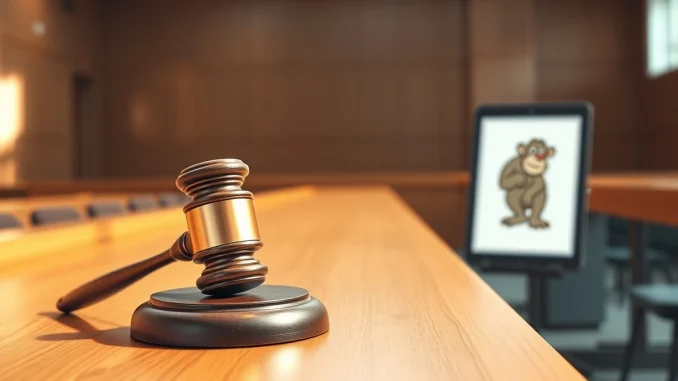
A nearly four-year legal saga over digital art and copyright has reached its conclusion. On April 9, 2026, court documents confirmed that Yuga Labs, creator of the Bored Ape Yacht Club (BAYC), has settled its high-profile lawsuit against artists Ryder Ripps and Jeremy Cahen. The dispute centered on allegations that the artists copied BAYC imagery to create and sell lookalike NFTs.
Yuga Labs Lawsuit Settlement Terms
According to filings in the U.S. District Court for the Central District of California, the parties informed the court they reached a settlement agreement. The terms are definitive. Ripps and Cahen are now permanently prohibited from using any of Yuga Labs’ trademarks or imagery.
Also read: Visa's AI Shopping Platform Unleashes Autonomous Commerce Revolution
They must also transfer control of key digital assets to Yuga Labs within ten days. This includes the smart contracts, domain names, and any remaining NFTs linked to their RR/BAYC project. A court injunction explicitly bars the artists from hiding or disposing of these assets to avoid compliance.
This settlement halts a jury trial that was set to proceed. The case’s path shows how complex digital copyright enforcement can be.
Also read: PEPE ETF Filing: Canary Capital's Bold Bet on a Battered Memecoin
Legal Battle Timeline and Key Rulings
Yuga Labs first filed suit in June 2022. The company accused Ripps and Cahen of copying its iconic cartoon ape images to mint and sell confusingly similar NFTs. Yuga argued this activity siphoned millions from unsuspecting buyers.
The defense claimed their RR/BAYC NFTs, first minted in May 2022, were protected satire. Lawyers for the artists said the project was a parody of the original Bored Ape collection, covered by free speech laws.
Initial court rulings favored Yuga Labs. In April 2023, a judge found that Ripps and Cahen violated copyright law. The court ordered them to pay $1.37 million in damages, plus $200,000. This penalty ballooned to roughly $9 million after a failed counterclaim in 2024.
However, the legal ground shifted in 2025. An appeals court tossed the earlier judgment. It ruled that a jury must decide if Yuga’s trademarks were actually infringed, sending the case toward a trial. This settlement avoids that unpredictable outcome.
What This Means for NFT Copyright Law
The settlement provides clarity but leaves some legal questions open. According to legal analysts, the case underscored the challenges of applying traditional intellectual property frameworks to blockchain-based assets.
“This was a significant test case,” said a legal scholar specializing in digital assets, who requested anonymity to speak freely. “The settlement ends the dispute for the parties, but the appellate ruling means we didn’t get a final, precedential jury verdict on the parody defense in this context. Other creators will still have to handle these waters.”
The implication is that while Yuga Labs secured a practical victory, the broader legal standard for NFT satire remains somewhat undefined. This could signal to other large NFT projects that litigation is a viable, though costly, tool for brand protection.
Impact on the NFT Market and Creators
The resolution of this lawsuit removes a major source of uncertainty for one of NFT’s most recognizable brands. The Bored Ape Yacht Club is a cornerstone of the modern NFT market, with individual ape NFTs selling for hundreds of thousands of dollars at their peak.
Market observers note that prolonged legal battles can dampen investor and collector confidence. “A clear resolution, even a settlement, is often better for market stability than ongoing litigation,” commented an industry analyst. “This allows Yuga Labs to focus fully on its roadmap and community.”
For creators, the case serves as a stark warning. The transfer of smart contracts and domains to Yuga Labs shows that courts can and will enforce judgments in the digital sphere. Projects that explicitly reference or derive from established NFT collections now face a clearer legal risk.
Key outcomes from the settlement:
- Permanent Injunction: Ripps and Cahen cannot use BAYC trademarks or imagery.
- Asset Transfer: Control of RR/BAYC smart contracts and domains moves to Yuga Labs.
- Financial Closure: The earlier monetary judgments are presumably resolved as part of the confidential settlement terms.
- Precedent Avoided: No jury ruling sets a firm legal standard for NFT parody.
Conclusion
The Yuga Labs lawsuit settlement closes a contentious chapter in NFT history. After nearly four years of litigation, appeals, and counterclaims, the creator of the Bored Ape Yacht Club has successfully halted a project it deemed infringing. While the legal debate over digital parody continues, this outcome reinforces the power of established intellectual property holders in the web3 space. For the market, it brings a measure of finality to a dispute that captivated and concerned the digital art world.
FAQs
Q1: What was the Yuga Labs lawsuit about?
Yuga Labs sued artists Ryder Ripps and Jeremy Cahen, alleging they created and sold counterfeit Bored Ape Yacht Club NFTs called RR/BAYC, causing consumer confusion and infringing on copyrights and trademarks.
Q2: What are the main terms of the settlement?
Ripps and Cahen are permanently banned from using Yuga Labs’ imagery and must transfer all RR/BAYC project assets—including smart contracts and domains—to Yuga Labs. Specific financial terms are likely confidential.
Q3: Did the courts rule this was copyright infringement?
A lower court did rule it was infringement in 2023, ordering monetary damages. However, an appeals court overturned that ruling in 2025, stating a jury should decide the trademark issue. The settlement prevents that jury trial.
Q4: What was the artists’ defense?
The artists argued the RR/BAYC NFTs were satire and parody, protected under the First Amendment’s free speech provisions. They claimed the work was commentary on the original Bored Ape collection.
Q5: What does this mean for other NFT parody projects?
The settlement does not create a legal precedent, but it demonstrates that large IP holders like Yuga Labs are willing to pursue lengthy, expensive litigation. It raises the perceived risk for projects that directly copy and commercialize another project’s artwork.
Q6: Are the RR/BAYC NFTs still available?
According to the settlement terms, control of the project’s smart contracts will be transferred to Yuga Labs. The future of any existing RR/BAYC NFTs on the blockchain is now determined by Yuga Labs.

This article was produced with AI assistance and reviewed by our editorial team for accuracy and quality.




Be the first to comment