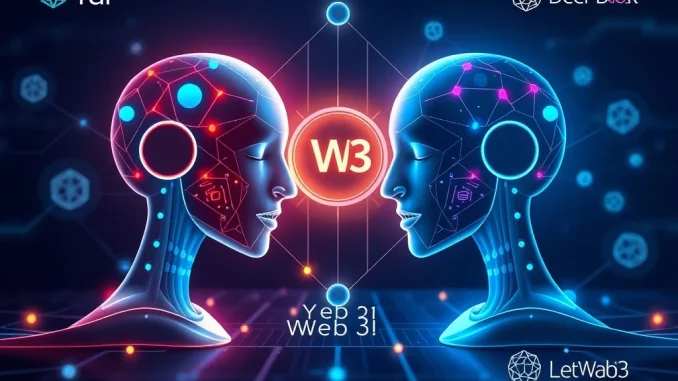
Global, May 2025: The Web3 landscape witnesses a significant consolidation of expertise as YAP AI, a prominent decentralized artificial intelligence platform, announces a formal strategic partnership with DeepBook AI, a specialist in on-chain data intelligence and predictive analytics. This alliance represents a calculated move to address persistent user experience challenges within decentralized ecosystems by combining complementary technological strengths. Industry analysts immediately recognize the partnership as a potential inflection point for practical AI integration in blockchain applications.
YAP AI and DeepBook AI Forge Strategic Web3 Partnership
The partnership, formalized through a joint development agreement and shared resource pool, centers on creating a seamless interface between YAP AI’s conversational and automation agents and DeepBook AI’s deep liquidity and market data infrastructure. Unlike simple API integrations, this alliance involves co-development of native modules. The core objective is to allow decentralized applications (dApps) built on YAP’s framework to directly query, analyze, and act upon real-time, verifiable data from DeepBook’s on-chain order books across multiple networks, including Solana and Sui. This technical synergy aims to reduce latency, increase transaction reliability, and provide users with more intuitive, context-aware interactions. The collaboration follows a six-month pilot program where select features were tested with a cohort of 50 development teams, resulting in a reported 40% improvement in task completion rates for complex DeFi operations.
Addressing Core Web3 User Experience Challenges
User experience (UX) remains a critical barrier to mainstream Web3 adoption. Common pain points include fragmented data, confusing transaction flows, and a lack of intuitive guidance within dApps. This partnership directly targets these issues through a multi-layered approach. First, it integrates predictive analytics. DeepBook AI’s models, which analyze historical liquidity patterns and price impact, will feed into YAP AI’s agentic systems. This allows an AI assistant to not only execute a swap but also advise on optimal timing and route based on projected slippage, presenting the information in plain language. Second, the alliance focuses on abstraction. The goal is to let users interact with complex protocols through natural language commands, while the integrated AI layer handles the underlying blockchain calls, wallet interactions, and data fetching from DeepBook’s infrastructure. A comparative table illustrates the intended shift:
| Traditional Web3 UX | Post-Partnership AI-Enhanced UX |
|---|---|
| User manually checks multiple DEXs for prices. | User asks AI agent: “Find the best price for 100 SOL to USDC.” |
| User estimates gas fees and slippage tolerance. | AI agent analyzes DeepBook data, predicts fees/slippage, and recommends parameters. |
| Transaction fails due to insufficient liquidity on chosen route. | AI agent pre-validates route liquidity and suggests alternatives before execution. |
The Technical Roadmap and Integration Timeline
The integration will roll out in three defined phases over the next 18 months. Phase One (Q3-Q4 2025) involves the release of a unified software development kit (SDK) for existing developers on both platforms, enabling basic data calls and agentic triggers. Phase Two (Q1-Q2 2026) will see the launch of co-branded “smart agent” templates for common DeFi, gaming, and social dApp use cases. Phase Three (H2 2026) is slated for the release of a fully merged, standalone protocol layer that can be deployed by new projects seeking an out-of-the-box AI-powered UX. This phased approach mitigates risk and allows for community feedback at each stage. The technical teams have established a joint governance council to oversee protocol upgrades and prioritize feature development based on user metrics.
Industry Context and Competitive Landscape
This move occurs within a broader trend of vertical integration in the Web3 AI sector. Over the past 18 months, several high-profile mergers and partnerships have sought to bridge the gap between AI computation and blockchain execution. However, most have focused on either decentralized GPU marketplaces for AI training or on-chain inference verification. The YAP-DeepBook alliance is distinct in its focus on the application layer and end-user interaction. It positions the combined entity against two main competitor types: large, centralized exchanges with nascent AI features, and other decentralized AI agent platforms that lack deep, native integration with a liquidity layer. The partnership’s success may hinge on its ability to attract third-party developers to build upon its new integrated stack, creating a defensible ecosystem moat.
Implications for Developers and End-Users
For the Web3 developer community, this partnership promises a reduction in development complexity. Instead of stitching together disparate services for AI, data, and execution, developers can access a more coherent toolkit. This could accelerate dApp innovation and lower barriers to entry for new teams. For end-users, the tangible benefits are expected to include:
- Simplified Interactions: Moving from multi-step, technical processes to goal-oriented conversations with AI assistants.
- Improved Transaction Success: Higher success rates for trades and interactions due to pre-execution simulation powered by accurate, real-time data.
- Enhanced Education: AI agents capable of explaining complex Web3 concepts or transaction details on-demand.
- Personalized Experiences: dApps that can adapt their interface and suggestions based on user behavior and preference patterns analyzed across sessions (with privacy-preserving techniques).
Conclusion
The strategic partnership between YAP AI and DeepBook AI represents a substantive, engineering-driven effort to mature the Web3 user experience. By tightly coupling advanced conversational AI with robust on-chain data intelligence, the alliance seeks to move beyond hype and deliver practical utility. While the full vision will unfold over the coming years, its initial framework addresses long-standing UX deficiencies with a clear technical roadmap. The success of this Web3 alliance will be measured not by announcements, but by its adoption by developers and the subsequent enhancement of simplicity, reliability, and intuition for everyday users navigating the decentralized web.
FAQs
Q1: What is the primary goal of the YAP AI and DeepBook AI partnership?
The primary goal is to significantly improve Web3 user experience by integrating YAP AI’s conversational and automation agents with DeepBook AI’s real-time on-chain data and liquidity analytics, creating more intuitive, reliable, and intelligent decentralized applications.
Q2: How will this partnership directly benefit a regular user of a DeFi application?
A user could interact with a dApp using natural language (e.g., “Save 10% of my portfolio in a stable yield vault”). The integrated AI would find the best options using live data, explain the choices, handle the complex transactions, and ensure optimal execution, all within a simplified interface.
Q3: Is this a merger or an acquisition?
No, this is a strategic partnership and co-development alliance. Both companies remain independent entities but are committing technical resources and code to build shared tools and integrated protocols for the benefit of their respective developer ecosystems.
Q4: Which blockchain networks will this integrated solution support?
The partnership initially focuses on networks where DeepBook AI has strong liquidity infrastructure, notably Solana and Sui, with plans to expand to other ecosystems supported by both platforms’ existing technology.
Q5: When can developers start building with the new integrated tools?
The first phase, releasing a unified SDK for existing developers, is targeted for Q3 2025. A broader public developer launch with more comprehensive tools is planned for early 2026.
Q6: How does this differ from just using an AI chatbot alongside a normal dApp?
The key difference is deep, native integration. Instead of a chatbot that merely reads a static website, the partnered AI agents have direct, programmable access to live on-chain data and execution pathways. This allows for actionable assistance, predictive analysis, and automated handling of multi-step processes within the secure dApp environment.
This article was produced with AI assistance and reviewed by our editorial team for accuracy and quality.