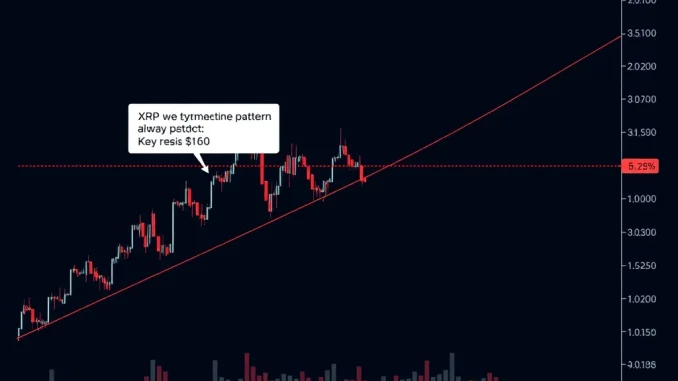
Global, May 2025: The XRP market approaches a decisive technical juncture as price action consolidates into a critical triangle pattern near the $1.60 level. This formation, occurring alongside notable inflows into cryptocurrency exchange-traded funds (ETFs), suggests heightened potential for volatility and a possible directional breakout in the coming sessions. Technical analysts are closely monitoring the convergence of trendlines, which historically precedes significant price movements.
Deciphering XRP’s Critical Triangle Formation
Technical analysis provides a framework for understanding market psychology through price patterns. The triangle pattern currently forming on XRP charts represents a period of consolidation where buying and selling pressures reach an equilibrium. This pattern is characterized by converging trendlines connecting a series of lower highs and higher lows. The narrowing price range indicates decreasing volatility and often culminates in a forceful breakout. The current pattern’s apex converges near the $1.60 price point, a level that has served as both support and resistance in recent months, adding to its technical significance. Market participants view such patterns as a coiling mechanism, where energy builds before a release in either direction.
Historical Context and Pattern Precedents
Triangle patterns are not uncommon in cryptocurrency markets, which are known for their cyclical volatility. A review of XRP’s price history reveals several instances where similar formations led to substantial moves. For example, in early 2023, a symmetrical triangle preceded a 25% upward movement over two weeks. The reliability of such patterns depends on several factors, including trading volume during the formation and the broader market context. Analysts note that the current pattern’s duration and the clarity of its trendlines contribute to its perceived importance. Furthermore, the pattern’s development coincides with a macroeconomic environment where digital asset correlations with traditional markets have shown signs of decoupling, potentially amplifying the impact of technical triggers.
The Mechanics of a Potential 11% Breakout
The projected 11% move is derived from a common technical measurement technique. Analysts measure the height of the pattern at its widest point—the vertical distance between the initial high and low trendline touches—and project that distance from the point of breakout. This method, while not predictive, offers a statistically common magnitude for the subsequent price move based on historical precedents. It is crucial to understand that this is a probabilistic projection, not a guarantee. The direction of the breakout remains unknown until price convincingly closes outside the pattern’s boundaries, typically accompanied by a surge in trading volume to confirm the move’s legitimacy.
The Role of ETF Inflows in Market Structure
Parallel to the technical setup, fund flow data shows increasing capital allocation into cryptocurrency-focused ETFs. These investment vehicles, which gained significant regulatory approval and mainstream traction in 2024, provide institutional and retail investors with regulated exposure to digital assets. Sustained inflows suggest underlying demand that may provide fundamental support for prices. Analysts monitor whether these inflows represent broad-based accumulation or are concentrated in specific assets. The interaction between technical patterns and fundamental flows creates a multifaceted market narrative. Large, sustained inflows can alter market liquidity and volatility profiles, potentially influencing the force and sustainability of any technical breakout that occurs.
Key Resistance and Support Levels to Monitor
Beyond the triangle pattern itself, several distinct price levels are critical for traders. The $1.60 area acts as immediate resistance, a level where selling pressure has previously emerged. A confirmed break above this level, with volume, would signal bullish conviction and could trigger algorithmic buying programs. Conversely, key support lies near $1.48, the pattern’s lower trendline. A breakdown below this level would invalidate the bullish breakout scenario and could lead to a test of stronger support around $1.40. Market technicians often use a multi-timeframe analysis approach, examining the pattern on hourly, daily, and weekly charts to gauge the strength of support and resistance across different investor time horizons.
Volatility Expectations and Market Implications
The compression phase of a triangle pattern typically results in a volatility expansion upon resolution. Options market data, such as implied volatility readings, often reflects this expectation. Elevated implied volatility suggests traders are pricing in larger potential price swings in the near term. This environment affects strategies across the market, from spot traders to derivatives participants. For the broader digital asset ecosystem, significant moves in major assets like XRP can influence sentiment and capital rotation into or out of correlated altcoins. Furthermore, a decisive breakout could attract media attention and retail interest, creating reflexive feedback loops that extend the initial move.
Conclusion
XRP’s price action presents a clear technical narrative as it consolidates within a critical triangle pattern near the $1.60 resistance level. The convergence of this pattern with rising ETF inflows creates a backdrop conducive to increased volatility and a probable directional resolution. While technical analysis points to a potential 11% breakout magnitude, the ultimate direction will be determined by market forces at the moment of pattern resolution. Traders and investors are advised to monitor volume confirmation and key support and resistance levels closely. This juncture underscores the dynamic interplay between chart patterns, fund flows, and market psychology in the evolving cryptocurrency landscape.
FAQs
Q1: What is a triangle pattern in technical analysis?
A triangle pattern is a chart formation created by converging trendlines that connect a series of sequential lower highs and higher lows. It indicates a period of consolidation and decreasing volatility before a potential breakout.
Q2: How is the potential 11% breakout target calculated?
Analysts typically measure the vertical height of the pattern at its widest point and project that distance from the eventual breakout point. This provides a common technical price objective based on the pattern’s size.
Q3: Why is the $1.60 level significant for XRP?
The $1.60 level has acted as a key psychological and technical price point in recent history, serving as both support and resistance. Its proximity to the triangle’s apex adds to its importance for determining the next directional move.
Q4: How do ETF inflows affect cryptocurrency prices?
Sustained inflows into cryptocurrency ETFs represent net buying pressure and increased institutional demand. This can provide fundamental support, improve liquidity, and influence market sentiment, potentially amplifying technical breakouts.
Q5: What confirms a valid breakout from a triangle pattern?
A valid breakout is typically confirmed by a price closing decisively outside the pattern’s trendlines, accompanied by a significant increase in trading volume. This volume confirmation helps distinguish genuine breakouts from false moves.
Updated insights and analysis added for better clarity.
This article was produced with AI assistance and reviewed by our editorial team for accuracy and quality.