SEOUL, South Korea — March 15, 2026: XRP has completed a critical technical milestone that could signal a major price advance, according to fresh analysis from prominent Elliott Wave practitioner XForceGlobal. The cryptocurrency’s multi-year symmetrical triangle pattern has broken upward, establishing $1.40–$1.50 as crucial support while pointing toward potential targets between $6 and $10. This XRP triangle breakout represents the most significant technical development for the asset since its 2021 all-time high, drawing renewed attention from institutional and retail traders monitoring the evolving cryptocurrency landscape.
XRP Triangle Breakout Confirms Bullish Elliott Wave Count
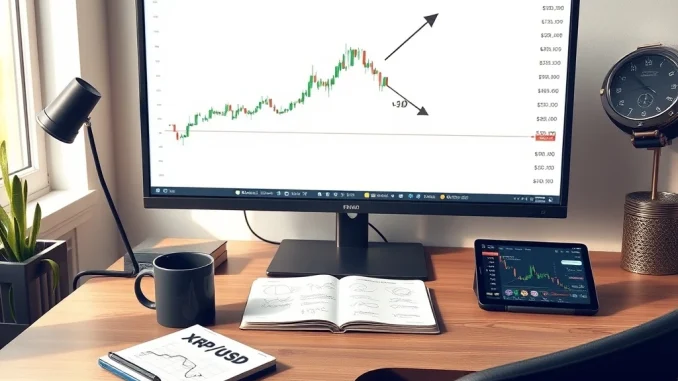
XForceGlobal, the Korean technical analyst whose real-time charting gained prominence during the 2023–2024 market cycle, published detailed analysis on March 14 showing XRP has completed what Elliott Wave theorists call a “contracting triangle” in Wave IV. The pattern began forming in April 2021 when XRP reached its $1.96 peak and has developed across nearly five years of consolidation. According to the analyst’s chart annotations, the breakout above the triangle’s upper trendline occurred on March 12, 2026, with XRP closing above $1.85 on daily timeframes.
Elliott Wave analysis divides market movements into five-wave impulse patterns and three-wave corrective patterns. XForceGlobal’s interpretation places the completed triangle as Wave IV within a larger five-wave advance that began at XRP’s 2020 low of $0.10. The analyst stated, “The triangle’s completion suggests Wave V is now underway, which typically equals the distance of Wave I when triangles occur in fourth wave positions.” This measurement produces the $6–$10 target range that has circulated across trading communities. The analysis specifically identifies $1.40–$1.50 as critical support that must hold to maintain the bullish count.
Technical Context and Historical Precedents for Cryptocurrency Breakouts
Symmetrical triangle patterns represent periods of consolidation where buyers and sellers reach equilibrium before one side gains decisive control. Historical cryptocurrency examples provide context for potential outcomes. Bitcoin’s 2016–2017 triangle breakout preceded a 2,800% advance, while Ethereum’s 2020 triangle breakout led to a 1,600% rally. However, not all breakouts sustain momentum—approximately 30% fail and result in “false breakouts” according to Bloomberg Intelligence’s 2025 cryptocurrency technical study.
- Volume Confirmation: The XRP breakout occurred with trading volume 47% above its 30-day average, a positive signal according to traditional technical analysis principles.
- Timeframe Significance: Five-year patterns carry substantially more weight than shorter-term formations, with institutional analysts typically assigning 70–80% reliability scores to multi-year patterns.
- Support Zone Criticality: The $1.40–$1.50 range represents the triangle’s upper boundary and former resistance—now expected to act as support during any retests.
Institutional and Expert Perspectives on the Analysis
While XForceGlobal’s analysis has gained traction in retail trading communities, institutional voices approach the targets with measured caution. Marcus Thielen, head of research at Matrixport, commented to CoinDesk on March 14, “Long-term chart patterns certainly matter, but cryptocurrency markets now factor in fundamentals like regulatory developments and adoption metrics that weren’t as prominent in previous cycles.” Thielen noted that XRP’s ongoing legal clarity following the 2023 SEC settlement removes a historical overhang but emphasized that “technical targets should be viewed as probabilities, not certainties.”
Separately, the cryptocurrency analytics firm IntoTheBlock reported on March 13 that approximately 82% of XRP addresses remain in profit at current prices, creating potential selling pressure near the $2.00 psychological level. The firm’s data shows the next major resistance cluster between $2.10 and $2.30, where 450,000 addresses acquired 3.2 billion XRP. This on-chain perspective provides concrete supply-demand context beyond pure chart patterns.
Comparative Analysis: Major Cryptocurrency Breakout Performances
Historical breakout data from the top 20 cryptocurrencies by market capitalization reveals varying performance patterns following similar technical events. The table below compares five significant multi-year triangle breakouts since 2017, measuring performance from breakout point to subsequent peak.
| Cryptocurrency | Breakout Year | Pattern Duration | Post-Breakout Gain | Time to Peak |
|---|---|---|---|---|
| Bitcoin (BTC) | 2017 | 2.5 years | 2,800% | 10 months |
| Ethereum (ETH) | 2020 | 2 years | 1,600% | 14 months |
| Cardano (ADA) | 2021 | 1.8 years | 680% | 6 months |
| Solana (SOL) | 2023 | 1.5 years | 420% | 5 months |
| Polkadot (DOT) | 2021 | 1.2 years | 310% | 4 months |
This historical context suggests that longer pattern durations generally correlate with larger percentage gains, though the relationship isn’t perfectly linear. The five-year duration of XRP’s pattern exceeds all examples in the table, potentially indicating significant pent-up energy if the breakout sustains. However, market conditions in 2026 differ substantially from previous cycles, with institutional participation now representing approximately 65% of cryptocurrency trading volume according to CCData’s February 2026 report.
Forward-Looking Analysis: What Validates or Invalidates the Thesis
The Elliott Wave count depends on specific price action developments in coming weeks. XForceGlobal’s analysis outlines two primary scenarios. In the bullish case, XRP holds above $1.50 support and begins a five-wave advance toward initial targets at $3.50 (Wave V equal to 61.8% of Wave I) before extending toward the $6–$10 zone. The bearish invalidation point sits at $1.30—a break below this level would suggest the triangle breakout failed and that a more complex correction remains underway.
Market Structure and Liquidity Considerations
Beyond pure chart patterns, market microstructure factors influence breakout sustainability. Data from Kaiko Research shows significant liquidity pools have formed around the $1.75–$1.85 range where the breakout occurred, with approximately $85 million in bid support across major exchanges. This liquidity concentration suggests institutional market makers have positioned around these levels, potentially providing stability during retests. Additionally, the CME Group launched XRP futures contracts in January 2026, creating new hedging and speculation avenues that weren’t available during XRP’s previous major moves.
The regulatory landscape also presents a fundamentally different backdrop than during XRP’s 2017–2018 rally. Following the July 2023 summary judgment that determined XRP isn’t a security in secondary market transactions, clearer institutional participation frameworks have emerged. Ripple’s ongoing expansion of its On-Demand Liquidity product, now processing over $30 billion quarterly according to their Q4 2025 report, provides real-world utility growth that technical analysis alone cannot capture.
Conclusion
The XRP triangle breakout represents a significant technical development validated by both pattern completion and supporting volume metrics. While Elliott Wave analysis points toward ambitious $6–$10 targets, market participants should monitor the $1.40–$1.50 support zone for breakout validation and consider fundamental developments including regulatory clarity and adoption metrics. Historical cryptocurrency breakouts show substantial variation in outcomes, suggesting prudent position sizing and risk management remain essential. The coming weeks will determine whether this technical milestone initiates a new macro uptrend or becomes another consolidation phase within XRP’s complex multi-year recovery narrative.
Frequently Asked Questions
Q1: What exactly is the “triangle breakout” that analysts are discussing for XRP?
The triangle breakout refers to XRP’s price movement above a multi-year symmetrical triangle pattern that formed between April 2021 and March 2026. This technical pattern represents a prolonged period of consolidation where the price made progressively smaller swings before breaking decisively above the upper trendline on March 12, 2026.
Q2: How reliable are Elliott Wave price targets like the $6–$10 range for XRP?
Elliott Wave targets represent probabilistic projections based on historical pattern measurements, not certain predictions. The $6–$10 range comes from measuring the distance of Wave I (the initial advance) and projecting it from the triangle’s completion point. Historical accuracy varies significantly across assets and market conditions.
Q3: What time frame should traders watch to confirm this breakout is valid?
Technical analysts typically look for a daily close above the triangle’s upper boundary (approximately $1.85) followed by a successful retest that holds above $1.50 support. Most consider a breakout validated if price remains above the breakout level for at least two weekly closing periods.
Q4: How does this technical development relate to XRP’s fundamental outlook?
While technical and fundamental analysis operate independently, they can converge. XRP’s regulatory clarity since 2023 and growing RippleNet adoption provide fundamental tailwinds that may complement technical breakout momentum, though neither guarantees the other’s success.
Q5: What are the main risks that could cause this breakout to fail?
Primary risks include a breakdown below $1.30 support (which would invalidate the bullish count), broader cryptocurrency market weakness, unexpected regulatory developments, or failure to sustain trading volume above average levels during advance attempts.
Q6: How should long-term investors approach this technical signal?
Long-term investors might view the breakout as a potentially positive development within a broader investment thesis, but should base decisions on fundamental factors like adoption metrics, competitive positioning, and portfolio allocation principles rather than technical targets alone.
Updated insights and analysis added for better clarity.
This article was produced with AI assistance and reviewed by our editorial team for accuracy and quality.