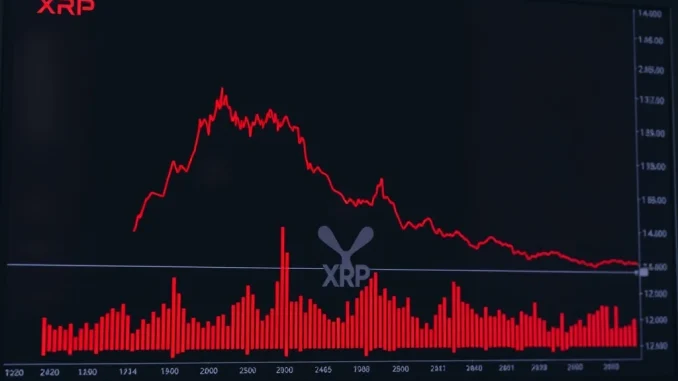
February 4, 2026: The cryptocurrency market faces significant turbulence as XRP, one of its largest assets, experiences a sharp and concerning decline. This week, XRP depreciated by 17.94%, a move underscored by a historic signal from a key technical indicator, the Moving Average Convergence Divergence (MACD). Traders and analysts are now scrutinizing the critical support level of $1.30 amidst broader market disarray. As of February 4, 2026, XRP trades at $1.57, reflecting a 2.63% loss over the preceding 24 hours, with its total market capitalization standing at approximately $95.5 billion. This price action has triggered widespread analysis and debate regarding the token’s near-term trajectory.
XRP Price Plunge and Market Context
The 17.94% weekly decline for XRP represents one of its most significant contractions in recent months. This drop occurred within a complex macroeconomic and crypto-specific environment. Broader market sentiment has been cautious, influenced by regulatory developments, shifting monetary policy expectations, and volatility in traditional equity markets. XRP’s performance often correlates with, yet can diverge from, movements in Bitcoin and Ethereum. The asset’s current price of $1.57 places it under considerable technical pressure, having broken through several short-term support levels that traders previously monitored. The $95.5 billion market capitalization, while substantial, reflects a notable decrease from recent highs, impacting its ranking among top cryptocurrencies.
Understanding the Historic MACD Signal
The Moving Average Convergence Divergence (MACD) is a cornerstone momentum indicator used by technical analysts across all financial markets, including cryptocurrencies. It consists of two lines—the MACD line and the signal line—and a histogram. Analysts interpret crossovers, divergences, and the histogram’s position relative to a zero line to gauge trend strength and potential reversals. The “historic” signal currently referenced likely pertains to a bearish crossover of significant magnitude or a histogram reading that has reached an extreme not seen for an extended period, perhaps months or even years. Such signals suggest strong downward momentum is prevailing. It is critical to note that while MACD is a powerful tool, it is a lagging indicator, reflecting price movements that have already occurred, and should be used in conjunction with other data points.
- MACD Composition: Calculated from Exponential Moving Averages (EMAs) of an asset’s price.
- Bearish Crossover: Occurs when the MACD line crosses below the signal line, suggesting increasing downward momentum.
- Histogram Significance: The bars represent the difference between the MACD and signal lines; deepening negative bars confirm bearish strength.
- Context is Key: The signal’s severity is judged against historical XRP chart data, not in isolation.
Technical Analysis and the $1.30 Support Level
Amid the sell-off, market participants have identified the $1.30 price zone as a critical support level. Support levels are price points where buying interest is historically strong enough to halt or reverse a downtrend. The $1.30 mark may represent a previous resistance-turned-support area, a key Fibonacci retracement level, or a psychological round-number threshold where accumulation often occurs. A sustained break below $1.30, especially on high volume and confirmed by weekly closing prices, could signal the next leg down, potentially targeting lower support zones. Conversely, a strong rebound from this area could indicate that the selling pressure has been exhausted, setting the stage for a consolidation or recovery phase. Traders are watching order book depth and volume profiles around this level with intense focus.
Comparative Market Performance and Implications
To fully understand XRP’s decline, one must view it within the performance of the wider digital asset ecosystem. During the same period, how did major assets like Bitcoin (BTC) and Ethereum (ETH) fare? Did XRP underperform the broader market, or was its drop part of a sector-wide correction? Furthermore, news specific to Ripple Labs, the company closely associated with XRP, such as legal case developments or partnership announcements, can cause idiosyncratic price movements. The implications of a sustained XRP downturn are multifaceted. It can affect investor confidence in large-cap altcoins, influence the liquidity and trading pairs on major exchanges, and impact the valuation of projects within the Ripple ecosystem and those utilizing the XRP Ledger.
| Metric | Value | Context |
|---|---|---|
| Current Price | $1.57 | Point-in-time valuation |
| 24-Hour Change | -2.63% | Short-term momentum |
| 7-Day Change | -17.94% | Weekly trend strength |
| Market Capitalization | $95.5B | Relative size and rank |
| Critical Support | $1.30 | Key technical level |
Historical Precedents and Trader Psychology
Cryptocurrency markets are no stranger to volatility, and XRP has experienced several major drawdowns and recoveries throughout its history. Examining past instances where similar MACD signals or percentage declines occurred can provide context, though past performance never guarantees future results. These events often test trader psychology, shaking out “weak hands”—short-term speculators—while longer-term holders may see it as an accumulation opportunity. Market sentiment indicators, such as the Crypto Fear & Greed Index, often shift dramatically during such phases. The current alarm sparked by the MACD signal is as much a reflection of collective market memory and risk management protocols as it is a reaction to the raw chart data.
Conclusion
The significant XRP price plunge, marked by a historic MACD signal, presents a critical moment for cryptocurrency market participants. The move to $1.57, accompanied by a 17.94% weekly loss, underscores the inherent volatility and technical nature of digital asset trading. All attention now converges on the $1.30 support level, a breach of which could dictate the next major trend. While technical indicators like the MACD provide valuable insights, prudent analysis must also consider on-chain data, broader market conditions, and fundamental developments. This event serves as a stark reminder of the importance of robust risk management strategies in the dynamic and ever-evolving cryptocurrency landscape.
FAQs
Q1: What is the MACD indicator and why is it important?
The Moving Average Convergence Divergence (MACD) is a trend-following momentum indicator that shows the relationship between two exponential moving averages (EMAs) of an asset’s price. Traders use it to identify potential buy and sell signals, making it a cornerstone of technical analysis for spotting changes in trend strength, direction, and momentum.
Q2: What does a “historic” MACD signal for XRP mean?
A “historic” signal suggests the MACD indicator is showing a bearish reading—like a crossover or histogram depth—that is extreme compared to its own history on the XRP chart. This doesn’t predict the future but indicates the current downward momentum is among the strongest measured in a long time, warranting heightened caution.
Q3: Why is the $1.30 price level considered critical support for XRP?
Support levels are prices where buying interest has historically emerged. The $1.30 level may be a previous price ceiling that became a floor, align with a key technical analysis calculation, or serve as a major psychological benchmark. A break below it could trigger further automated selling and shift market sentiment.
Q4: How does XRP’s drop compare to the broader cryptocurrency market?
While the article notes general “market disarray,” specific comparative performance requires real-time data. XRP can sometimes move independently (due to its unique legal context) or in tandem with major assets like Bitcoin. An underperformance would suggest XRP-specific factors are at play.
Q5: Should traders rely solely on the MACD signal for decisions?
Absolutely not. Reliable trading and investment decisions require a confluence of signals. The MACD should be used alongside other indicators (like RSI or volume analysis), fundamental news, and clear risk management rules. No single indicator is infallible.
This article was produced with AI assistance and reviewed by our editorial team for accuracy and quality.