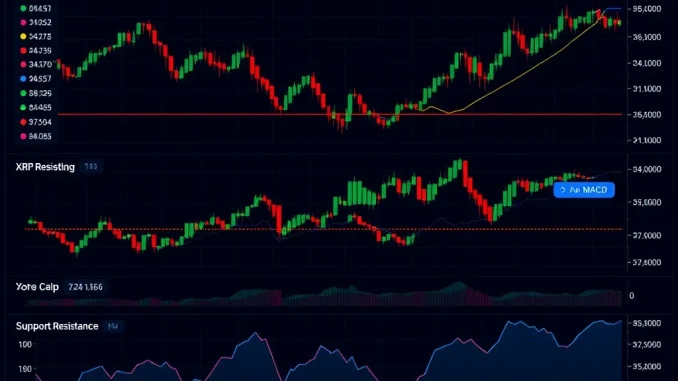
Global Cryptocurrency Markets, April 2025: XRP, the digital asset associated with Ripple Labs, finds itself in what technical analysts describe as a ‘max pain’ zone—a critical juncture where market sentiment and technical indicators conflict, creating uncertainty about the next significant price movement. Following a bounce from the $1.16 support level, XRP currently trades below the crucial $1.56 resistance, presenting traders with conflicting signals about whether the asset will experience a final decline toward $0.65 before establishing a sustainable recovery.
XRP Technical Analysis: Conflicting Signals Emerge
The current XRP price action reveals a complex technical picture that requires careful examination. On the bullish side, the Moving Average Convergence Divergence (MACD) indicator has recently completed a crossover, traditionally signaling rising buying pressure and potential momentum shift. This technical development suggests that some market participants see value at current levels and are accumulating positions. However, this bullish signal exists within a broader context of uncertainty.
Market analysts note that XRP has left significant price levels untested between $0.77 and $1.08. In technical analysis, markets often ‘sweep’ these untouched areas before establishing a definitive trend direction. This creates the possibility that XRP might decline further to test the $0.75–$0.65 range before any sustained upward movement begins. The concept of ‘max pain’ refers to the price level where the maximum number of options contracts would expire worthless, often creating psychological pressure on market participants.
Historical Context and Market Psychology
To understand the current XRP situation, we must examine historical patterns and market psychology. XRP has experienced similar consolidation periods throughout its history, particularly during regulatory uncertainty surrounding Ripple Labs’ ongoing legal proceedings with the U.S. Securities and Exchange Commission. These periods typically feature elevated volatility followed by decisive breakouts in either direction.
The cryptocurrency market overall faces macroeconomic headwinds in 2025, including potential interest rate adjustments and evolving regulatory frameworks globally. These factors influence all digital assets, but XRP faces additional unique considerations due to its specific use case in cross-border payments and its ongoing legal status clarification. Market participants must weigh these fundamental factors against purely technical readings.
- Regulatory Developments: The resolution of Ripple’s legal matters continues to influence investor sentiment
- Adoption Metrics: Real-world usage of XRP for cross-border settlements provides fundamental support
- Market Correlation: XRP often moves in correlation with broader cryptocurrency trends
- Liquidity Considerations: Trading volume and liquidity patterns affect price stability
Analyst Perspectives on the $0.65 Scenario
Crypto analyst EGRAG CRYPTO represents one viewpoint in the current debate, warning that a final decline toward $0.65 might precede any meaningful recovery. This perspective aligns with traditional technical analysis principles suggesting that markets often test lower support levels before reversing trend. Other analysts counter that the MACD crossover and current buying pressure might indicate the decline has already concluded.
The divergence between these viewpoints creates the ‘max pain’ environment where neither bulls nor bears feel comfortable with their positions. This uncertainty typically resolves through increased volatility as the market searches for equilibrium. Traders report preparing for multiple scenarios, with some establishing positions at various support levels while others wait for clearer directional signals.
Technical Indicators and Their Interpretation
Professional traders utilize multiple technical indicators to navigate complex market environments like the current XRP situation. Beyond the MACD crossover, analysts monitor several key metrics:
| Indicator | Current Reading | Typical Interpretation |
|---|---|---|
| Relative Strength Index (RSI) | Approaching neutral | Neither overbought nor oversold conditions |
| Trading Volume | Moderate but increasing | Growing interest but not decisive participation |
| Support/Resistance Levels | Multiple clustered zones | Increased likelihood of volatility between levels |
| Market Sentiment Indicators | Mixed signals | Conflicting expectations among participants |
These technical readings collectively paint a picture of a market at an inflection point. The convergence of multiple support and resistance levels between $0.65 and $1.56 creates what technical analysts call a ‘compression zone’—a period of reduced volatility that typically precedes significant price movement in either direction.
Broader Cryptocurrency Market Context
XRP does not exist in isolation, and its price movements occur within the context of broader cryptocurrency market trends. In 2025, the digital asset sector continues maturing, with increased institutional participation and regulatory clarity in some jurisdictions. However, volatility remains inherent to cryptocurrency markets, particularly for assets with specific use cases like XRP.
The cross-border payments sector that XRP targets has seen increased competition from both traditional financial institutions upgrading their systems and other blockchain projects offering similar solutions. This competitive landscape influences long-term valuation assessments, even as short-term price movements respond primarily to technical factors and market sentiment.
Risk Management Considerations for Traders
Experienced cryptocurrency traders emphasize risk management during periods of uncertainty like the current XRP environment. Common strategies include position sizing adjustments, diversification across multiple timeframes, and establishing clear exit criteria before entering trades. The ‘max pain’ concept serves as a reminder that markets often move in ways that cause discomfort to the maximum number of participants.
Technical analysts recommend watching for confirmation signals rather than anticipating movements. A decisive break above $1.56 with sustained volume would suggest the bullish scenario is unfolding, while a breakdown below $1.08 with increasing selling pressure would support the bearish outlook toward $0.65. Until such confirmation occurs, many traders maintain reduced exposure or employ hedging strategies.
Conclusion
XRP currently occupies a critical technical position that analysts describe as a ‘max pain’ zone, where conflicting signals create uncertainty about the next significant price movement. The MACD crossover suggests building buying pressure and potential upward momentum, while untouched support levels around $0.65 present a plausible scenario for further decline before recovery. This XRP price analysis highlights the complex interplay between technical indicators, market psychology, and fundamental developments affecting the digital asset. As the market seeks direction, traders monitor key levels between $0.65 and $1.56 for confirmation of the next sustained trend. The resolution of this technical standoff will provide important insights into XRP’s medium-term trajectory within the evolving cryptocurrency landscape.
FAQs
Q1: What does ‘max pain zone’ mean in cryptocurrency trading?
The term ‘max pain zone’ refers to a price level or range where the maximum number of options contracts would expire worthless, creating psychological pressure on market participants. In broader technical analysis, it describes a period where conflicting signals create uncertainty and discomfort for both bullish and bearish traders.
Q2: How reliable is the MACD indicator for predicting XRP price movements?
The Moving Average Convergence Divergence (MACD) is a momentum indicator that shows the relationship between two moving averages. While it provides useful information about trend changes and momentum shifts, experienced traders use it alongside other indicators and fundamental analysis rather than relying on it exclusively for predictions.
Q3: What factors besides technical analysis influence XRP’s price?
XRP’s price responds to multiple factors including regulatory developments involving Ripple Labs, adoption by financial institutions for cross-border payments, broader cryptocurrency market trends, macroeconomic conditions, and overall digital asset sentiment. Technical analysis represents one component of comprehensive market assessment.
Q4: How do traders typically respond to uncertainty in cryptocurrency markets?
During periods of uncertainty, experienced traders often reduce position sizes, increase diversification, employ hedging strategies, wait for confirmation signals before establishing new positions, and maintain strict risk management protocols including stop-loss orders and profit-taking targets.
Q5: What timeframes are most relevant for analyzing XRP’s current technical situation?
Analysts typically examine multiple timeframes simultaneously. Short-term traders focus on hourly and 4-hour charts for entry and exit timing, while medium-term investors analyze daily and weekly charts for trend direction. The current ‘max pain’ discussion involves analysis across these timeframes, with particular attention to daily chart patterns and key support/resistance levels.