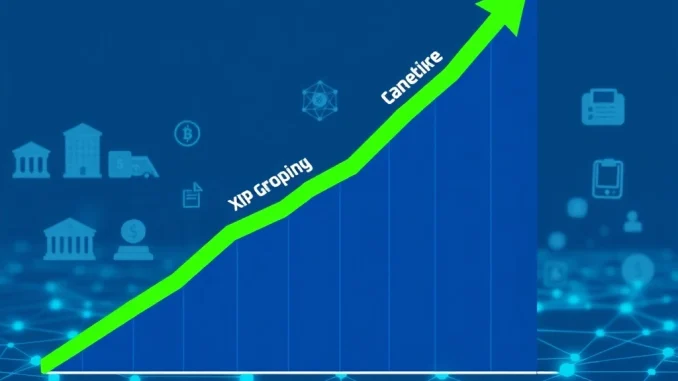
Global, May 2025: The blockchain landscape for tokenizing real-world assets (RWAs) has witnessed a significant shift. Recent data reveals the XRP Ledger (XRPL) has executed a stunning surge, now ranking second in 30-day growth for tokenized RWAs. With approximately $1.5 billion in assets now represented on its network, XRPL has overtaken major competitors like Solana, Polygon, and Avalanche in this critical metric, signaling a pivotal moment in the convergence of traditional finance and decentralized technology.
XRP Ledger’s Remarkable RWA Growth Trajectory
The ascent of the XRP Ledger in the real-world asset sector is not an isolated event but the result of evolving infrastructure and strategic positioning. RWAs refer to the digital representation of tangible, off-chain assets—such as real estate, commodities, government bonds, or invoices—on a blockchain. This process, known as tokenization, aims to unlock liquidity, enhance transparency, and streamline settlement. For years, Ethereum has dominated this nascent field, but the latest 30-day growth figures highlight XRPL as the most rapidly expanding challenger. Analysts attribute this surge to several concurrent factors, including lower transaction costs compared to some rivals, the ledger’s inherent speed for settlement, and a growing ecosystem of financial institutions exploring its capabilities for institutional-grade asset representation.
Analyzing the Competitive Blockchain Landscape
The race to host tokenized real-world assets is fiercely competitive, with each blockchain offering distinct trade-offs. The recent data places XRPL ahead of several prominent networks in terms of monthly growth momentum. To understand this shift, it is essential to consider the core value propositions of the involved platforms.
- Ethereum: Remains the undisputed leader in total value locked (TVL) for RWAs due to its deep liquidity, extensive developer ecosystem, and robust security. Its growth, while substantial, is from a much larger base.
- Solana: Known for its high throughput and low fees, Solana has attracted numerous DeFi and NFT projects. Its RWA growth has been steady, but the latest cycle shows XRPL gaining ground more rapidly in this specific vertical.
- Polygon: As a Layer-2 scaling solution for Ethereum, Polygon has been a popular choice for enterprises seeking Ethereum compatibility with improved efficiency. XRPL’s recent surge suggests competition is heating up even among Ethereum-alternatives.
- Avalanche: With its custom subnet functionality, Avalanche offers tailored blockchain environments for institutions. Despite this flexibility, its 30-day RWA growth rate has been surpassed by XRPL in this reporting period.
The $1.5 billion figure for XRPL represents a significant milestone, indicating that the network is moving beyond its traditional association with cross-border payments and into the broader arena of asset digitization.
The Technical and Market Drivers Behind the Surge
This growth spike did not occur in a vacuum. Industry observers point to specific technical features and market developments that have coalesced to drive activity on the XRP Ledger. Firstly, the ledger’s native decentralized exchange (DEX) and its support for issued currencies provide a built-in mechanism for trading tokenized assets without requiring complex smart contracts, which can reduce certain operational risks. Secondly, a series of partnerships and pilot programs announced in late 2024 and early 2025 between Ripple (a major contributor to the XRPL ecosystem) and various asset managers and central banks have likely spurred confidence and experimentation. Furthermore, the broader macroeconomic environment, with institutions seeking yield and diversification beyond traditional markets, has accelerated demand for blockchain-based RWA solutions across the board, with XRPL capturing a notable share of this new interest.
Implications for the Future of Finance and Blockchain
The implications of XRP Ledger’s rapid growth in RWA tokenization are multifaceted. For the blockchain industry, it demonstrates that the infrastructure race is far from over, and networks with specific advantages for institutional use-cases can gain rapid adoption. It validates the multi-chain future thesis, where different blockchains specialize in different asset classes or financial functions. For traditional finance, the entry of a well-known, compliance-focused ledger like XRPL into the top tier of RWA platforms may encourage more conservative institutions to engage with tokenization. The competition is likely to drive innovation across all platforms, leading to better standards for regulatory compliance, interoperability, and investor protection. However, experts caution that growth metrics are just one indicator; long-term success will depend on sustaining this momentum, ensuring robust security as value increases, and navigating the complex global regulatory landscape for digital securities.
Conclusion
The recent data confirming the XRP Ledger’s surge past Solana and Polygon in 30-day real-world asset growth marks a significant evolution in the blockchain sector. Reaching $1.5 billion in tokenized assets underscores XRPL’s emerging role as a serious platform for institutional asset digitization. This stunning RWA surge highlights the dynamic and competitive nature of the tokenization landscape, where technological advantages and strategic partnerships can rapidly alter market positions. As the bridge between traditional finance and blockchain continues to strengthen, the performance of networks like the XRP Ledger will be a critical barometer for the industry’s maturation and its tangible impact on global markets.
FAQs
Q1: What are Real-World Assets (RWAs) in blockchain?
Real-World Assets (RWAs) are tangible or traditional financial assets that are represented as digital tokens on a blockchain. This process, called tokenization, can include real estate, government bonds, commodities, or even invoices, enabling them to be traded or used as collateral in decentralized finance (DeFi) applications with greater efficiency and transparency.
Q2: Why is the XRP Ledger’s growth in this area significant?
The growth is significant because it shows the XRP Ledger expanding beyond its primary use-case of cross-border payments into the broader and highly competitive field of asset tokenization. Overtaking established players like Solana and Polygon in growth rate indicates rising developer and institutional interest in its specific technical features for handling financial assets.
Q3: How does the XRP Ledger handle tokenized assets differently?
The XRP Ledger has a native decentralized exchange (DEX) and a built-in system for issuing and managing custom digital assets (called “issued currencies”). This can allow for the trading of tokenized RWAs without relying on the same smart contract models used by Ethereum Virtual Machine (EVM)-compatible chains, potentially offering simplicity and speed in settlement.
Q4: Is Ethereum still the leader in RWA tokenization?
Yes, by total value locked (TVL), Ethereum remains the dominant blockchain for RWA tokenization by a wide margin. The recent data highlights 30-day growth rates, where XRP Ledger has shown faster expansion from a smaller base, not total market share.
Q5: What does this mean for investors and the crypto market?
For the market, it signals healthy competition and specialization among blockchains, which can lead to more innovation and better products. For investors, it highlights a growing sector—tokenized RWAs—that is attracting real capital and could be a major driver for the next phase of blockchain adoption, potentially impacting the utility and value of underlying native tokens like XRP.