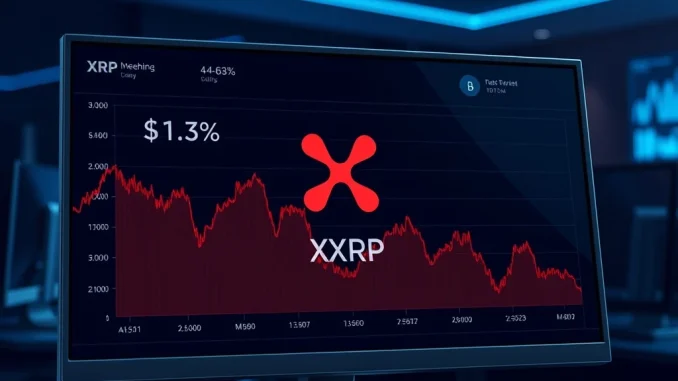
March 10, 2026 — Global cryptocurrency investors are confronting staggering losses as XRP, one of the largest digital assets by market capitalization, trades below the critical $1.40 threshold. The cryptocurrency currently sits at $1.35, representing a devastating 63% decline from its July 2025 peak of $3.66. This dramatic downturn has left XRP holders facing approximately $50 billion in unrealized losses, with more than 60% of the circulating supply now underwater according to blockchain analytics firm Glassnode. The situation underscores the severe volatility risks inherent in cryptocurrency markets during bear cycles, particularly affecting long-term investors who entered positions near previous highs.
XRP’s $50 Billion Unrealized Loss Crisis Deepens
Glassnode’s latest data reveals the alarming scale of investor pain in the XRP market. Approximately 36.8 billion XRP tokens, representing over 60% of the circulating supply, are currently held at a loss. This translates to roughly $50.8 billion in unrealized losses across investor portfolios globally. The aggregate holder cost basis, which represents the average price at which current holders purchased their XRP, stands at $1.44. Consequently, the current trading price of $1.35 places most long-term holders in negative territory. Market analysts attribute this situation to several converging factors including sustained spot ETF outflows, weakening investor sentiment, and broader cryptocurrency market pressures that have persisted since late 2025.
Historical context sharpens the current predicament. XRP opened 2025 at $1.87, meaning the asset has declined 28% year-to-date following an 11.6% drop throughout 2025. This prolonged weakness represents one of the most challenging periods for XRP investors since the 2018 cryptocurrency winter. The current price action marks a significant departure from the optimism that followed the July 2025 peak, when regulatory clarity and institutional adoption appeared to signal a new era for the digital asset.
Spot ETF Outflows and Institutional Retreat Intensify Pressure
Institutional investors are rapidly reducing exposure to XRP through exchange-traded funds, creating additional downward pressure. Data from financial analytics platform SoSoValue shows spot XRP ETFs recorded $22.8 million in net outflows over two consecutive days last week. Friday alone saw $16.2 million in redemptions, marking the largest single-day outflow since January 29, 2026, when these products experienced $93 million in withdrawals. This risk-off sentiment extends globally, with international XRP investment products recording over $30 million in net outflows during the week ending March 6, 2026.
- Accelerated Institutional Exit: Professional investors are reducing XRP exposure at the fastest pace in six weeks, signaling deteriorating confidence in near-term recovery prospects.
- Liquidity Concerns: Sustained ETF outflows reduce market liquidity, potentially exacerbating price volatility during periods of heightened selling pressure.
- Sentiment Indicator: Institutional flows often serve as leading indicators for retail investor behavior, suggesting further challenges ahead for XRP’s price stability.
Analyst Perspectives on XRP’s Technical Outlook
CryptoPulse senior market analyst, Michael Chen, provided specific technical analysis during a Monday briefing. “XRP/USD continues trading within a well-defined range between $1.40 resistance and $1.30 support,” Chen explained. “The price is currently retesting the range bottom. If buyers step in here, we could see XRP rotate back toward the top of the range. However, if this $1.30 level breaks, the range structure collapses and price could seek significantly lower levels.” Chen’s assessment aligns with data from Glassnode’s UTXO Realized Price Distribution, which identifies $1.40 as a critical level where investors acquired approximately $1.28 billion in XRP. This concentration of buying activity creates both potential support and resistance, depending on whether the level holds or breaks.
Critical Price Levels and Technical Analysis Breakdown
Technical analysts are closely monitoring several key price levels that could determine XRP’s near-term trajectory. The immediate battle centers on the $1.30-$1.27 support zone, which represents the local low established on February 28, 2026. A breach below this level could trigger further declines toward the February 6 low of $1.13, which coincides with the 200-week exponential moving average—a long-term trend indicator watched by institutional traders. On the upside, bulls must reclaim the 200-week simple moving average at $1.40 to signal potential trend reversal.
| Price Level | Significance | Potential Outcome if Breached |
|---|---|---|
| $1.40 | 200-week SMA & major resistance | Break above could target $1.60 then $1.95 |
| $1.30-$1.27 | Current range support & local low | Break below could target $1.13 (200-week EMA) |
| $1.13 | 200-week EMA & February low | Break below could trigger accelerated selling |
| $1.44 | Aggregate holder cost basis | Price above this level would return most holders to profit |
Broader Cryptocurrency Market Context and Historical Parallels
The XRP situation reflects broader challenges across cryptocurrency markets during the first quarter of 2026. Major digital assets including Bitcoin and Ethereum have similarly faced pressure, though XRP’s 63% drawdown from its high exceeds many peers. This underperformance raises questions about asset-specific factors versus general market conditions. Historically, assets experiencing such severe drawdowns relative to their sector often face extended recovery periods. The current scenario echoes patterns observed during the 2018-2019 cryptocurrency winter, when many assets took 12-18 months to reclaim previous highs following similar percentage declines.
Investor Psychology and Behavioral Finance Considerations
Behavioral finance experts note that the psychology of “unrealized losses” versus “realized losses” creates distinct investor behaviors. Dr. Elena Rodriguez, behavioral economist at Stanford University’s Digital Assets Research Initiative, explains: “When facing paper losses, investors often exhibit loss aversion—holding positions hoping for recovery rather than accepting the loss. This can create selling pressure at break-even points if prices recover partially, as investors seek to exit without loss.” This dynamic suggests that even if XRP recovers toward the $1.44 aggregate cost basis, renewed selling could emerge as underwater investors seek to exit positions.
Regulatory and Macroeconomic Factors Influencing XRP’s Trajectory
Beyond technical factors, regulatory developments continue influencing XRP’s market position. While the asset achieved greater regulatory clarity than many peers following its 2023 legal victory, ongoing global regulatory evolution creates uncertainty. Simultaneously, macroeconomic conditions including interest rate policies and inflation concerns affect risk asset valuations broadly. The convergence of these factors creates a complex environment for XRP price discovery, with multiple variables influencing investor decisions beyond simple supply-demand dynamics.
Conclusion
XRP investors currently face one of the most challenging environments in the asset’s history, with $50 billion in unrealized losses and 60% of circulating supply underwater. The critical technical battle between $1.30 support and $1.40 resistance will likely determine near-term direction, while sustained ETF outflows and weakening institutional sentiment create headwinds. Market participants should monitor the $1.27-$1.30 support zone closely, as a breach could trigger accelerated declines toward the $1.13 level. Conversely, a reclaim of the $1.40 level could signal potential recovery toward $1.60. Regardless of short-term price action, the current situation underscores the extreme volatility and risk inherent in cryptocurrency investments, particularly during bear market cycles.
Frequently Asked Questions
Q1: What exactly are “unrealized losses” for XRP holders?
Unrealized losses represent the paper losses investors face when an asset’s current market price falls below their purchase price. For XRP, this means holders who bought above $1.35 are currently experiencing losses on paper, but haven’t sold their positions to realize those losses.
Q2: How significant is the $50 billion loss figure in context?
The $50 billion represents approximately 60% of XRP’s circulating supply value at current prices. This scale of unrealized losses across such a large percentage of holders creates psychological and technical pressure that can influence market dynamics for months.
Q3: What are the key price levels to watch for XRP recovery?
Analysts identify $1.40 as the critical resistance level that must be reclaimed for bullish momentum. Below current prices, $1.30-$1.27 represents crucial support, with a break potentially targeting $1.13.
Q4: How do ETF outflows affect XRP’s price?
ETF outflows represent institutional selling pressure that reduces market liquidity. When ETFs redeem shares, the fund managers must sell underlying XRP holdings, creating direct selling pressure in the market.
Q5: Is this situation unique to XRP or part of broader market trends?
While XRP’s 63% drawdown exceeds many peers, the broader cryptocurrency market faces similar pressures. However, XRP’s specific technical levels, holder concentration, and ETF flow patterns create unique dynamics within the general bearish environment.
Q6: What should current XRP holders consider doing?
Investors should assess their risk tolerance, investment timeframe, and portfolio allocation. Many financial advisors recommend against making emotional decisions during volatile periods, but rather reviewing investment theses and considering diversification strategies appropriate to individual circumstances.