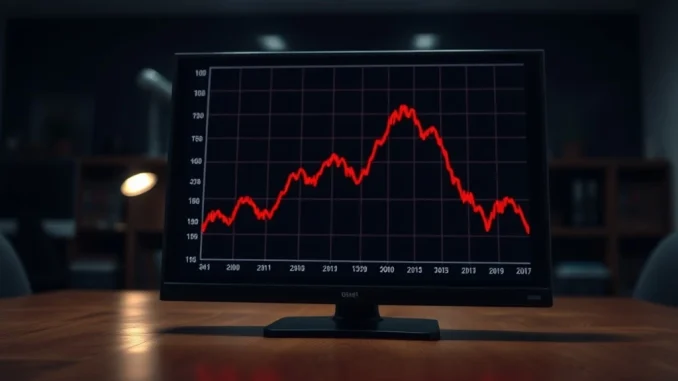
On Monday, March 10, 2026, the global cryptocurrency market witnessed a significant downturn as XRP, one of the largest digital assets by market capitalization, plunged below the critical $1.40 support level. This decline has left XRP holders facing a staggering collective unrealized loss exceeding $50 billion, according to real-time blockchain analytics. The sharp drop from its July 2025 high of $3.66 represents a 63% drawdown, placing intense pressure on both retail and institutional investors. Market analysts attribute the sell-off to consecutive days of outflows from spot XRP exchange-traded funds (ETFs) and a broader risk-off sentiment permeating digital asset markets.
XRP’s 63% Drawdown Creates $50.8 Billion Unrealized Loss Hole
Data from the blockchain analytics firm Glassnode reveals the precise scale of the damage. As XRP traded at $1.35 on Monday, approximately 36.8 billion XRP tokens—representing over 60% of the circulating supply—were held at a loss. This translates to $50.8 billion in paper losses that have not yet been realized through selling. “The concentration of supply in loss is a critical on-chain metric,” explained Marcus Thielen, Head of Research at CryptoPulse. “When it surpasses 60%, it often indicates capitulation pressure is building, as the average holder’s cost basis is breached.” The aggregate cost basis for XRP holders currently sits at $1.44, meaning the spot price has fallen below the average price at which investors acquired their tokens, intensifying psychological strain.
The downturn extends a prolonged period of weakness for XRP. The asset closed 2025 down 11.6% and now trades 28% below its yearly opening price of $1.87. This persistent bearish trend has systematically eroded investor portfolios that were built during the 2024-2025 rally. The current price action mirrors patterns seen in previous crypto bear markets, where assets retrace a significant portion of their bull market gains, testing the conviction of long-term holders.
Spot ETF Outflows and Weak Sentiment Amplify Selling Pressure
The pressure on XRP is not isolated to spot markets. Investment products tracking the asset are experiencing significant redemptions, signaling a pullback from institutional and accredited investors. Data from the financial analytics platform SoSoValue shows spot XRP ETFs recorded net outflows for two consecutive days, totaling $22.8 million. Friday, March 7, alone saw $16.2 million exit these products, marking the largest single-day redemption since January 29.
- Institutional Retreat: Global XRP investment products saw over $30 million in net outflows for the week ending March 6, 2026, according to Coinshares’ Digital Asset Fund Flows report.
- Sentiment Indicator: These outflows are a direct sentiment indicator, showing a reduction in exposure from some of the market’s most capital-sensitive participants.
- Liquidity Impact: ETF selling creates direct sell-side pressure on the underlying asset as authorized participants redeem shares, potentially exacerbating the downward price spiral.
Analyst Perspectives on the Current XRP Slump
Market experts are closely monitoring key technical and on-chain levels. Allen Scott, a veteran crypto market editor, notes that the $1.30 to $1.27 zone represents a critical local support area established in late February. “If buyers step in at the $1.30 support, we could see XRP rotate back toward the top of its recent range near $1.40,” Scott stated. “However, a break below $1.27 shifts the entire structure and could open the path toward the February 6 low of $1.13.” This $1.13 level coincides with the 200-week exponential moving average, a long-term trend indicator watched by many algorithmic and quantitative funds.
Broader Crypto Market Context and Historical Comparisons
XRP’s struggles occur within a complex macro environment for digital assets. While Bitcoin and Ethereum have shown relative stability, several major altcoins have experienced severe corrections, suggesting a rotation out of perceived higher-risk assets. The current cycle’s drawdown, while sharp, is not unprecedented. During the 2018 bear market, XRP fell over 90% from its peak. A comparison of key metrics highlights the current stress points.
| Metric | Current Status (March 2026) | July 2025 Peak |
|---|---|---|
| Price | $1.35 | $3.66 |
| Supply in Loss | 60%+ | < 15% |
| Holder Cost Basis | $1.44 | Below Price |
| Spot ETF Flow (Weekly) | ~$30M Outflow | Net Inflow |
Critical Price Levels and Potential Scenarios Ahead
The immediate technical picture hinges on several clearly defined levels. On the upside, bulls must reclaim the 200-week simple moving average, currently at $1.40, to signal any potential trend reversal. Glassnode’s UTXO Realized Price Distribution (URPD) data, which maps the price levels at which coins last moved, shows significant volume was acquired around this $1.40 zone, making it a formidable resistance area. Conversely, a breakdown below the $1.27-1.30 support cluster could trigger accelerated selling, with the next major support not appearing until the $1.13 region.
Community and Developer Response to Market Stress
Within the XRP community, reactions are mixed. Some long-term advocates, often called “XRPArmy” on social platforms, are promoting a “buy the dip” mentality, pointing to the fundamental utility of the RippleNet payment network. However, developer activity and network upgrade timelines, which can influence long-term sentiment, continue on their planned schedules, unaffected by short-term price volatility. The focus remains on technological adoption rather than market speculation.
Conclusion
The situation facing XRP holders is a stark reminder of the volatility inherent in cryptocurrency markets. With over $50 billion in unrealized losses and 60% of the supply underwater, the asset is at a critical juncture. The combination of spot ETF outflows, broken key support levels, and weak broader altcoin sentiment has created a perfect storm of selling pressure. Investors should monitor the $1.30 support and the $1.40 resistance closely, as a break in either direction will likely dictate the short-to-medium-term trend. While the losses are significant on paper, they only become permanent upon sale, leaving the ultimate outcome dependent on holder resolve and broader market recovery.
Frequently Asked Questions
Q1: What does ‘unrealized loss’ mean for XRP holders?
An unrealized loss is a decrease in the value of an asset that an investor still holds. For XRP holders, the $50 billion figure represents the total paper loss across all wallets where the current price ($1.35) is below the price at which those coins were originally acquired. The loss is only “realized” if the holder sells at this lower price.
Q2: Why are spot XRP ETF outflows significant?
Spot ETF outflows are significant because they represent institutional and large-scale investors reducing their exposure. Authorized participants must sell the underlying XRP to meet redemption requests, creating direct sell-side pressure in the market that can drive prices lower.
Q3: What is the most important price level for XRP to hold?
The most critical immediate support level is between $1.27 and $1.30. This zone held in late February. A daily close below $1.27 could trigger further technical selling, potentially targeting the next major support near $1.13.
Q4: How does the current XRP drawdown compare to past bear markets?
The current 63% drawdown from the 2025 high is severe but less extreme than the 90%+ declines experienced in the 2018 and 2022 bear markets. Historical patterns suggest such corrections are a common, though painful, feature of crypto market cycles.
Q5: Does this price drop affect the operation of the XRP Ledger or RippleNet?
No. The XRP Ledger, the decentralized blockchain, and RippleNet, the enterprise payment network, operate independently of XRP’s market price. Transaction speed, cost, and network functionality remain unchanged.
Q6: What should a current XRP holder consider doing?
This is not investment advice. Generally, investors should assess their financial situation, risk tolerance, and investment thesis. Many consult a financial advisor and conduct their own research, considering whether their original reasons for holding XRP are still valid despite the price change.