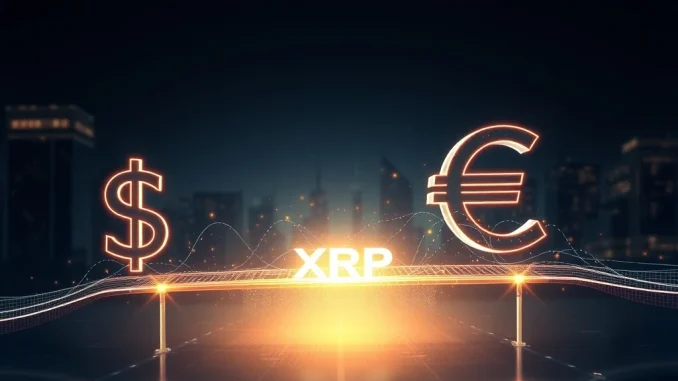
Global, May 2025: The XRP Ledger’s decentralized exchange (DEX) has executed a significant real-time trade, bridging the RLUSD and EUROP stablecoins. This event moves the concept of XRP as a bridge currency from theoretical discussion into demonstrable practice. The transaction provides concrete evidence of the ledger’s capability to facilitate efficient, counterparty-free liquidity between diverse digital assets, particularly as the European Union’s Markets in Crypto-Assets (MiCA) regulation brings increased focus to euro-denominated stablecoins.
XRP Bridge Currency Executes Critical Stablecoin Trade
On-chain data, initially highlighted by the analyst known as Vet_X0 on the social platform X, confirms a direct exchange between RLUSD and EUROP occurred on the XRP Ledger DEX. This is not a simulated test but a live, verifiable transaction. The trade’s importance lies in its demonstration of a functional, on-ledger bridge between a US dollar-pegged stablecoin and a nascent, MiCA-oriented euro stablecoin. For years, proponents of the XRP Ledger have cited its native digital asset, XRP, as an ideal bridge currency due to its fast settlement times (3-5 seconds) and low transaction costs. This real-world event provides a tangible use case for that proposed utility, showing how value can move seamlessly between different currency corridors without traditional financial intermediaries.
Decoding the RLUSD and EUROP Stablecoin Pair
Understanding the assets involved is key to grasping the transaction’s significance. RLUSD is a stablecoin issued on the XRP Ledger, designed to maintain a 1:1 peg with the US dollar. EUROP represents a newer class of digital assets: euro-pegged stablecoins being developed with strict compliance to the European Union’s MiCA framework, which aims to establish a comprehensive regulatory regime for crypto assets. The trade between these two assets on a single decentralized exchange highlights a maturing ecosystem. It suggests that the XRP Ledger DEX is evolving beyond trading XRP and its native issuances to becoming a venue for multi-currency stablecoin liquidity. This development could appeal to European institutions and users seeking regulated, euro-based digital asset exposure with easy convertibility to dollar-based tokens.
The Mechanics of Counterparty-Free Market Making
The “counterparty-free” aspect of this liquidity demonstration refers to the automated market maker (AMM) functionality integrated into the XRP Ledger DEX. Unlike traditional order books where a buyer must match with a specific seller, AMMs use liquidity pools. Users deposit pairs of assets (like RLUSD and EUROP) into a shared pool, and algorithms set prices based on a mathematical formula, typically a constant product formula. This allows for continuous, 24/7 trading without requiring two parties to agree on a price at the exact same moment. The real-time trade between RLUSD and EUROP was facilitated by such a liquidity pool, proving that deep enough liquidity exists for even niche currency pairs to function smoothly. This reduces friction and can lower spreads for traders converting between global stablecoins.
Implications for MiCA and Euro Digital Asset Integration
The timing of this liquidity event is particularly relevant. MiCA regulations are coming into full effect, creating a structured environment for stablecoin issuers within the EU. A MiCA-compliant euro stablecoin like EUROP gaining traction on a high-performance ledger like the XRP Ledger could accelerate institutional adoption. It provides a clear, compliant on-ramp and off-ramp for euro-denominated value within the crypto economy. Furthermore, the ability to instantly arbitrage or convert between EUROP and RLUSD on the same ledger enhances capital efficiency for market participants operating in both dollar and euro zones. This seamless integration is a foundational step toward the vision of a global, interconnected digital asset market that respects regional regulatory frameworks.
Historical Context: The Long Road to a Functional Bridge
The idea of XRP as a bridge asset predates the launch of the XRP Ledger’s native DEX and AMM. Initially, the focus was on Ripple’s payment solutions for financial institutions, using XRP to source liquidity in cross-border transactions. The development of the on-ledger DEX and, crucially, the 2024 activation of the AMM feature, shifted the bridge utility directly onto the open, decentralized ledger itself. This evolution means the bridge function is no longer dependent on a single company’s products but is available for any developer or project building on the XRPL to utilize. The RLUSD-EUROP trade is arguably the first high-profile example of this decentralized bridge utility in action for a fiat currency pair, marking a milestone in the ledger’s development roadmap.
Analyzing the Liquidity and Volume Data
While the single transaction proves functionality, sustainable utility requires consistent depth. Analysis of the XRP Ledger DEX shows that total value locked (TVL) in AMM pools and daily trading volumes have seen gradual growth since the feature’s launch. The creation of a viable RLUSD/EUROP pool indicates developers and liquidity providers are strategically seeding pools for anticipated future demand, especially around euro assets. The health of such a pool depends on several factors:
- Yield for Liquidity Providers (LPs): Fees generated from trades incentivize users to deposit assets.
- Low Slippage: The ability to execute large orders without significantly moving the price, which is a direct function of pool size.
- Arbitrage Opportunities: Efficient pools attract arbitrageurs who correct price discrepancies between different exchanges, which in turn reinforces the peg and pool efficiency.
The presence of this pool suggests confidence that these conditions can be met for the euro-dollar corridor on the XRPL.
Conclusion: A Step Toward a Frictionless Value Layer
The successful real-time exchange of RLUSD for EUROP on the XRP Ledger DEX is more than an isolated trade. It is a validation of the ledger’s core architectural promise to serve as a neutral, efficient bridge for global value. By demonstrating functional liquidity between a dollar stablecoin and a MiCA-aligned euro stablecoin, the XRP Ledger positions itself as a potential infrastructure player in the evolving regulated digital asset landscape. This liquidity revolution is not about hype, but about the quiet, technical work of building pools, writing code, and executing transactions that collectively make the movement of money as seamless as the movement of information. The bridge is now open, and the market will decide how heavily it is traveled.
FAQs
Q1: What does it mean that XRP acted as a bridge currency in this trade?
In this context, “bridge currency” describes the function of the XRP Ledger’s ecosystem. The trade occurred directly between RLUSD and EUROP in a shared liquidity pool on the ledger’s DEX. XRP itself facilitates the ledger’s operations (paying transaction fees) and can be used in other bridge scenarios, but this specific trade showcased the ledger’s ability to bridge two different fiat-pegged stablecoins efficiently.
Q2: Why is the EUROP stablecoin significant?
EUROP represents a growing category of euro-pegged stablecoins designed to comply with the European Union’s Markets in Crypto-Assets (MiCA) regulation. MiCA provides a comprehensive legal framework, aiming to protect consumers and ensure financial stability. A MiCA-compliant stablecoin gaining traction is crucial for the legal integration of crypto assets within the EU’s economy.
Q3: What is an Automated Market Maker (AMM) and how does it work?
An AMM is a decentralized trading protocol that uses mathematical formulas to price assets. Instead of matching buyers and sellers, users provide liquidity to pools containing pairs of tokens. Trades are executed against these pools, with prices adjusting algorithmically based on the pool’s ratio of assets. This allows for continuous, 24/7 trading without a traditional counterparty.
Q4: How does this relate to traditional finance or Ripple the company?
This development occurs on the public, decentralized XRP Ledger, which is separate from Ripple’s enterprise products. While Ripple is a major contributor to the ledger, the DEX and AMM are open, permissionless systems. The trade demonstrates utility that could complement traditional finance by providing a faster, cheaper corridor for converting between digital dollar and euro assets.
Q5: What are the main challenges for this type of liquidity going forward?
The primary challenges are achieving sufficient liquidity depth (Total Value Locked) to handle large transactions without high slippage, maintaining the stablecoins’ pegs under market stress, and ensuring the legal and regulatory compliance of all assets in the pools, especially as global regulations like MiCA are implemented.