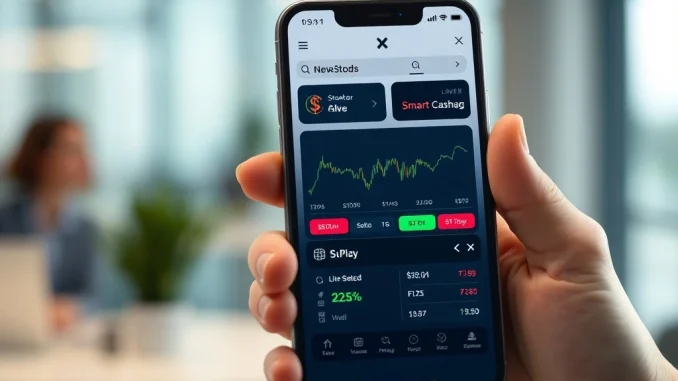
San Francisco, April 2025: X, the social media platform formerly known as Twitter, has confirmed the imminent launch of its Smart Cashtags feature, a development poised to fundamentally alter how users interact with financial markets. This update will enable users to view live data, execute trades, and manage investments in both stocks and cryptocurrencies directly within their timelines, eliminating the need for external brokerage apps. Product lead Nikita Bier has verified the rollout, signaling X’s most significant step yet toward becoming a comprehensive, integrated trading and financial services hub.
Smart Cashtags: The Mechanics of Integrated Trading
The core functionality of Smart Cashtags builds upon X’s existing cashtag system, where symbols like $TSLA or $BTC generate links to basic price information. The new Smart Cashtags feature transforms these static links into dynamic, interactive trading portals. When a user taps on a cashtag, they will access a dedicated module containing real-time price charts, key financial metrics, relevant news headlines aggregated from the platform, and crucially, integrated buy and sell order buttons. This seamless integration means a user discussing a company’s earnings report can immediately act on that information without switching applications, creating a frictionless loop between information consumption and financial action.
Industry analysts note this move follows a broader trend of social media platforms expanding into fintech. However, X’s approach is distinct in its ambition for deep integration rather than a standalone financial tab. The platform is reportedly partnering with regulated brokerage and payment processing entities to facilitate custody and execution. This structure suggests X will act as the front-end interface and social layer, while licensed partners handle the back-end compliance, clearing, and settlement—a model similar to how many popular trading apps operate.
Implications for the Retail Trading and Crypto Landscape
The introduction of integrated trading via Smart Cashtags carries substantial implications for both the retail investment community and the cryptocurrency sector. For the average user, it dramatically lowers the barrier to entry for executing trades, embedding the action within a familiar environment. This could accelerate the trend of retail trading driven by social sentiment, a phenomenon vividly demonstrated during events like the GameStop short squeeze of 2021, which was largely coordinated on social platforms including the former Twitter.
For the cryptocurrency market, the integration represents a major onboarding channel. By placing crypto assets like Bitcoin and Ethereum on equal footing with traditional stocks in the user interface, X normalizes them as legitimate investment vehicles for its massive global user base. The feature’s design likely includes:
- Unified Portfolio View: A dashboard aggregating holdings across stocks and crypto.
- Live Order Books: Real-time data feeds for transparency.
- Educational Tooltips: Contextual explanations of terms for novice traders.
This convergence challenges traditional online brokers and dedicated crypto exchanges, forcing them to compete on the basis of advanced tools and lower fees, as X captures the market segment prioritizing convenience and social context.
Regulatory Hurdles and the Path to Launch
X’s journey to this launch has not been without significant challenges, primarily in the regulatory domain. Offering securities and cryptocurrency trading requires navigating a complex web of financial regulations that vary by country, including know-your-customer (KYC) and anti-money laundering (AML) protocols. The platform’s global reach complicates this further, as it must either secure licenses in numerous jurisdictions or restrict the Smart Cashtags feature geographically at launch.
Historical context is important here. Previous attempts by large tech companies to enter finance, such as Meta’s Libra/Diem project, faced intense regulatory scrutiny and ultimately folded. X appears to be adopting a more cautious, partnership-driven approach to mitigate these risks. The confirmed involvement of established brokerage partners suggests a strategy to leverage existing regulatory frameworks rather than attempting to build a全新的, unproven financial infrastructure. The phased rollout mentioned by Nikita Bier is a standard industry practice to manage technical load and regulatory compliance in a controlled manner.
Beyond Trading: X’s Vision for a Financial Ecosystem
The launch of Smart Cashtags is not an isolated product update but a cornerstone of X’s broader strategy to evolve into an “everything app.” Since its acquisition, the platform has steadily added payment capabilities, peer-to-peer transactions, and content monetization features. Integrated trading is a logical next step in creating a closed-loop financial ecosystem where users can discover information, discuss assets, execute trades, and potentially even use holdings for payments—all within a single platform.
This expansion positions X to capture multiple revenue streams, including potential transaction fees, payment processing, and enhanced data services. It also increases user engagement and session time, key metrics for any social platform. The long-term vision may include:
- Advanced Analytics: Premium subscription tiers offering deeper charting and data.
- Creator Economy Integration: Allowing creators to offer tokenized assets or shares.
- Decentralized Finance (DeFi) Gateways: Connecting users to on-chain financial protocols.
The success of this feature will depend heavily on execution security, data accuracy, and user trust—factors where any misstep could have severe reputational and financial consequences.
Conclusion
The confirmed launch of Smart Cashtags by X represents a pivotal moment in the convergence of social media and finance. By enabling seamless stock and crypto trading directly within the timeline, X is betting that the future of retail investment is social, contextual, and immediate. This move challenges traditional financial intermediaries and could democratize market access for millions, while also introducing new complexities around regulation, financial literacy, and platform responsibility. As the rollout begins, the industry will watch closely to see if this integrated model defines the next generation of fintech or serves as a cautionary tale about the limits of platform expansion.
FAQs
Q1: What exactly are Smart Cashtags on X?
A1: Smart Cashtags are an enhanced version of X’s existing financial symbols. Tapping on a cashtag (like $AAPL or $BTC) will open an interactive module with live price data, charts, news, and integrated buttons to buy or sell the associated stock or cryptocurrency without leaving the X app.
Q2: Do I need a separate brokerage account to use Smart Cashtags for trading?
A2: Based on available information, X is partnering with regulated brokerage firms. Users will likely need to link an account with one of these partner brokers or create a new sub-account through X’s integrated system to hold assets and execute trades, similar to signing up for any online trading platform.
Q3: Will Smart Cashtags be available to all X users globally?
A3: Initially, the feature will likely have a phased rollout and may be restricted to certain countries due to varying financial regulations. Availability will depend on X and its partners securing the necessary licenses in each jurisdiction.
Q4: What assets can I trade using Smart Cashtags?
A4: The feature is designed to support both traditional stocks (likely major exchanges like NYSE, NASDAQ) and popular cryptocurrencies (like Bitcoin, Ethereum). The exact list of supported assets will be confirmed at launch and may expand over time.
Q5: How does X make money from Smart Cashtags?
A5: While official details are pending, potential revenue models could include earning a small fee on executed trades (like payment for order flow), charging partners for integration, or offering premium data and analytics features through its subscription service, X Premium.