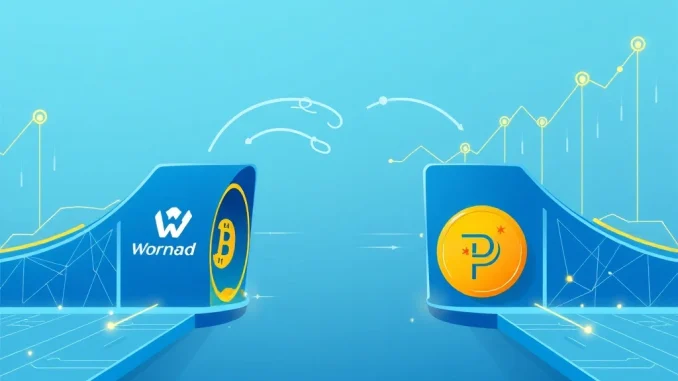
March 25, 2025: The cross-chain communication protocol Wormhole has executed a significant integration, launching Perena’s USD* stablecoin on the emerging Monad blockchain. This deployment utilizes Wormhole’s Native Token Transfers (NTT), a framework designed to provide a secure, seamless, and high-performance conduit for digital assets. The move represents a calculated step toward solving one of decentralized finance’s (DeFi) most persistent challenges: fragmented liquidity across isolated blockchain networks. By enabling a major stablecoin to flow natively into Monad’s high-throughput environment, the collaboration aims to unlock new DeFi applications and user experiences built on scalable, low-cost transactions.
Wormhole and Native Token Transfers: The Technical Backbone
The core innovation enabling this integration is Wormhole’s Native Token Transfers framework. Unlike traditional bridging methods that often involve wrapping assets—creating a synthetic version of a token on a destination chain—NTT allows the original canonical token to move between chains while preserving its fundamental properties. This technical distinction carries substantial implications for security and user experience. The process relies on Wormhole’s decentralized network of guardians, which observe and attest to events on connected chains. When a user initiates a transfer of USD* from a source chain like Ethereum to Monad, these guardians collectively verify the transaction’s legitimacy before authorizing its minting on the destination chain. This model seeks to reduce the systemic risks and complexity associated with bridge contracts, which have been a frequent target for exploits in the past. The focus on a secure, canonical representation of the asset is a direct response to the industry’s historical pain points.
Perena’s USD*: A Stablecoin Engine for DeFi Growth
Perena’s USD* enters the Monad ecosystem not merely as another dollar-pegged asset, but as a potential foundational pillar for its DeFi landscape. USD* is a fully collateralized stablecoin, meaning it is backed one-to-one by a reserve of high-quality, liquid assets. This model prioritizes stability and transparency, which are critical for users and developers building financial applications. The stablecoin’s arrival on Monad addresses a fundamental need: a trusted, scalable medium of exchange and store of value. For developers, it provides a predictable base asset for lending protocols, decentralized exchanges (DEXs), and yield-bearing strategies. For users, it offers a fast and cheap on-ramp to participate in Monad’s nascent economy without exposure to the volatility of native tokens. The integration effectively transplants a piece of mature DeFi infrastructure into a new, performance-oriented environment.
The Monad Advantage: A High-Performance Destination
Monad’s value proposition lies in its pursuit of scalability without compromising decentralization. The blockchain employs parallel execution and other advanced optimizations to target significantly higher transactions per second (TPS) and lower fees than its Ethereum Virtual Machine (EVM)-compatible predecessors. This technical roadmap makes it an attractive destination for applications requiring high frequency and low latency, such as decentralized gaming, high-frequency trading, and social finance. However, a high-performance chain is only as useful as the assets and liquidity available on it. Prior to this integration, developers on Monad faced the “cold start” problem—building innovative applications without the essential stablecoin liquidity to fuel them. The canonical arrival of USD* via Wormhole directly mitigates this issue, providing the monetary fuel needed to bootstrap a vibrant economic ecosystem.
The Implications for Cross-Chain Liquidity and DeFi Users
This integration is a case study in the evolving architecture of a multi-chain world. It demonstrates a shift from isolated, chain-specific liquidity pools toward a more interconnected and fluid asset landscape. The primary implications are multifaceted. First, it enhances capital efficiency. Liquidity providers can now move USD* to where it earns the highest yield or is most needed, without being siloed on a single chain. Second, it improves user experience. A trader or liquidity provider can interact with Monad-based applications using a familiar, canonical stablecoin, reducing cognitive load and transaction friction. Third, it de-risks development. Projects building on Monad can now confidently integrate a major stablecoin with a robust security model, lowering a key barrier to entry. The table below outlines the key benefits of this specific integration model.
| Feature | Traditional Bridging | Wormhole NTT with USD* on Monad |
|---|---|---|
| Asset Type | Wrapped, synthetic token | Canonical, native representation |
| Security Model | Relies on bridge contract security | Leverages Wormhole’s guardian network & canonical minting |
| User Complexity | Often requires multiple steps & approvals | Streamlined, single transaction flow |
| Liquidity Fragmentation | High (multiple wrapped versions) | Reduced (canonical asset across chains) |
| Developer Integration | Varies per bridge standard | Standardized via NTT framework |
Historical Context and the Road to Secure Interoperability
The development of secure cross-chain messaging and asset transfer is a narrative defined by both ambition and adversity. High-profile bridge exploits, resulting in losses exceeding billions of dollars, have starkly highlighted the vulnerabilities of early designs. These events forced the industry to re-evaluate security as the paramount concern over speed or cost. Protocols like Wormhole have since evolved, emphasizing decentralized validation networks, rigorous auditing, and frameworks like NTT that minimize attack surfaces. The choice to bring USD* to Monad via this method reflects a mature, security-first approach that has become the industry’s post-learning curve standard. It signifies a move beyond the “move fast and break things” phase toward building resilient financial infrastructure.
Conclusion
The launch of Perena’s USD* on Monad via Wormhole’s Native Token Transfers is a strategically important development for the cross-chain liquidity landscape. It combines the security and canonical asset properties of an advanced bridging framework with the high-performance potential of the Monad blockchain and the stability of a well-collateralized stablecoin. This integration does not merely add another token to another chain; it provides a critical piece of monetary infrastructure designed to foster secure and efficient DeFi growth. As the blockchain ecosystem continues to fragment into specialized networks, the ability to move core assets like USD* securely and seamlessly will remain a fundamental determinant of which platforms can attract developers and users. This collaboration between Wormhole, Perena, and Monad offers a concrete blueprint for how that future can be built.
FAQs
Q1: What are Wormhole’s Native Token Transfers (NTT)?
Native Token Transfers is a framework developed by the Wormhole protocol that allows a blockchain’s canonical token to be transferred to another chain without creating a wrapped version. It uses a secure, attestation-based model to mint a native representation of the asset on the destination chain, aiming to improve security and user experience.
Q2: Why is bringing USD* to Monad significant?
Monad is a new, high-performance blockchain targeting scalable DeFi applications. The integration of a major, fully-collateralized stablecoin like Perena’s USD* provides essential base liquidity for its ecosystem. It allows developers to build complex financial applications and gives users a stable asset for transactions and yield generation from day one.
Q3: How does this integration benefit DeFi users?
Users gain the ability to move a trusted stablecoin into a high-throughput, low-cost environment seamlessly. This enables participation in Monad’s DeFi ecosystem with reduced friction and exposure to volatility. It also improves capital efficiency by allowing liquidity to flow to where it is most useful across chains.
Q4: Is USD* on Monad via Wormhole a wrapped token?
No. Through the Native Token Transfers framework, the USD* on Monad is a canonical, native representation of the stablecoin, not a wrapped or synthetic version. This design aims to enhance security and simplify the user experience by maintaining a single canonical asset across multiple chains.
Q5: What are the security advantages of this model?
The model leverages Wormhole’s decentralized guardian network for transaction attestation, moving away from reliance on a single, complex bridge contract. By minting a canonical asset, it also avoids the risks associated with managing separate wrapped token contracts on each chain, which have been historical points of failure.
Updated insights and analysis added for better clarity.
This article was produced with AI assistance and reviewed by our editorial team for accuracy and quality.