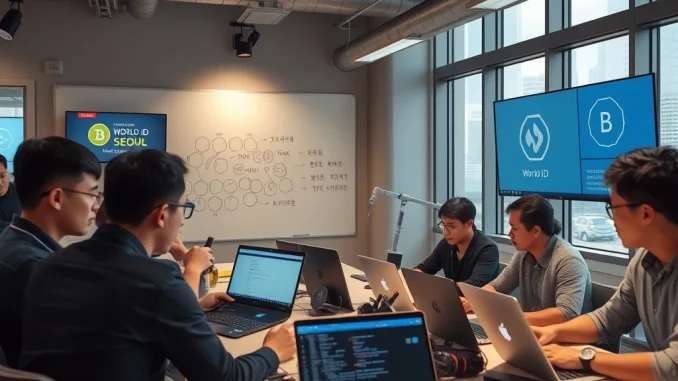
In a significant move to advance human-centric digital infrastructure, Worldcoin (WLD) has officially announced it will host the 2026 World Build Korea Hackathon in Seoul, South Korea. This major event, scheduled for the first half of 2026, represents a strategic push to foster innovation in Web3 services that fundamentally require proof of unique human identity. Consequently, the hackathon will challenge developers to build practical applications using World ID, Worldcoin’s privacy-preserving digital identity protocol, to distinguish real users from artificial intelligence, bots, and Sybil accounts. The initiative has already garnered robust support from leading South Korean blockchain societies and media outlets, signaling a strong regional commitment to solving one of the internet’s most persistent problems.
World Build Korea Hackathon Aims to Reshape Web3 Verification
The core mission of the World Build Korea Hackathon is to catalyze the development of functional Miniapps and services that are accessible exclusively to verified human users. This focus directly addresses a critical vulnerability in current digital ecosystems: the inability to reliably differentiate between genuine human interaction and automated or malicious activity. Participants will utilize World ID, a zero-knowledge proof-based credential, to design prototypes across several high-impact verticals. These areas explicitly include:
- Artificial Intelligence (AI): Creating AI interfaces and tools where contributions, training data, or access are gated by proven human input to ensure quality and authenticity.
- Web3 & DeFi: Developing decentralized finance protocols, governance systems, or airdrop mechanisms resistant to Sybil attacks and bot manipulation.
- Social Platforms & Community Tools: Building social networks, forums, or community hubs where every participant is a verified unique individual, aiming to reduce spam and toxic behavior.
- Gaming & Metaverse: Designing gaming economies, NFT distributions, or virtual world access models that prevent multi-account farming and ensure fair play.
Moreover, the event offers a total prize pool of $5,000, with top-performing teams gaining invaluable networking opportunities. Successful participants may also secure pathways for future collaboration within the expanding global Worldcoin ecosystem. This structure incentivizes not just short-term innovation but also long-term project sustainability and integration.
Strategic Importance of Seoul and South Korean Blockchain Ecosystem
Hosting the hackathon in Seoul is a deliberate strategic choice, reflecting South Korea’s status as a global leader in technology adoption and cryptocurrency innovation. The country boasts one of the world’s most active and sophisticated retail and institutional crypto markets. Furthermore, its vibrant developer community and government initiatives in digital innovation create an ideal environment for pioneering Web3 experiments. The event’s list of supporting organizations underscores this deep local expertise and engagement. Key supporters include:
- Decipher and Oracle: Prominent blockchain research and education groups.
- BADG (Blockchain Academic Development Group): Focused on academic and developmental growth in blockchain.
- Identei, Ewhachain, SKKrypto, Layer-A, and De-Butler: Influential university and community-based blockchain societies driving grassroots adoption and talent development.
Additionally, media partnerships with HumanLabs, TokenPost, CoinPulseHQ, and 071Labs ensure the hackathon’s developments and outcomes will receive thorough coverage within the Korean tech press and beyond. This multi-stakeholder approach provides participants with access to mentors, potential investors, and a platform for visibility, significantly enhancing the event’s practical impact.
The Evolving Context of Digital Identity and World ID
To fully appreciate the hackathon’s significance, one must understand the broader trajectory of digital identity solutions. For decades, the internet has operated on a model of pseudonymous or weakly verified identities, leading to rampant issues with fraud, misinformation, and unequal resource distribution. In response, the concept of “proof of personhood” has emerged as a critical frontier in cryptography and platform design. Worldcoin’s World ID protocol represents one of the most ambitious attempts to create a global, privacy-preserving standard for this proof. The protocol allows users to verify their unique humanness through an orb-based biometric scan without revealing any personal data, generating a zero-knowledge proof that can be used across applications.
Industry analysts often compare this approach to other digital identity frameworks, such as government-issued e-IDs or decentralized identifiers (DIDs). However, World ID’s specific aim is cryptographic proof of uniqueness, not the storage of attribute credentials. The 2026 Seoul hackathon will serve as a vital real-world test bed for this technology. It will explore whether developers can build compelling, user-friendly services that leverage this proof to create better online experiences. Success in Seoul could provide a powerful blueprint for similar initiatives worldwide, demonstrating tangible utility beyond theoretical design.
Potential Impacts and Future Trajectory for Verified Web3
The outcomes of the World Build Korea Hackathon could have several profound implications for the Web3 landscape and digital interaction at large. Firstly, successful prototypes may demonstrate clear, market-ready use cases for human verification, moving the conversation from speculation to application. Secondly, by fostering a cohort of Korean developers skilled in World ID integration, the event could accelerate the regional adoption of Worldcoin’s tools and establish Seoul as a hub for human-centric Web3 development. Finally, the collaborative models tested—between a global protocol like Worldcoin and local academic and community groups—could inform future ecosystem-building efforts in other regions.
Experts observing the space note that the integration of verified human identity is becoming a prerequisite for the next generation of scalable, fair, and trustworthy online services. Events like this hackathon are essential for bridging the gap between advanced cryptographic research and mainstream developer practice. They provide a structured, incentivized environment for innovation that directly addresses the urgent need for systems resilient against the rising sophistication of AI-generated content and automated attacks.
Conclusion
The announcement of the 2026 World Build Korea Hackathon in Seoul marks a pivotal step in the practical development of a verified human web. By focusing developer energy on building Miniapps that require World ID verification, Worldcoin is catalyzing innovation aimed at solving fundamental problems of trust and authenticity online. Supported by a strong coalition of South Korean blockchain societies and media partners, this event promises to yield not only innovative prototypes but also a strengthened local developer community skilled in next-generation identity solutions. As the digital world grapples with the challenges posed by AI and bots, initiatives like the Worldcoin hackathon in Seoul offer a constructive, build-focused path toward a more secure and human-centric internet.
FAQs
Q1: What is the primary goal of the World Build Korea Hackathon?
The primary goal is for developers to plan and build prototype Web3 services, or “Miniapps,” that require verification of real human users using Worldcoin’s World ID, specifically to exclude AI, bots, and Sybil accounts.
Q2: When and where will the Worldcoin hackathon take place?
The event is scheduled for 2026 and will be hosted in Seoul, South Korea. The exact dates within the year are to be announced.
Q3: What can participants win at the hackathon?
Participants compete for a share of a total prize pool of $5,000. Top teams also gain significant networking opportunities and the potential for future collaboration within the Worldcoin ecosystem.
Q4: Which organizations are supporting the event in South Korea?
Supporting organizations include Decipher, Oracle, BADG, Identei, Ewhachain, SKKrypto, Layer-A, and De-Butler. Media partners are HumanLabs, TokenPost, CoinPulseHQ, and 071Labs.
Q5: What is World ID, and how is it used in the hackathon?
World ID is Worldcoin’s privacy-preserving digital identity protocol that uses zero-knowledge proofs to verify a user is a unique human without revealing personal data. Hackathon participants must use it as the foundational verification layer for their application prototypes.
Updated insights and analysis added for better clarity.
This article was produced with AI assistance and reviewed by our editorial team for accuracy and quality.