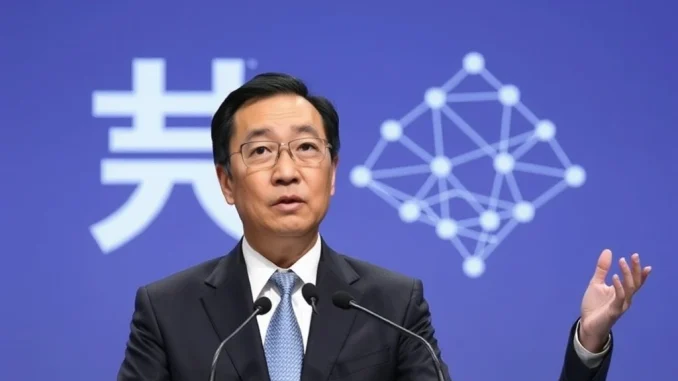
Hong Kong, January 2025: A proposed won-pegged stablecoin has triggered a stark warning from South Korea’s top central banker, highlighting a critical regulatory blind spot in the global digital currency race. Speaking at the Asian Financial Forum, Bank of Korea (BOK) Governor Lee Chang-yong articulated profound concerns that such a digital asset could be weaponized to bypass the nation’s stringent capital controls, potentially destabilizing its financial system. His comments underscore the escalating tension between financial innovation and monetary sovereignty as stablecoins evolve from niche crypto tools to potential vectors for large-scale capital flight.
Won-Pegged Stablecoin Presents a Unique Regulatory Challenge
Governor Lee’s primary apprehension centers on the specific mechanics of a Korean won-backed digital currency. Unlike a central bank digital currency (CBDC), which would be a direct liability of the BOK, a privately issued won-pegged stablecoin would operate in a regulatory gray area. Lee explained that its danger lies not in isolation, but in combination with existing dollar-pegged stablecoins like USDT or USDC. He detailed a potential circumvention scenario: a user could convert local currency into the won-pegged stablecoin, swap it for a dollar-pegged stablecoin on a decentralized exchange, and then move those digital dollars offshore—all potentially outside the purview of traditional banking channels and capital outflow regulations.
This concern is rooted in the fundamental appeal of dollar stablecoins. They offer near-instantaneous, global settlement at a fraction of the cost and time of traditional correspondent banking. For jurisdictions with capital controls or volatile currencies, they present a tempting, accessible off-ramp. Lee noted that if exchange rate volatility fuels speculation, domestic funds could rapidly flood into these dollar-linked digital assets, accelerating capital movement in ways that existing monitoring systems may not capture in real time.
The Global Stablecoin Landscape and Regulatory Difficulties
Governor Lee’s warning arrives amid a global regulatory scramble. The stablecoin market, valued in the hundreds of billions, is dominated by a handful of large issuers, but the entry of numerous non-bank financial institutions and tech firms has complicated oversight. “Regulation is becoming more difficult,” Lee emphasized, pointing to the diverse and often cross-jurisdictional nature of these entities. Unlike banks, which operate under well-defined licensing and supervisory regimes, stablecoin issuers can be structured in various ways, sometimes obscuring the ultimate responsible party and the location of reserve assets.
The international community lacks a unified framework. While the Financial Stability Board and the Basel Committee have issued high-level recommendations, implementation varies wildly. The European Union’s Markets in Crypto-Assets (MiCA) regulation imposes strict requirements on “significant” stablecoin issuers, including robust reserve backing and licensing. The United States continues to debate federal legislation, leaving a patchwork of state-level rules. In Asia, jurisdictions like Singapore and Japan have advanced licensing regimes, while others remain in exploratory phases. This fragmentation creates arbitrage opportunities and regulatory gaps that innovative financial products can exploit.
Historical Precedents and the Capital Control Conundrum
South Korea’s vigilance is informed by history. The country maintains capital controls that were strengthened following the 1997 Asian Financial Crisis, which devastated its economy. These controls are designed to prevent sudden, destabilizing inflows and outflows of “hot money.” The rise of digital assets represents the first significant technological challenge to this decades-old defense system. Analogies can be drawn to China’s strict capital account controls and its aggressive crackdown on cryptocurrency trading and mining, driven by similar fears of capital flight and financial instability.
The technological capability to move value peer-to-peer across borders without intermediary financial institutions fundamentally alters the capital control equation. While authorities can monitor and restrict flows through banks and licensed money transfer services, a sufficiently determined individual using privacy-enhancing tools and decentralized protocols presents a far more difficult challenge. A domestically pegged stablecoin could act as the crucial, compliant-looking on-ramp to this shadow cross-border payment system.
Potential Implications for Monetary Policy and Financial Stability
The BOK’s concern extends beyond mere circumvention. The widespread adoption of a won-pegged stablecoin, especially one issued by a private entity, could erode the central bank’s monetary policy transmission. If significant portions of everyday transactions and savings migrate to this digital currency, changes to the BOK’s benchmark interest rate might have a diminished effect on the real economy. Furthermore, the stability of the peg itself is paramount. A loss of confidence in the issuer’s ability to maintain the 1:1 redemption with the Korean won could trigger a “digital bank run,” with sell pressure spilling into traditional markets.
The systemic risk is amplified if the stablecoin’s reserves are not truly isolated, liquid, and of high quality—a lesson from the collapse of the algorithmic stablecoin TerraUSD in 2022, which wiped out tens of billions in value. Governor Lee’s statement implicitly calls for preemptive clarity: if a won-pegged stablecoin is to exist, what legal claim do holders have on the underlying reserves, and who ensures those reserves are properly managed?
Conclusion: A Call for Proactive and International Coordination
Bank of Korea Governor Lee Chang-yong’s comments are a clear signal that monetary authorities are moving from observing the stablecoin phenomenon to actively defending against its perceived risks. The warning about a won-pegged stablecoin is not a rejection of innovation but a demand for a regulatory framework that precedes market adoption. It highlights the urgent need for domestic legislation that clearly defines the treatment of stablecoins and for enhanced international cooperation to manage cross-border spillovers. As the line between traditional finance and digital assets continues to blur, the race is on to build guardrails that protect financial stability without stifling the potential benefits of this new technology.
FAQs
Q1: What is a won-pegged stablecoin?
A won-pegged stablecoin is a type of cryptocurrency designed to maintain a stable value by being pegged 1:1 to the South Korean won (KRW). It is typically backed by reserves of the actual currency or other high-quality assets held by the issuing entity.
Q2: Why is the Bank of Korea concerned about it?
The BOK is concerned because a privately issued won-pegged stablecoin could be used in tandem with dollar-pegged stablecoins to circumvent South Korea’s capital outflow regulations, potentially enabling large-scale, rapid capital flight that is difficult for authorities to monitor and control.
Q3: What are capital outflow regulations?
Capital outflow regulations are rules imposed by a government or central bank to restrict the flow of domestic currency and other assets out of the country. South Korea employs them as a tool to maintain financial stability and prevent economic shocks from sudden capital movements.
Q4: How do dollar-pegged stablecoins like USDT work?
Dollar-pegged stablecoins like Tether (USDT) or USD Coin (USDC) are cryptocurrencies whose value is tied to the U.S. dollar. Issuers hold reserves (cash, cash equivalents, bonds) to back each token in circulation, allowing them to be used for trading, remittances, and as a digital dollar proxy with low transaction costs.
Q5: What is the Asian Financial Forum (AFF)?
The Asian Financial Forum is a high-level annual conference held in Hong Kong, bringing together global financial leaders, policymakers, and business executives to discuss key issues and trends shaping the regional and world economy, including fintech and digital finance.