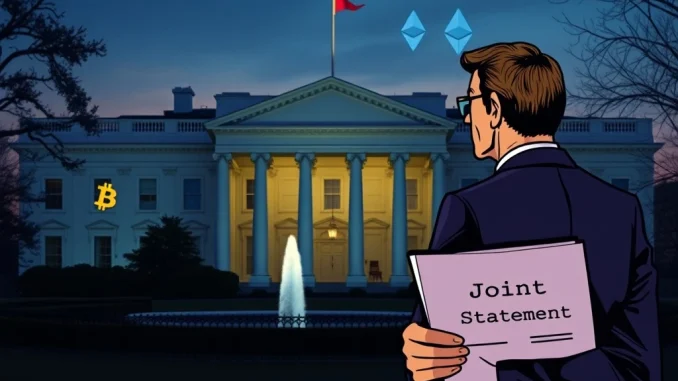
Washington D.C., April 8, 2025: A high-stakes meeting at the White House regarding cryptocurrency market structure has triggered immediate and significant alarm across the traditional banking sector. Five of the nation’s most influential banking trade groups issued a rare joint statement following Tuesday’s discussions, delivering a stark warning that proposed stablecoin regulations could cripple local lending and spearhead a dangerous outflow of deposits from small-town and community banks. This confrontation highlights a deepening rift between innovative financial technology and the bedrock institutions of American community finance.
White House Crypto Meeting Details and Immediate Fallout
The closed-door meeting, which included senior administration officials and key figures from both the crypto industry and traditional finance, aimed to discuss the evolving structure and oversight of digital asset markets. A primary topic was the long-pending framework for stablecoins—cryptocurrencies pegged to stable assets like the U.S. dollar. While the administration seeks to mitigate systemic risk and protect consumers, banking representatives left with profound concerns. The joint statement, released within hours by the American Bankers Association, the Bank Policy Institute, the Consumer Bankers Association, the Independent Community Bankers of America, and the Mid-Size Bank Coalition of America, represents a unified front rarely seen in the competitive financial world. Their core argument is that poorly crafted rules could inadvertently redirect crucial capital away from the traditional banking system that funds Main Street.
How Stablecoin Laws Threaten Community Bank Deposits
The banking groups’ alarm centers on the fundamental role of deposits. Community banks rely on customer deposits to fund a majority of their lending activities, including mortgages, small business loans, and agricultural financing. The groups contend that if stablecoins—offering digital dollar equivalents—are authorized under a regulatory framework that makes them appear as safe or more convenient than bank accounts, a gradual but substantial migration of funds could occur.
- Deposit Disintermediation: Consumers and businesses might hold transactional funds in stablecoin wallets rather than checking accounts, directly reducing the core deposit base for local banks.
- Liquidity Squeeze: With fewer deposits, banks have less capacity to issue loans. This could tighten credit precisely in communities that depend on local banks for access to capital.
- Competitive Disadvantage: The proposed rules, the banks argue, might create a two-tier system where non-bank stablecoin issuers operate with different, potentially lighter, regulatory burdens than chartered institutions holding similar assets.
This scenario is not merely theoretical. Analysts point to the rapid growth of money market funds in the late 20th century, which drew deposits away from banks, as a historical precedent for how new financial products can reshape liquidity landscapes.
The Historical Context of Financial Innovation vs. Stability
The tension between innovation and systemic stability is a recurring theme in American finance. The rise of shadow banking before the 2008 crisis demonstrated how activities moving outside the traditional regulated perimeter can accumulate hidden risks. Regulators now face a modern parallel with digital assets. Their mandate is to foster responsible innovation while safeguarding the established banking system that supports economic growth in every congressional district. The banking industry’s forceful response indicates they believe the current regulatory trajectory may fail this balance, prioritizing the new ecosystem at the potential expense of the old.
Potential Consequences for Local Lending and Economic Health
The implications extend far beyond bank balance sheets. Community banks are often the primary lenders for small businesses, which create nearly two-thirds of net new jobs in the U.S. A contraction in their lending ability could have a direct impact on economic vitality, particularly in rural and underserved areas where large national banks have a limited presence.
A potential ripple effect includes:
- Higher costs or reduced availability of credit for farmers, restaurateurs, and independent retailers.
- Slower economic growth in communities reliant on local capital.
- Increased consolidation in the banking sector as smaller institutions struggle, reducing consumer choice.
The banking groups emphasize that their concern is not opposition to innovation, but a plea for a regulatory approach that recognizes the interconnectedness of the financial system. They advocate for any stablecoin regime to be bank-centric, ensuring that entities issuing digital dollars are subject to the same rigorous oversight, capital requirements, and consumer protection laws as depository institutions.
Analysis of the Regulatory Path Forward
The White House meeting has set the stage for a complex political and legislative negotiation. Key lawmakers in Congress have been working on bipartisan stablecoin legislation for years, but consensus has been elusive. The banking industry’s vocal stance adds a powerful new dimension to the debate. Regulators, including the Federal Reserve and the Treasury Department, must now weigh the promise of payment innovation and digital asset clarity against the risk of unintended harm to the traditional lending architecture.
Possible outcomes include a delayed regulatory timeline to allow for more impact studies, amendments to proposed bills to address deposit concerns more explicitly, or the development of new safeguards that link stablecoin issuers directly to the banking system. The ultimate framework will signal whether policymakers view crypto as a compartmentalized sector or an integral, but tightly managed, component of the broader financial landscape.
Conclusion
The White House crypto meeting has acted as a catalyst, revealing a profound and urgent concern within the banking industry that proposed stablecoin laws pose a direct threat to the financial health of community banks and the local lending they sustain. This is not a simple debate about technology adoption; it is a conflict over the future flow of capital and credit in the American economy. As the administration and Congress move forward, they must navigate a path that neither stifles responsible financial innovation nor undermines the community-based institutions that form a critical pillar of national economic stability. The unified voice of the banking trade groups ensures this perspective will be central to all future discussions on cryptocurrency regulation.
FAQs
Q1: What was the main concern raised by banking groups after the White House meeting?
The primary concern is that proposed stablecoin regulations could cause consumers and businesses to move funds from traditional bank accounts into stablecoins, reducing the deposit base that community banks rely on to make local loans.
Q2: Which banking groups issued the joint statement?
The statement came from the American Bankers Association, the Bank Policy Institute, the Consumer Bankers Association, the Independent Community Bankers of America, and the Mid-Size Bank Coalition of America.
Q3: How could stablecoins affect small-town banks differently than large banks?
Community banks are more dependent on local deposits for lending. Large banks have diverse funding sources, including global capital markets. A deposit outflow would therefore disproportionately impact smaller institutions’ ability to serve their local economies.
Q4: What is a stablecoin?
A stablecoin is a type of cryptocurrency designed to have a stable value, typically pegged to a fiat currency like the U.S. dollar. They are used for trading and as a digital medium of exchange within the crypto ecosystem.
Q5: What do banking groups want regulators to do?
They advocate for a “bank-centric” regulatory model where any entity issuing stablecoins at scale is subject to the same strict oversight, capital rules, and consumer protection laws as a chartered bank, to ensure a level playing field and protect the traditional banking system.
This article was produced with AI assistance and reviewed by our editorial team for accuracy and quality.