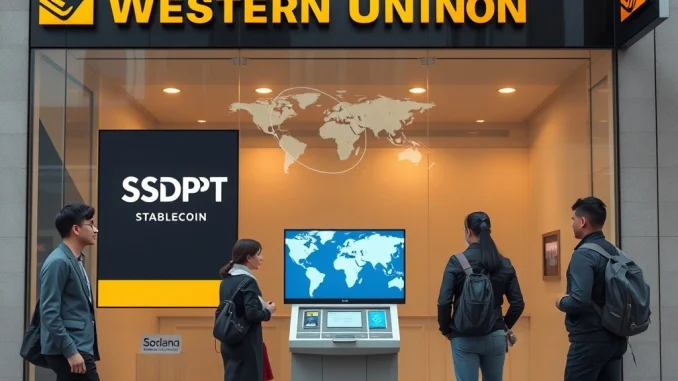
DENVER, March 15, 2026 — In a strategic move that bridges traditional finance with digital currency, global payments giant Western Union has officially launched USDPT, a new U.S. dollar-pegged stablecoin, on the high-speed Solana blockchain. Announced today from its Denver headquarters, the launch leverages Western Union’s unparalleled physical network of over 360,000 agent locations across more than 200 countries to provide real-world backing and redemption points. This initiative marks the most significant entry by a traditional money transfer operator into the stablecoin sector and signals a potential transformation for low-cost, high-speed cross-border transactions. The company simultaneously unveiled its Western Union Digital Asset Platform, a comprehensive ecosystem for managing and transferring digital value.
Western Union’s USDPT Stablecoin: Architecture and Backing
The newly minted USDPT stablecoin is designed as a fully reserved, fiat-collateralized digital currency. Each token in circulation is backed one-to-one by U.S. dollars held in a combination of cash reserves at agent locations and segregated accounts with regulated financial partners. Devin McGranahan, CEO of Western Union, stated in the official release, “Our network provides a tangible, trusted bridge between cash and digital value. USDPT is not just a digital token; it’s a utility backed by the most extensive physical distribution network on earth.” The choice of the Solana network is critical. Analysts point to Solana’s capability of processing over 65,000 transactions per second with sub-second finality as a key factor, enabling Western Union to offer near-instant settlement for remittances at a fraction of current costs.
This development follows two years of internal blockchain pilots and a 2024 partnership with the Stellar Development Foundation, which initially signaled the company’s digital asset ambitions. However, the pivot to Solana in late 2025, confirmed by company filings, highlights a focus on scalability and developer ecosystem support. The launch includes immediate integration with major Solana-based decentralized exchanges (DEXs) and wallets, allowing for secondary market liquidity from day one.
Impact on Global Remittances and Financial Inclusion
The immediate impact of USDPT centers on the $860 billion global remittance market. Western Union processes billions in cross-border person-to-person payments annually, often involving corridors with high fees and slow processing times. By using USDPT, a sender could convert cash to stablecoin at an agent location, send it instantly via the Solana blockchain for minimal cost, and have the recipient cash out at another agent—all within minutes. This model directly challenges both traditional banking rails and existing crypto remittance services.
- Cost Reduction: Potential to slash average remittance fees from the current global average of 6.2% to below 2%, saving migrants billions annually.
- Speed and Access: Enables 24/7 instant settlement, bypassing banking hours and holiday closures critical for time-sensitive transfers.
- Market Expansion: Opens digital payment avenues for the estimated 1.4 billion adults globally who remain unbanked but have access to a mobile phone and a cash agent.
Expert Analysis and Institutional Response
Industry observers note the profound implications for crypto adoption. “This isn’t just another stablecoin launch,” said Meltem Demirors, Chief Strategy Officer at CoinShares. “It’s the first time a legacy financial institution with massive retail distribution is using a public blockchain as a core settlement layer. It validates the utility of networks like Solana for real-world payment throughput.” Regulatory response will be closely watched. A spokesperson for the U.S. Treasury’s Financial Crimes Enforcement Network (FinCEN) provided a standard comment to news outlets, reiterating that all money transmission laws, including the Bank Secrecy Act, apply equally to fiat and digital asset transactions. Western Union has emphasized its existing compliance infrastructure across jurisdictions as a key advantage over crypto-native startups.
Broader Context: Stablecoin Competition and Market Dynamics
USDPT enters a crowded but evolving stablecoin market dominated by Tether (USDT) and USD Coin (USDC). However, Western Union’s unique value proposition is not just digital issuance but integrated off-ramps. Unlike purely digital stablecoins, USDPT offers guaranteed liquidity at physical locations worldwide—a hybrid model no other major player can replicate. The move also pressures other money transfer operators like MoneyGram and Wise to accelerate their own digital asset strategies.
| Stablecoin | Primary Issuer/Backer | Key Differentiator | Global Cash Access Points |
|---|---|---|---|
| USDPT | Western Union | Integrated 360k+ cash agent network for minting/redemption | 360,000+ |
| USDC | Circle | Regulatory compliance, banking partnerships | Limited, via partners |
| USDT | Tether | First-mover advantage, deepest liquidity on exchanges | None |
| PYUSD | PayPal | Integration with PayPal’s e-commerce and Venmo user base | None |
What Happens Next: Rollout Phases and Strategic Goals
Western Union has outlined a phased rollout. The initial phase, starting this week, enables USDPT minting and redemption at 5,000 pilot agent locations in key corridors like United States to Mexico, United Arab Emirates to India, and within Europe. The full Digital Asset Platform, including direct integration with the Western Union mobile app for wallet services, is scheduled for Q3 2026. Company executives have also hinted at exploring tokenized versions of other major fiat currencies, like the Euro and British Pound, on Solana, contingent on regulatory approvals and market demand. The long-term vision positions Western Union not just as a payment conduit but as a gateway between the traditional financial system and the growing digital asset economy.
Stakeholder Reactions and Market Response
The announcement triggered immediate reactions across financial markets. Solana’s native token (SOL) saw a 7% increase in price following the news, reflecting perceived value accretion to the network. Conversely, shares of some pure-play digital remittance companies dipped slightly. Within the crypto community, developers praised the potential for new applications built on USDPT’s guaranteed liquidity. However, some decentralization advocates expressed caution, noting the stablecoin’s centralized issuance model and reliance on a single corporate entity’s compliance policies. Public response on social media has been mixed, with excitement about cheaper remittances tempered by questions about transaction privacy and the learning curve for first-time users.
Conclusion
The launch of Western Union’s USDPT stablecoin on Solana represents a pivotal convergence of legacy finance and blockchain technology. By leveraging its vast physical network for trust and accessibility, Western Union addresses one of crypto’s biggest hurdles: the last-mile connection to cash. While regulatory scrutiny and market adoption remain to be seen, this move has undeniably raised the stakes in the stablecoin and remittance industries. The success of USDPT could catalyze a new wave of institutional adoption of public blockchains for core financial services, making high-speed, low-cost cross-border value transfer a tangible reality for millions. Observers should monitor the pilot corridor transaction volumes in the coming months and any subsequent regulatory statements as key indicators of the initiative’s trajectory.
Frequently Asked Questions
Q1: What is the USDPT stablecoin and who issues it?
The USDPT is a U.S. dollar-pegged stablecoin issued by Western Union. It is built on the Solana blockchain and is uniquely backed by a combination of cash reserves at Western Union’s global agent locations and traditional bank deposits.
Q2: How can someone use USDPT to send money internationally?
A sender visits a participating Western Union agent, converts cash to USDPT tokens, sends them instantly via the Solana network to the recipient’s digital wallet, and the recipient can then cash out at another Western Union agent, potentially completing the process in minutes.
Q3: What are the main benefits of using USDPT over traditional Western Union transfers?
The primary benefits are significantly lower fees, near-instant transaction settlement 24/7, and the security and transparency of blockchain-based tracking, while still maintaining access to cash-in and cash-out points.
Q4: Is USDPT available everywhere Western Union operates?
Not immediately. The launch begins with a pilot program in select high-volume corridors. A full global rollout to all 360,000+ agent locations is planned but will occur in phases throughout 2026 and 2027, subject to local regulations.
Q5: How does this affect competitors like USDC or traditional banks?
USDPT introduces direct competition by offering a physical cash network advantage that purely digital stablecoins lack. For banks, it pressures them to lower costs and improve speed in the remittance space or risk losing market share.
Q6: What should a first-time user know before trying USDPT?
Users will need a compatible Solana wallet to receive tokens and should confirm that both the sending and receiving agent locations in their corridor support USDPT transactions. Standard identification procedures for money transmission will still apply.