January 28, 2026 — If it has a processor and consumes electricity, someone has likely attempted to mine cryptocurrency with it. While specialized ASIC miners dominate industrial Bitcoin mining operations globally, a persistent subculture of tinkerers continues pushing computational boundaries with increasingly unconventional hardware. From repurposed gaming consoles to historical computing artifacts, these experiments reveal both the accessibility and absurdity of proof-of-work cryptocurrency systems. Magazine has documented six of the most bizarre devices people have actually used to mine Bitcoin and other cryptocurrencies, showcasing remarkable technical ingenuity against overwhelming mathematical odds.
PlayStation Consoles: From Gaming to Crypto Mining Operations
The convergence of gaming hardware and cryptocurrency mining began years before the 2020s, but reached notable scale in 2021 when Ukrainian authorities uncovered a massive mining operation. The Security Service of Ukraine reported seizing approximately 5,000 devices from an illicit facility allegedly stealing $260,000 monthly in electricity. Among the confiscated equipment, authorities identified 3,800 units appearing to be PlayStation 4 consoles alongside 500 graphics cards and numerous other computing devices. This discovery highlighted how consumer gaming hardware, designed for entertainment, could be repurposed for computational mining tasks.
Industry developments followed this trend. In 2024, computer hardware manufacturer ASRock developed a $15,000 cryptomining rig utilizing twelve AMD BC-250 mining cards—processors derived from the architecture powering Sony’s PlayStation 5. Each rig reportedly achieved hash rates up to 610 MH/s when mining Ethereum during its proof-of-work era. YouTube creators subsequently documented their own experiments with BC-250 processors throughout 2024, demonstrating continued interest in gaming-adjacent hardware for cryptocurrency applications despite shifting consensus mechanisms.
Botnet-Enabled Surveillance Cameras and IoT Devices
Perhaps the most concerning unconventional mining method involves compromised Internet of Things devices. In 2017, IBM X-Force researchers identified a variant of the Mirai botnet specifically modified for Bitcoin mining when Bitcoin traded around $1,300. Originally discovered in August 2016, the Mirai malware infected thousands of IoT devices—including routers, DVRs, and surveillance cameras—by exploiting default factory credentials. The botnet initially facilitated distributed denial-of-service attacks before threat actors adapted its code for cryptocurrency mining.
Security firm Darktrace documented one instance where Mirai malware infected a digital video recorder camera at a Canadian company. IBM researchers, however, questioned the practical effectiveness of such botnet mining operations. “Given Mirai’s power to infect thousands of machines at time, there is a possibility that Bitcoin miners could work together in tandem as one large miner consortium,” their analysis noted. The fundamental challenge remained: even thousands of low-power IoT devices could not compete with specialized ASIC miners already dominating Bitcoin’s network hashrate by 2017.
- Scale vs. Efficiency: Botnets could coordinate thousands of devices but each contributed minimal computational power
- Security Implications: These operations represented unauthorized use of compromised devices rather than legitimate mining
- Economic Reality: Electricity theft often proved more valuable than any potential mining rewards
Technical Analysis from Cybersecurity Experts
Charles Henderson, head of IBM’s X-Force Red security testing team, contextualized these developments during a 2023 security conference. “The Mirai Bitcoin mining variant represented a natural evolution of malware monetization,” Henderson explained. “When cryptocurrency values surged, threat actors explored every possible revenue stream, even technically impractical ones.” This perspective highlights how cryptocurrency’s economic incentives drive unconventional computational experiments, regardless of their practical viability or legal standing.
Nintendo Game Boy: Retro Gaming Meets Cryptocurrency
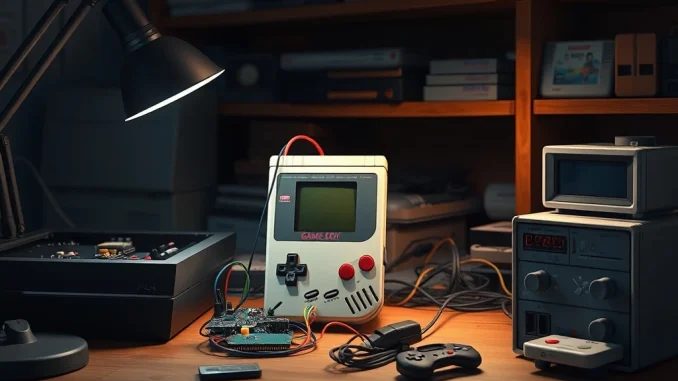
In 2021, YouTuber stacksmashing demonstrated that technical possibility often outweighs practical utility. Using a vintage Nintendo Game Boy (originally released in Japan, April 1989), a Raspberry Pi Pico microcontroller, custom software, and a modified link cable, stacksmashing created a functional Bitcoin miner. The Game Boy handled mining computations while a connected computer managed network communications. This experiment utilized the same SHA-256 implementation firmware found in Trezor hardware wallets, adapted for the Game Boy’s limited 8-bit architecture.
The mining process involved an endless loop: receiving block data and target values from the computer, performing hash computations, checking results against targets, and either transmitting successful nonces or restarting the cycle. stacksmashing reported audible feedback—a distinctive “whine” from the Game Boy as it strained under computational loads. The achieved hash rate measured approximately 0.8 hashes per second. For perspective, modern ASIC miners operate at around 100 terahashes per second, making the Game Boy roughly 125 trillion times slower. At this rate, mining a single Bitcoin block would require “a couple of quadrillion years,” according to stacksmashing’s calculations.
Apollo Guidance Computer: Mining on Moon Mission Hardware
Vintage computer restorer Ken Shirriff pushed historical hardware limits further in 2019 by attempting Bitcoin mining on an Apollo Guidance Computer (AGC). This revolutionary 1960s computer, which guided Apollo missions to the moon, represented cutting-edge miniaturization when most computers occupied entire rooms. Shirriff faced substantial technical challenges: incompatible hardware architecture, extremely limited memory, and obsolete programming methods. Original AGC software was physically woven into core rope memory via magnetic ferrite cores—a manufacturing process requiring weeks.
Shirriff employed a core rope simulator, custom interface boards, and self-written software to load and execute Bitcoin mining code on the AGC. The result? Approximately 10.3 seconds per hash, or 0.10 hashes per second. To contextualize this speed, Shirriff calculated that successfully mining a Bitcoin block would require “a million times the age of the universe.” This experiment highlighted both the exponential growth of computational power since the 1960s and the sheer difficulty of Bitcoin’s proof-of-work algorithm, designed specifically to resist such unconventional mining approaches.
| Device | Hash Rate | Time Per Bitcoin Block (Estimated) |
|---|---|---|
| Modern ASIC Miner | 100 TH/s | ~10 minutes |
| PlayStation 5 Derivative | 610 MH/s | ~Years |
| Nintendo Game Boy | 0.8 H/s | Quadrillion years |
| Apollo Guidance Computer | 0.1 H/s | Million x universe age |
Pen and Paper Mining: The Ultimate Manual Approach
Before his Apollo computer experiment, Ken Shirriff demonstrated perhaps the most fundamentally human mining method: pen and paper. In a detailed blog post and accompanying YouTube video, Shirriff showed that SHA-256 algorithms could technically be computed manually. Completing one round of SHA-256 hashing took 16 minutes and 45 seconds. Since Bitcoin mining requires 128 rounds for a complete hash, a full computation would require approximately 1.5 days of continuous manual calculation—achieving a hash rate of 0.67 hashes per day.
For comparison, Bitmain’s Antminer S21 Pro operates at 234 terahashes per second, roughly 30 quintillion times faster than manual computation. “Not surprisingly, the process is extremely slow compared to hardware mining and is entirely impractical,” Shirriff concluded. This experiment served primarily as an educational exercise in understanding SHA-256’s mathematical foundations, though it theoretically provides a Bitcoin mining method should civilization ever lose electrical power entirely.
Microsoft’s Patent for Biological Proof-of-Work Systems
In 2019, Microsoft filed U.S. Patent Application US20200074427A1, titled “Cryptocurrency System Using Body Activity Data.” The application proposed using biological signals—brain waves, body heat, heart rate, or facial movements—as proof-of-work for cryptocurrency systems. Inventors Dustin Abramson, Derrick Fu, and Joseph Johnson Jr. suggested this approach could replace computationally intensive mining with “proof-of-human-effort” for tasks like viewing advertisements or solving CAPTCHAs.
The patent described a system where body activity data meeting specific conditions would trigger cryptocurrency rewards. “Instead of massive computation work required by some conventional cryptocurrency systems, data generated based on the body activity of the user can be a proof-of-work,” the inventors wrote. However, patent records indicate abandonment by 2021. Interestingly, Abramson and Johnson also authored a separate patent for conversational AI chatbots based on deceased individuals, granted in 2021.
Conclusion: Why Unconventional Mining Persists
These six examples demonstrate that cryptocurrency mining extends far beyond industrial data centers. From compromised IoT devices to historical computers, tinkerers continue exploring computational boundaries despite overwhelming economic impracticality. The common thread remains technological curiosity rather than profit motivation. As stacksmashing noted regarding his Game Boy experiment, “Obviously, mining Bitcoin on a Game Boy is anything but profitable, but I learned a lot of things while building this and definitely had a ton of fun.”
These experiments serve important educational purposes: they demystify mining algorithms, highlight computational evolution, and explore alternative consensus mechanisms. While specialized hardware will continue dominating actual cryptocurrency production, unconventional mining methods provide valuable insights into blockchain technology’s fundamental principles and the relentless human drive to repurpose technology for novel applications.
Frequently Asked Questions
Q1: Can you actually mine Bitcoin profitably with gaming consoles?
No, mining Bitcoin profitably with gaming consoles is virtually impossible today. While PlayStation and Xbox consoles contain capable processors, they cannot compete with specialized ASIC miners that are millions of times more efficient. The electricity costs alone would exceed any potential Bitcoin rewards.
Q2: Why would anyone mine cryptocurrency with extremely slow devices like Game Boys?
These experiments are primarily educational demonstrations rather than serious mining attempts. Developers and hobbyists use them to understand blockchain technology fundamentals, demonstrate cryptographic principles, or simply challenge themselves technically. The goal is learning, not profit.
Q3: Is it legal to mine cryptocurrency with botnets or compromised devices?
No, using botnets or unauthorized devices for cryptocurrency mining constitutes illegal activity in most jurisdictions. This typically involves unauthorized access to computer systems, electricity theft, and may violate computer fraud laws. Legitimate mining requires permission to use hardware and responsible payment for electricity consumption.
Q4: How has cryptocurrency mining hardware evolved since Bitcoin’s creation?
Bitcoin mining has progressed through four hardware generations: CPUs (2009-2010), GPUs (2010-2011), FPGAs (2011-2013), and ASICs (2013-present). Each generation brought exponential efficiency improvements, making earlier methods economically obsolete while increasing network security through higher hashrates.
Q5: What’s the difference between proof-of-work and other consensus mechanisms?
Proof-of-work requires computational effort to validate transactions and create new blocks, while proof-of-stake uses cryptocurrency holdings, and proof-of-authority uses approved validators. Ethereum’s 2022 transition to proof-of-stake significantly reduced energy consumption but eliminated GPU mining opportunities that previously supported gaming hardware repurposing.
Q6: Are there any practical applications for unconventional mining experiments?
Yes, these experiments advance cryptographic education, hardware optimization techniques, and alternative consensus mechanism research. Understanding how SHA-256 functions on constrained devices informs IoT security, embedded systems design, and the development of more energy-efficient blockchain protocols for future applications.