February 28, 2026 — Global cryptocurrency mining operations continue evolving beyond traditional ASIC hardware, with recent investigations revealing six of the most unconventional devices ever used for Bitcoin and crypto mining. Security agencies worldwide have documented cases ranging from gaming consoles to vintage NASA computers being repurposed for blockchain validation. The Security Service of Ukraine’s 2021 raid on a massive mining operation uncovered 3,800 PlayStation 4 consoles among 5,000 seized devices, highlighting how mainstream electronics have entered the mining landscape. Meanwhile, independent researchers continue pushing boundaries with experimental setups using decades-old technology, demonstrating that where there’s computational power — however minimal — someone will attempt cryptocurrency mining.
PlayStation Consoles Become Unlikely Mining Hardware
The Ukrainian security raid in 2021 revealed how gaming consoles had been systematically repurposed for large-scale cryptocurrency operations. Authorities confiscated equipment allegedly responsible for stealing $260,000 worth of electricity monthly, with PlayStation 4 units comprising the majority of seized hardware. This case demonstrated how consumer electronics could be deployed en masse for mining operations, particularly in regions with subsidized energy costs. The operation’s scale surprised investigators, who noted the consoles were modified to run mining software continuously alongside 500 graphics cards and numerous other devices.
Industry developments followed this discovery, with computer hardware manufacturer ASRock reportedly developing a $15,000 mining rig utilizing 12 AMD BC-250 processors in 2023. These chips represented cut-down versions of the Sony PlayStation 5’s processing architecture, capable of achieving 610 MH/s when mining Ethereum during its proof-of-work era. YouTube creators documented their experiments with these processors throughout 2024, confirming their mining capabilities despite not being designed for such applications. The trend illustrates how gaming hardware manufacturers inadvertently created components suitable for cryptocurrency validation through their pursuit of graphical processing power.
IoT Botnets and Surveillance Camera Mining Operations
IBM X-Force researchers identified a concerning development in 2017 when they discovered a Mirai botnet variant specifically configured for Bitcoin mining. This malware targeted Linux machines running BusyBox, which powers numerous Internet of Things devices including security cameras, routers, and digital video recorders. The original Mirai botnet, first identified in August 2016, had previously been used for large-scale distributed denial-of-service attacks by compromising devices with factory default credentials. Threat actors adapted this infrastructure for cryptocurrency mining by March 2017, attempting to leverage thousands of compromised devices as a collective mining pool.
- Mass Device Compromise: The botnet infected thousands of IoT devices globally, creating a distributed mining network
- Targeted Hardware: Security researchers at Darktrace documented one instance infecting a DVR camera at a Canadian company
- Questionable Efficiency: IBM researchers questioned the operation’s success given Bitcoin’s rising mining difficulty
Expert Analysis on IoT Mining Viability
IBM X-Force researchers published detailed analysis questioning the practical effectiveness of IoT-based Bitcoin mining. “Given Mirai’s power to infect thousands of machines at a time, however, there is a possibility that the Bitcoin miners could work together in tandem as one large miner consortium,” their report stated. The researchers emphasized that Bitcoin mining in 2017 already required specialized ASIC hardware to compete effectively, making IoT devices’ minimal processing power largely impractical. Despite this, the attempt demonstrated how malicious actors continuously seek unconventional processing resources for cryptocurrency operations, often compromising consumer devices without owners’ knowledge or consent.
Retro Gaming Hardware Meets Blockchain Technology
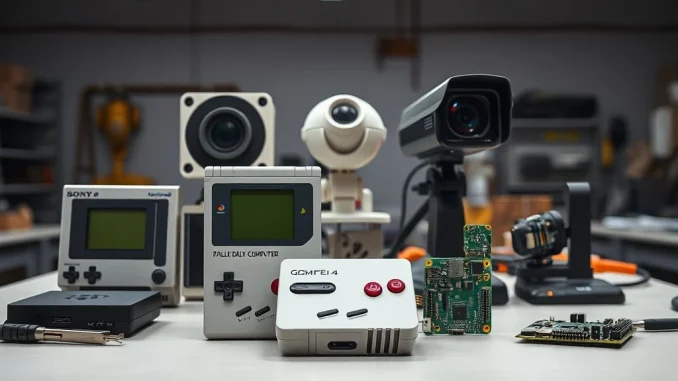
YouTuber stacksmashing achieved technical notoriety in 2021 by successfully mining Bitcoin using a 1989 Nintendo Game Boy console. The project required a Raspberry Pi Pico, custom link cable, and specialized software to interface the vintage handheld with the Bitcoin network. stacksmashing implemented Trezor hardware wallet’s SHA-256 algorithm on the Game Boy through custom ROM programming, creating what he described as “anything but profitable” but educationally valuable. The modified Game Boy produced approximately 0.8 hashes per second, compared to modern ASIC miners’ 100 terahashes per second — a performance difference spanning 125 trillion times.
| Device | Hash Rate | Time Per Block Estimate | Year Demonstrated |
|---|---|---|---|
| Nintendo Game Boy | 0.8 H/s | Quadrillion years | 2021 |
| Apollo Guidance Computer | 0.1 H/s | Million universe ages | 2019 |
| Modern ASIC Miner | 100 TH/s | ~10 minutes | 2026 |
Historic Computing Hardware Repurposed for Mining
Vintage computer restoration expert Ken Shirriff pushed experimental mining to its logical extreme in 2019 by attempting Bitcoin validation on a 1960s Apollo Guidance Computer. This hardware, which navigated Apollo missions to the moon, presented substantial technical challenges due to its archaic architecture and limited memory. Shirriff needed to use a core rope simulator and custom interface boards to load mining software, ultimately achieving approximately 0.10 hashes per second. He noted this performance would require “a million times the age of the universe” to successfully mine a single Bitcoin block, making the exercise purely academic but technically impressive.
Shirriff previously demonstrated even more fundamental approaches, completing manual SHA-256 calculations using pen and paper in 2014. His YouTube documentation shows one round of hashing taking 16 minutes and 45 seconds, translating to roughly 0.67 hashes per day if sustained continuously. This performance compares to Bitmain’s Antminer S21 Pro at 234 terahashes per second — approximately 30 quintillion times faster. While completely impractical for actual mining, these experiments provide valuable educational insights into cryptocurrency’s underlying cryptographic processes and how computational requirements have evolved.
Corporate Patent Exploration in Alternative Mining
Microsoft filed a controversial patent application in 2019 titled “Cryptocurrency System Using Body Activity Data,” proposing human physiological signals as proof-of-work alternatives. The application described using brain waves, body heat, and facial movements to validate transactions, creating what inventors called “proof-of-humanity” systems. Dustin Abramson, Derrick Fu, and Joseph Johnson Jr. proposed this approach as an alternative to energy-intensive computational mining, suggesting users could “unconsciously” solve cryptographic puzzles through normal biological activity. Patent records indicate the application was abandoned by 2021, though it demonstrated corporate interest in radically different consensus mechanisms.
Future Implications and Industry Responses
Security agencies worldwide have increased monitoring for unconventional mining operations following the Ukrainian PlayStation case and IoT botnet discoveries. The European Union Agency for Cybersecurity issued 2025 guidelines specifically addressing IoT device vulnerabilities that could enable unauthorized mining. Meanwhile, cryptocurrency communities continue debating proof-of-work alternatives, with several major blockchains transitioning to proof-of-stake consensus mechanisms partly in response to mining’s environmental and hardware concerns.
Regulatory and Security Considerations
International law enforcement coordination has improved regarding cross-border mining operations using compromised or unconventional hardware. INTERPOL’s 2024 cybercrime report highlighted cryptocurrency mining as a growing concern within IoT security breaches, noting that compromised devices often serve dual purposes for both mining and other malicious activities. Energy regulatory bodies in multiple countries have implemented stricter monitoring of commercial electricity consumption patterns to detect unauthorized mining operations, particularly those using diverted power sources.
Conclusion
The six strangest Bitcoin mining devices demonstrate cryptocurrency’s pervasive influence across technological domains, from vintage gaming hardware to space exploration computers. While conventional ASIC miners dominate professional operations, these unconventional approaches reveal both security vulnerabilities and creative technical experimentation within the crypto ecosystem. The Ukrainian PlayStation case exposed how consumer electronics can be repurposed at scale, while IoT botnets showed malicious actors’ adaptability in seeking processing resources. Looking forward, continued innovation in consensus mechanisms may reduce reliance on computational mining altogether, though the fundamental drive to validate blockchain transactions through available processing power — however unconventional — appears unlikely to diminish soon.
Frequently Asked Questions
Q1: Can you actually mine Bitcoin profitably with a PlayStation or Game Boy?
No, these devices cannot mine Bitcoin profitably. A Game Boy achieves approximately 0.8 hashes per second, while modern ASIC miners operate at 100 terahashes per second — a 125 trillion times difference. Even thousands of such devices would be impractical for profitable mining given electricity costs and Bitcoin’s mining difficulty.
Q2: Why would anyone mine cryptocurrency with such inefficient devices?
Most unconventional mining serves educational, experimental, or proof-of-concept purposes rather than profit. Researchers like Ken Shirriff and stacksmashing demonstrate technical principles and explore hardware limits. Malicious actors using IoT devices typically seek free computational resources through compromised systems rather than efficiency.
Q3: What was the largest unconventional mining operation ever discovered?
The Security Service of Ukraine’s 2021 raid uncovered approximately 5,000 devices including 3,800 PlayStation 4 consoles allegedly stealing $260,000 monthly in electricity. This remains the largest documented case of consumer electronics being systematically repurposed for cryptocurrency mining.
Q4: Are there legal consequences for unauthorized cryptocurrency mining?
Yes, unauthorized mining operations face multiple legal consequences including theft of electricity charges, computer fraud charges for using compromised devices, and regulatory violations. The Ukrainian case resulted in criminal prosecutions, while IoT botnet operators face international cybercrime charges.
Q5: How has Bitcoin mining hardware evolved since these unconventional attempts?
Professional mining has consolidated around specialized ASIC (Application-Specific Integrated Circuit) hardware designed exclusively for cryptocurrency algorithms. These devices offer exponentially better efficiency than general-purpose hardware, making unconventional devices increasingly irrelevant for actual mining beyond experimentation.
Q6: Could alternative consensus mechanisms eliminate unconventional mining attempts?
Proof-of-stake and other alternative consensus mechanisms significantly reduce computational requirements, potentially decreasing incentives for unconventional mining. However, proof-of-work cryptocurrencies like Bitcoin continue attracting experimental mining attempts regardless of practicality, driven by technical curiosity and occasional malicious intent.