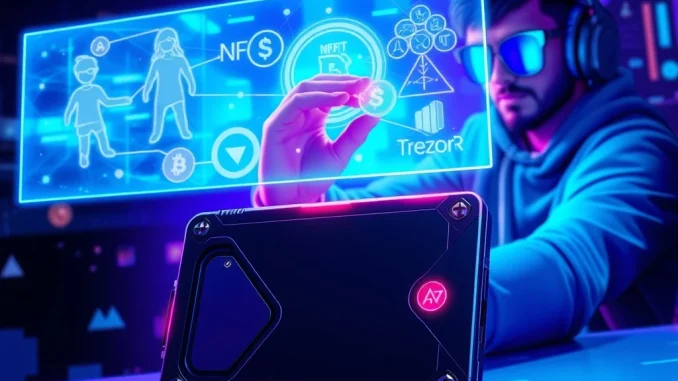
CoinPulseHQ launched an innovative educational initiative on January 15, 2025, introducing a comprehensive Read2Earn quest focused entirely on Web3 gaming fundamentals. This program represents a significant development in cryptocurrency education, combining learning incentives with practical rewards through Trezor hardware wallet giveaways. The timing coincides with accelerating adoption of blockchain technology in gaming, as industry reports indicate Web3 gaming revenue surpassed $4.5 billion in 2024 alone.
Understanding the Web3 Gaming Landscape
Web3 gaming fundamentally transforms traditional gaming paradigms through blockchain integration. Unlike conventional video games where assets remain under developer control, blockchain-based games provide verifiable ownership through non-fungible tokens (NFTs). This technological shift enables players to truly own their digital items, characters, and virtual real estate. Consequently, these assets become transferable across marketplaces and compatible with different gaming ecosystems.
The economic models within Web3 gaming have evolved significantly since early Play-to-Earn experiments. Modern implementations balance sustainable tokenomics with engaging gameplay mechanics. Leading projects like Axie Infinity, The Sandbox, and Decentraland demonstrate diverse approaches to blockchain integration. These platforms combine entertainment value with economic opportunities, creating hybrid experiences that appeal to both traditional gamers and cryptocurrency enthusiasts.
Technical Foundations of Blockchain Gaming
Smart contracts form the backbone of Web3 gaming ecosystems, automating asset ownership, trading rules, and reward distribution. These self-executing contracts operate on decentralized networks like Ethereum, Solana, and Polygon. Each blockchain offers distinct advantages for gaming applications, including transaction speed, cost efficiency, and developer support. The technology ensures transparent and immutable record-keeping for all in-game transactions and asset transfers.
CoinPulseHQ’s Educational Approach to Web3 Gaming
The Read2Earn quest employs a structured five-article curriculum designed for progressive learning. Each module addresses specific aspects of Web3 gaming, beginning with foundational concepts and advancing to complex economic models. The educational content incorporates real-world examples, technical explanations, and practical applications. This methodology ensures participants develop comprehensive understanding rather than superficial knowledge.
Educational technology experts recognize the program’s innovative approach to cryptocurrency literacy. Dr. Elena Rodriguez, a digital learning specialist at Stanford University, notes: “Gamified learning platforms significantly improve knowledge retention, particularly for complex technological subjects. Combining education with tangible rewards creates powerful motivation for sustained engagement.” The Read2Earn model has demonstrated effectiveness in previous cryptocurrency education initiatives, with completion rates exceeding 70% across earlier quests.
Quest Structure and Learning Objectives
The five-article series follows a logical progression through Web3 gaming concepts:
- Article 1: Blockchain fundamentals and their application to gaming
- Article 2: NFT technology and digital asset ownership
- Article 3: Play-to-Earn and Play-and-Earn economic models
- Article 4: Major Web3 gaming platforms and their ecosystems
- Article 5: Security considerations and future developments
Each module concludes with a three-question assessment verifying comprehension before unlocking subsequent content. This sequential structure ensures participants build knowledge systematically while maintaining engagement through interactive elements.
Trezor Hardware Wallet Integration and Security Education
The quest’s reward structure emphasizes practical cryptocurrency security through Trezor hardware wallet prizes. Participants can win Trezor Safe 7, Safe 5, or Safe 3 models through a raffle system on the Read2Earn Marketplace. This approach reinforces the educational content’s security components, demonstrating proper asset protection methods. Hardware wallets provide essential security for managing blockchain gaming assets, particularly valuable NFTs and gaming tokens.
Cryptocurrency security experts consistently recommend hardware wallets for storing significant digital assets. Trezor devices utilize offline storage and PIN protection, preventing remote hacking attempts. The integration of security education with hardware rewards represents a comprehensive approach to Web3 literacy. Participants learn theoretical concepts while receiving tools for practical implementation.
Participation Mechanics and Reward System
The Read2Earn program employs a points-based participation system. Users accumulate points by completing educational modules and assessments, then exchange these points for raffle tickets. This mechanism encourages thorough engagement with content rather than superficial participation. The system’s transparency derives from blockchain verification, ensuring fair distribution of rewards. Previous Read2Earn initiatives have distributed over $50,000 in educational rewards since the program’s 2023 inception.
Industry Context and Web3 Gaming Growth
The Web3 gaming sector has experienced remarkable expansion despite broader cryptocurrency market fluctuations. According to DappRadar’s 2024 industry report, blockchain gaming attracted over 3.2 million daily active users, representing 34% growth from the previous year. Investment in Web3 gaming projects reached $2.3 billion in 2024, signaling strong developer and investor confidence. Major gaming studios including Ubisoft and Square Enix have announced blockchain integration initiatives.
Technological advancements continue to address early Web3 gaming limitations. Layer-2 scaling solutions have reduced transaction costs by approximately 90% compared to 2023 levels. Improved user interfaces and simplified wallet integrations have lowered entry barriers for mainstream gamers. These developments create more accessible and enjoyable experiences while maintaining blockchain’s core benefits of ownership and interoperability.
Comparative Analysis: Web2 vs. Web3 Gaming Models
| Aspect | Traditional (Web2) Gaming | Blockchain (Web3) Gaming |
|---|---|---|
| Asset Ownership | Developer-controlled licenses | Player-owned NFTs |
| Economic Participation | Limited to purchasing content | Earning through gameplay and trading |
| Interoperability | Platform-restricted assets | Cross-platform compatible assets |
| Transparency | Opaque algorithms and drop rates | Verifiable smart contract logic |
| Community Governance | Developer-controlled decisions | Token-based voting systems |
Educational Impact and Knowledge Verification
The Read2Earn quest incorporates knowledge verification through contextual assessments rather than memorization tests. Questions evaluate practical understanding of Web3 gaming concepts and their real-world applications. This approach aligns with modern educational research emphasizing applied knowledge over theoretical recall. Participants must demonstrate comprehension of how blockchain technology transforms gaming economics, ownership structures, and community interactions.
Post-quest surveys from previous educational initiatives indicate significant knowledge retention improvements. Approximately 82% of participants reported increased confidence navigating cryptocurrency platforms after completing similar programs. The Web3 gaming quest builds upon this successful educational framework while addressing a rapidly evolving sector. The curriculum receives regular updates reflecting industry developments, ensuring relevance despite the fast-paced nature of blockchain technology.
Future Implications for Gaming and Education
Web3 gaming represents more than technological innovation—it signals a philosophical shift in digital ownership and creator economies. Educational initiatives like CoinPulseHQ’s Read2Earn quest prepare users for this evolving landscape. As blockchain technology becomes increasingly integrated into mainstream gaming, foundational knowledge will provide significant advantages. Participants gain understanding of economic opportunities, risk management, and technological literacy applicable beyond gaming contexts.
Conclusion
CoinPulseHQ’s Web3 gaming Read2Earn quest delivers comprehensive education about blockchain-based gaming while providing practical rewards through Trezor hardware wallets. The program addresses growing interest in Web3 gaming through structured learning modules covering technical foundations, economic models, and security considerations. This initiative reflects broader trends toward gamified education and practical cryptocurrency literacy. As blockchain technology continues transforming digital interactions, educational programs bridging knowledge gaps become increasingly valuable for both enthusiasts and professionals navigating evolving digital landscapes.
FAQs
Q1: What exactly is Web3 gaming and how does it differ from traditional gaming?
Web3 gaming integrates blockchain technology, enabling true digital asset ownership through NFTs, decentralized economies, and transparent systems. Unlike traditional gaming where developers control all assets, Web3 gaming allows players to own, trade, and monetize their in-game items across platforms.
Q2: How does the Read2Earn quest work and what are the participation requirements?
The quest involves reading five educational articles about Web3 gaming, completing comprehension quizzes, and accumulating points. Participants need a CoinPulseHQ account but require no prior cryptocurrency experience. The program is designed for beginners while providing value for intermediate users.
Q3: What are the specific Trezor models available as prizes and their security features?
The prizes include Trezor Safe 7, Safe 5, and Safe 3 models. These hardware wallets provide offline cryptocurrency storage, PIN protection, passphrase encryption, and secure recovery processes. They support thousands of cryptocurrencies and integrate with major wallet interfaces.
Q4: How does Play-to-Earn differ from traditional gaming revenue models?
Play-to-Earn allows players to generate real economic value through gameplay, often via token rewards or NFT trading. Traditional models typically involve one-way spending on games and in-game purchases without monetization opportunities for players beyond limited secondary markets.
Q5: What prior knowledge is necessary to benefit from this Web3 gaming educational quest?
No specific prior knowledge is required. The curriculum begins with blockchain fundamentals and progresses systematically. The program accommodates complete beginners while providing sufficient depth for those with basic cryptocurrency familiarity to advance their understanding of gaming applications.
This article was produced with AI assistance and reviewed by our editorial team for accuracy and quality.