January 31, 2026 — The Web3 gaming industry faces a brutal consolidation period in 2026, with Axie Infinity co-creator Jeff “JiHoz” Zirlin warning that numerous studios will “die” as funding runways shorten dramatically. Speaking from Singapore during a January 28 interview, Zirlin delivered his stark assessment to gaming influencer Yellow Panther, revealing that 32.6% of developers now cite cash shortages as their primary survival challenge according to recent Blockchain Gaming Alliance data. Meanwhile, NBA legend Scottie Pippen prepares to launch a Bitcoin-themed basketball game, and the PGA Tour announces its blockchain gaming entry—signaling both contraction and innovation within the volatile Web3 gaming sector.
Axie Infinity Founder’s Dire Warning for Web3 Gaming
Jeff Zirlin’s prediction carries particular weight given his role in creating one of blockchain gaming’s most successful franchises. During his 45-minute conversation with Yellow Panther, the Ronin Network co-founder emphasized that the coming shakeout won’t discriminate by blockchain. “I’m not throwing shade on games on other chains too,” Zirlin stated. “That will also happen on games on Ronin, right.” His warning follows a disastrous 2025 that saw multiple high-profile closures including Ethereum’s Ember Sword, Solana shooter Nyan Heroes, extraction shooter Deadrop, and pirate RPG Pirate Nation.
The industry’s financial pressures have been building for months. A November 2025 Blockchain Gaming Alliance survey of 417 developers revealed that nearly one-third struggle with funding shortages, while venture capital investment in blockchain gaming dropped 62% year-over-year according to Crunchbase data. Yield Guild Games co-founder Gabby Dizon contextualized the trend to Magazine, noting that “generally it’s really hard to ship a successful game—and games shut down all the time” across traditional gaming as well.
Funding Crisis Hits Web3 Gaming Studios
The financial squeeze manifests across multiple dimensions, creating what industry analysts describe as a “perfect storm” for smaller studios. Unlike the 2021 bull market when speculative investment flowed freely, 2026’s environment demands sustainable business models many projects lack. Consequently, developers face three simultaneous pressures: declining token valuations reducing treasury values, increased regulatory scrutiny affecting revenue models, and player retention challenges in oversaturated markets.
- Capital Depletion: Many studios raised funds during 2021-2022 peaks and now face depleted runways without profitable operations
- Revenue Model Challenges: Play-to-earn mechanics struggle as token economies collapse without sustainable sinks and faucets
- Technical Debt Accumulation: Rapid scaling during growth periods left many projects with unsustainable infrastructure costs
Industry Experts Analyze the Shakeout
Gaming economist Dr. Sarah Chen, who tracks blockchain gaming metrics at Stanford’s Digital Economy Lab, confirms the trend’s severity. “We’re observing classic market consolidation,” Chen explained in a January 29 research note. “The 2021-2023 period saw over 1,200 blockchain game announcements. Our models suggest fewer than 200 will maintain active development by 2027’s end.” Meanwhile, SKALE Labs CEO Jack O’Holleran argues the solution involves attracting mainstream brands. “With the PGA Tour’s popularity,” O’Holleran noted during a recent livestream, “we view this as an opportunity to onboard the next 10 million users into Web3 gaming.”
Scottie Pippen’s Bitcoin Basketball Game Defies Trend
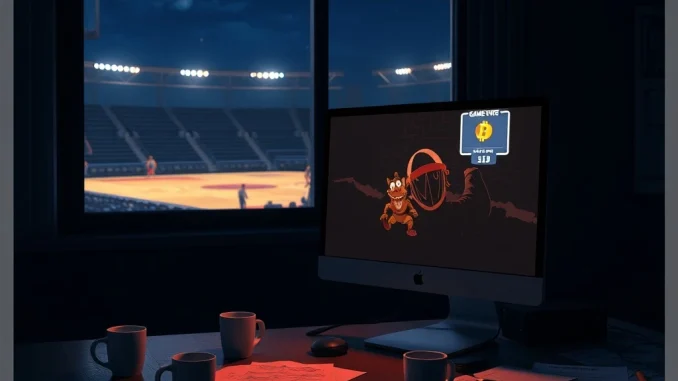
Amid the sector’s struggles, surprising innovations emerge. NBA Hall of Famer Scottie Pippen will launch Don’t Drop The Ball in February 2026—a Fortnite-inspired basketball game featuring subtle Bitcoin references throughout its virtual city. Players will discover graffiti and easter eggs referencing Satoshi Nakamoto, plus a custom statue honoring Bitcoin’s creator. “The experience includes a cultural layer tied to Bitcoin and digital innovation,” a spokesperson told Magazine. Pippen’s connection to Satoshi remains unconventional; the basketball legend claims to have met Bitcoin’s creator in dreams, though he told Magazine that MicroStrategy’s Michael Saylor advised him to “stop talking about it” in August 2025.
The game mechanics center on a simple but intense premise: 10-minute matches where players must hold onto a digital version of the actual Game 5 ball from Chicago Bulls’ 1991 NBA Finals victory. Pippen still owns the physical ball, calling it “the holy grail of sports memorabilia.” His digital adaptation represents a growing trend of physical-digital collectible convergence, similar to Nike’s .SWOOSH platform but with explicit cryptocurrency integration.
| Game | Blockchain | Status | Notable Feature |
|---|---|---|---|
| Don’t Drop The Ball | Unannounced | Beta Testing | Bitcoin cultural references |
| PGA Rise | SKALE on Base | Announced | Official PGA Tour licensing |
| Axie Infinity | Ronin | Live | Planning “larger risks” in 2026 |
| MapleStory Universe | Unspecified | Live | 1.94M registered accounts |
PGA Tour Enters Web3 Gaming via SKALE Network
In another significant development, the Professional Golfers’ Association Tour will launch PGA Rise on SKALE’s layer-3 network built on Base. The free-to-play mobile game lets users own digital clubs, design courses, and compete in virtual tournaments. SKALE Labs head of community Falcore described the approach during a January 27 livestream: “They are taking the golf experience and reimagining it. You as a player can go in there, own your clubs, house, create your own course, own all your assets, and battle against other players.” Crucially, the game supports both crypto and fiat transactions, addressing one of Web3 gaming’s major accessibility barriers.
Falcore identified a core industry problem during the announcement: “One of Web3 gaming’s core problems has been taking an original idea and just adding crypto to it. That was always the biggest issue we saw.” The PGA Tour follows other major sports organizations exploring blockchain integration, including Mythical Games’ partnerships with NFL and FIFA, plus The Sandbox’s experiments with ITV reality shows like Love Island and I’m a Celebrity.
Polygon Labs Acquires Gaming Infrastructure Provider
Consolidation isn’t limited to game studios. Polygon Labs announced on January 30 its acquisition of gaming infrastructure provider Sequence as part of a $250 million dual-acquisition strategy. The move strengthens Polygon’s position in the competitive blockchain gaming infrastructure market, where solutions for wallet integration, NFT minting, and marketplace development remain fragmented. Sequence previously served major publishers including Ubisoft and Atari, suggesting Polygon aims to bridge traditional and blockchain gaming more effectively.
What’s Next for Web3 Gaming in 2026?
The industry stands at a critical inflection point. Zirlin revealed that Axie Infinity plans “much larger risks” in 2026 after what he called a “too conservative” 2025. This strategic pivot reflects a broader recognition that incremental improvements won’t revive sector excitement. Meanwhile, successful traditional games continue attracting massive user bases without blockchain elements, raising fundamental questions about Web3 gaming’s value proposition.
Several developments will shape the coming months: MapleStory Universe’s strong Q4 2025 performance (1.94 million registered accounts, 46 million transactions) suggests established IPs retain advantages; regulatory clarity around gaming tokens may emerge from ongoing SEC proceedings; and technological improvements in zero-knowledge proofs could reduce transaction costs that currently hamper gameplay fluidity. The sector’s survival likely depends on delivering genuinely engaging experiences rather than speculative financial mechanics.
Conclusion
Jeff Zirlin’s warning about Web3 gaming studios facing extinction highlights the sector’s precarious transition from speculative frenzy to sustainable business models. While funding shortages threaten many projects, innovations like Scottie Pippen’s Bitcoin-integrated basketball game and the PGA Tour’s blockchain entry demonstrate continued experimentation. The coming year will separate projects building genuine player value from those relying on unsustainable token economics. As traditional gaming giants observe from the sidelines, the surviving blockchain games may emerge leaner, more focused on gameplay, and better integrated with mainstream platforms—potentially fulfilling the technology’s promise rather than repeating its speculative excesses.
Frequently Asked Questions
Q1: Why is the Axie Infinity founder warning about Web3 game shutdowns?
Jeff “JiHoz” Zirlin warns that many Web3 gaming studios face funding shortages, with 32.6% of developers citing cash as their biggest challenge. He predicts numerous teams will “die” in 2026 as venture capital diminishes and unsustainable business models collapse.
Q2: Which major Web3 games shut down in 2025?
Notable closures included Ethereum game Ember Sword, Solana shooter Nyan Heroes, extraction shooter Deadrop, and pirate-themed RPG Pirate Nation. These shutdowns reflect broader industry consolidation as funding becomes scarce.
Q3: What is Scottie Pippen’s new basketball game about?
Don’t Drop The Ball is a 10-minute multiplayer basketball game featuring Bitcoin references throughout its virtual city. Players discover Satoshi Nakamoto graffiti and easter eggs while competing to hold onto a digital version of the actual Game 5 ball from the Bulls’ 1991 championship.
Q4: How is the PGA Tour entering Web3 gaming?
The PGA Tour launches PGA Rise on SKALE’s layer-3 network on Base. The free-to-play mobile game lets users own digital golf clubs, design courses, and compete using either crypto or traditional payment methods, representing a major sports organization’s blockchain integration.
Q5: What percentage of Web3 gaming developers face funding shortages?
A Blockchain Gaming Alliance survey found 32.6% of developers cite cash shortages as their primary challenge. This financial pressure follows a 62% year-over-year drop in venture capital investment for blockchain gaming projects.
Q6: How might Web3 gaming change after this consolidation period?
Surviving projects will likely focus more on gameplay quality than token speculation, integrate better with traditional gaming platforms, and develop sustainable revenue models beyond initial coin offerings. Successful examples may blend blockchain elements subtly rather than making them central.