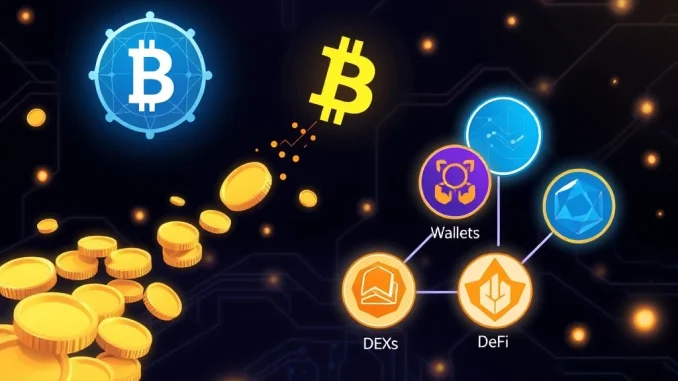
In a pivotal development for the digital asset industry, a significant redistribution of Web3 fee revenue is underway, moving value creation away from foundational blockchain networks and toward the application layer comprising wallets and decentralized finance (DeFi) protocols. This trend, highlighted in a recent analysis by crypto market expert Jamie Coutts of Real Vision and reported by Cointelegraph, suggests a maturation of the ecosystem where user-facing services are capturing an increasing share of economic activity. Consequently, this shift could redefine investment theses and developer incentives across the cryptocurrency sector for years to come.
Web3 Fee Revenue Undergoes a Fundamental Redistribution
The traditional model of blockchain economics often positioned the base layer network—like Ethereum or Solana—as the primary fee sink. Users pay transaction fees, known as gas, to validators or miners to secure and process their operations. However, recent data reveals a stark change. According to Coutts’s analysis, DeFi applications are now generating approximately five times the fee revenue of the underlying blockchains they operate on. This means for every dollar earned by the network for basic transaction processing, five dollars flow to applications like decentralized exchanges (DEXs), lending protocols, and sophisticated wallet interfaces.
This redistribution signals a critical evolution. Initially, blockchains captured most value as scarce digital real estate. Now, as the industry builds out, the most lucrative activity occurs in the services built on top. This mirrors the early internet, where infrastructure companies paved the way, but application-layer giants like Google and Facebook ultimately captured outsized economic value. The flow of Web3 fee revenue is a key metric tracking this maturation in real-time.
DeFi and Wallets: The New Fee Revenue Engines
Several key drivers are fueling this shift in fee generation. First, the complexity and frequency of DeFi transactions have skyrocketed. A simple token swap on a DEX like Uniswap or PancakeSwap often involves multiple smart contract interactions, each generating fees. Advanced activities like yield farming, liquidity provisioning, and leveraged trading compound this effect further.
Second, modern crypto wallets have evolved far beyond simple key storage. They now function as full-service financial dashboards, aggregating DeFi opportunities, facilitating cross-chain swaps, and offering staking services—all while taking a small fee or a share of the generated yield. This active role in routing user activity makes them central hubs for fee revenue capture.
- Decentralized Exchanges (DEXs): Charge swap fees (e.g., 0.3% per trade) distributed to liquidity providers and protocol treasuries.
- Lending Protocols (e.g., Aave, Compound): Generate fees from interest rate spreads and liquidation penalties.
- Advanced Wallets & Aggregators: May charge fees for premium services, gas optimization, or take a commission on yields earned through integrated protocols.
Expert Insight: Jamie Coutts on the Economic Implications
Jamie Coutts, the analyst behind the report, provides crucial context. He frames this not merely as a statistical trend but as an indicator of where developer innovation and user engagement are most concentrated. “The data shows capital and talent are voting with their feet,” his analysis suggests. The immense fee revenue generated at the application layer acts as a powerful incentive for entrepreneurs and developers to build consumer-facing products rather than new base-layer chains. This could slow the proliferation of new Layer 1 blockchains and intensify competition among existing ones to host the most profitable DeFi ecosystems and wallet integrations.
The Impact on Blockchain Networks and Investors
This redistribution carries profound implications. For blockchain networks, a smaller direct share of total fee revenue could pressure their long-term security budgets if transaction activity plateaus. Networks may become more reliant on alternative value accrual methods, such as capturing value through staking their native tokens or ensuring their token is essential for paying fees within top applications.
For investors, the focus may need to pivot. Evaluating a blockchain’s health might increasingly depend on the vibrancy and fee-generating capacity of its DeFi and wallet ecosystem, not just its raw transaction count. The report suggests a potential re-rating of assets, with value flowing toward tokens of high-utility applications and away from pure infrastructure plays that lack a thriving app layer.
| Metric | Blockchain Layer (e.g., Network Fees) | Application Layer (DeFi & Wallets) |
|---|---|---|
| Primary Source | Base transaction (gas) fees | Swap fees, interest spreads, service commissions |
| Current Trend | Growth tied to raw usage | Exponential growth from financial activity complexity |
| Value Recipients | Validators/Miners, Protocol Treasuries | Liquidity Providers, Protocol Treasuries, Wallet Developers |
| Investor Focus | Network security, adoption rate | Total Value Locked (TVL), user activity, fee models |
Real-World Context and the Path Forward
This trend is observable across major smart contract platforms. On Ethereum, fees from DeFi interactions consistently dwarf simple ETH transfers. Similarly, on chains like Solana and Avalanche, the boom in meme coin trading and DeFi has directed massive fee streams to applications. The shift in Web3 fee revenue is a natural consequence of an industry moving from building infrastructure to delivering usable financial services. It reflects a healthier, more utility-driven economy, though one that presents new challenges for network sustainability and investment analysis.
Looking ahead, we can expect several developments. Blockchain networks may innovate with new fee-sharing models or tighter integration with top applications. Regulatory scrutiny may also follow the money, focusing more on high-revenue-generating DeFi protocols and wallet services. Ultimately, the continuous flow of fee revenue to the application layer underscores that in Web3, as in Web2, the interface closest to the user often captures the greatest value.
Conclusion
The ongoing shift in Web3 fee revenue from blockchains to DeFi applications and wallets marks a definitive stage in the industry’s evolution. It highlights a market that is maturing beyond speculation toward providing real, complex financial services. This redistribution of value emphasizes the growing importance of the application layer, redirecting developer focus and investor capital. While foundational networks remain critical, their long-term success may increasingly be measured by their ability to foster and retain high-fee-generating ecosystems. Monitoring this fee revenue flow will be essential for understanding the next phase of growth in decentralized finance and the broader Web3 landscape.
FAQs
Q1: What does “Web3 fee revenue shifting” mean?
It means the money generated from user transactions within the cryptocurrency ecosystem is increasingly going to decentralized applications (like Uniswap) and wallet services, rather than being paid solely to the base blockchain networks (like Ethereum) as transaction fees.
Q2: Why are DeFi applications generating more fee revenue than blockchains?
DeFi activities like trading, lending, and yield farming involve more complex and frequent smart contract interactions than simple token transfers. Each step in these complex transactions can generate a fee for the application, leading to higher aggregate revenue.
Q3: Does this trend make blockchain networks less valuable?
Not necessarily, but it changes their value proposition. A blockchain’s value may depend more on its ability to host a vibrant, fee-generating ecosystem of apps. Networks might need to adapt their economic models if a smaller share of total fees flows directly to them.
Q4: How does this affect the average crypto user?
Users may see more innovation and services from wallets and DeFi apps as they compete for fee revenue. However, they should also be aware of the various fees (swap fees, network gas, service charges) layered into their transactions.
Q5: What is the main takeaway from Jamie Coutts’s report?
The main takeaway is that economic incentives in crypto are rapidly moving to the application layer. This signals where developer talent and investment capital are flowing, highlighting DeFi and wallets as the current central profit centers in the Web3 fee revenue landscape.
Updated insights and analysis added for better clarity.
This article was produced with AI assistance and reviewed by our editorial team for accuracy and quality.